



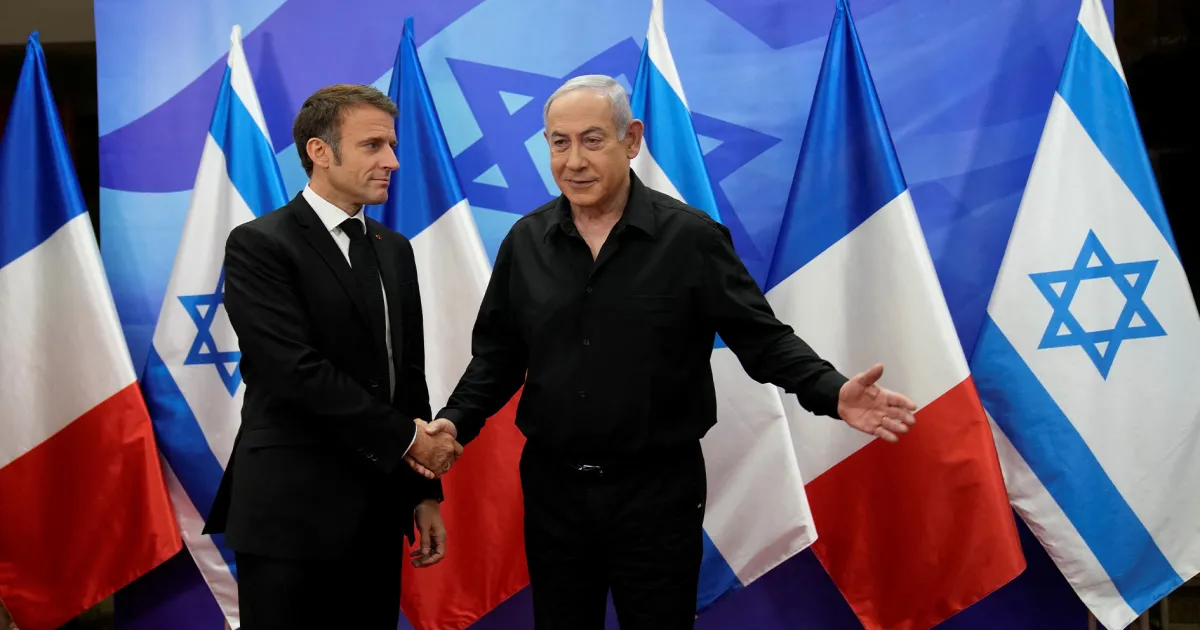
- Germany, historically Israel’s staunch ally, publicly warns Netanyahu over Gaza’s civilian toll and signals potential shift in weapons policy.
- The European Union has launched a formal review of its trade agreement with Israel, citing possible human rights violations.
- Israel’s aid blockade and controversial private distribution mechanism bypassing the UN have drawn sharp European criticism.
- Divisions within the 27-member bloc remain, but growing public outrage and internal pressure are pushing leaders toward tougher action.
BRUSSELS — For nearly two years, Europe has watched Israel’s war in Gaza unfold with unease, often torn between a commitment to Israel’s security and mounting public outrage over the spiraling humanitarian disaster. But this week, Europe’s discomfort spilled into open censure.
Germany, long one of Israel’s most steadfast allies, issued a stinging rebuke after another deadly strike on a Gaza school-turned-shelter. Chancellor Friedrich Merz, once unwavering in his support, now warns that civilian harm can “no longer be justified” and cautions that Israel may soon alienate even its closest friends.
The rhetorical shift reflects deeper currents within the European Union, where internal divisions, rising domestic discontent, and a worsening crisis in Gaza have forced even the most reluctant leaders to reassess their posture. What was once quiet concern has evolved into outright condemnation and a formal review of trade ties between the E.U. and Israel — a move led by the Netherlands and backed by a growing number of member states.
Yet the question persists: Will Europe go beyond strong words and symbolic gestures?
European leaders are grappling with the limits of diplomacy as the death toll mounts and Gaza sinks further into famine. Israeli Prime Minister Benjamin Netanyahu’s government has grown increasingly defiant, pressing forward with plans to indefinitely “control” the enclave and publicly flirting with the idea of depopulating Gaza. That has left many European leaders — even those long sympathetic to Israel’s security concerns — with little moral or political cover.
“The fact that it’s become so explicit makes it so they’ve got nothing to hide behind,” said Nathalie Tocci, a former E.U. foreign policy adviser, describing Europe’s unease with what appears to be a war strategy untethered from the original goal of eliminating Hamas. “It’s a war for war’s sake,” said Spanish Foreign Minister José Manuel Albares.
Trump’s ‘Liberation Day’ Tariffs Struck Down: Legal Setback, But Not End of Protectionist Push
For the E.U., which prides itself on being the world’s largest humanitarian donor to Palestinians, the optics are increasingly unbearable. Despite pledging hundreds of millions of euros in aid, Israel has blocked or delayed aid convoys since March, contributing to what the U.N. now warns is a risk of famine across the entire Gaza Strip. The Israeli government’s decision to bypass the U.N. and partner with a private aid distribution group tied to Israeli and American interests has further inflamed tensions, with aid officials likening the arrangement to a form of population control.
“Humanitarian aid cannot be weaponized,” said E.U. foreign policy chief Kaja Kallas, rejecting Israel’s improvised distribution system.
But while moral outrage may be at an all-time high, the road to meaningful E.U. action remains fraught. The bloc’s 27 member states are divided in both ideology and geopolitical calculus. Hungary remains staunchly pro-Israel; Ireland and Spain lean strongly pro-Palestinian. Even within major states like France and Germany, leaders must navigate complex domestic politics, Holocaust memory, and security partnerships with Israel.
Still, the momentum is shifting. Germany’s Johann Wadephul, foreign minister and member of Merz’s cabinet, recently warned that Berlin’s support for Israel “should not be exploited,” hinting for the first time at the possibility of restricting weapons sales — a sea change in a country where support for Israel has long been seen as a moral imperative.
READ MORE:China’s IOMed Launch in Hong Kong and Pakistan’s Endorsement: A Strategic Leap in Global Mediation
Other European powers are also reassessing. France is weighing unilateral recognition of a Palestinian state. Spain and Ireland have floated suspending trade ties and imposing an arms embargo. Britain, while no longer in the E.U., has imposed sanctions on Israeli settlers and suspended talks on a new trade agreement.
The E.U. trade review now underway may become a pivotal moment. European diplomats say the investigation will assess whether Israel’s conduct in Gaza violates its obligations under its trade agreement with the bloc — particularly on human rights. If violations are confirmed, punitive measures such as economic restrictions or partial suspension of the agreement could follow.
Still, such action is not guaranteed. “The review is as much a political signal as it is a legal process,” said one E.U. diplomat. “But if Netanyahu continues on this path, the pressure will grow — not just from within governments, but from European citizens demanding action.”
READ MORE:Europe’s leaders are scolding Israel over Gaza, but will they go further?
Indeed, internal dissent is rising. A coalition of anonymous E.U. employees, calling themselves “E.U. Staff for Peace,” welcomed the review but lamented the sluggish pace and lack of concrete outcomes. “This long-awaited decision comes devastatingly late for thousands killed in Gaza,” they wrote in an open letter.
Meanwhile, Netanyahu has taken a defiant tone, accusing France, Britain, and Canada of rewarding terrorism for entertaining recognition of a Palestinian state. The Israeli Foreign Ministry has decried the E.U.’s trade review as a fundamental misunderstanding of “the complex reality.”
But the complexity may no longer be a sufficient excuse. With each grisly image from Gaza, Europe’s political calculus shifts. Whether that shift leads to sanctions, diplomatic isolation, or only more warnings remains to be seen. But for the first time in this war, Israel’s European partners are not just whispering their concerns — they’re saying them out loud.