


- Tariffs Take Center Stage: U.S. President Donald Trump’s sweeping tariffs on steel, aluminum, and autos dominate the summit, with allies like Japan, Canada, and the EU seeking relief through trade concessions and defense commitments.
- Middle East Tensions Rise: The Iran-Israel war has turned into a regional crisis, forcing G7 leaders to discuss urgent diplomatic initiatives to prevent a wider conflict and economic fallout, especially in global energy markets.
- Ukraine Pushes for More Support: Ukrainian President Volodymyr Zelensky uses the summit to lobby for renewed Western aid as Russian forces escalate attacks in Kharkiv and Donbas, raising pressure on NATO and G7 unity.
- Canada Seeks Early USMCA Review: Prime Minister Mark Carney urges Trump to reopen discussions on the North American trade agreement, backed by a significant Canadian defense spending boost aimed at U.S. military contractors.
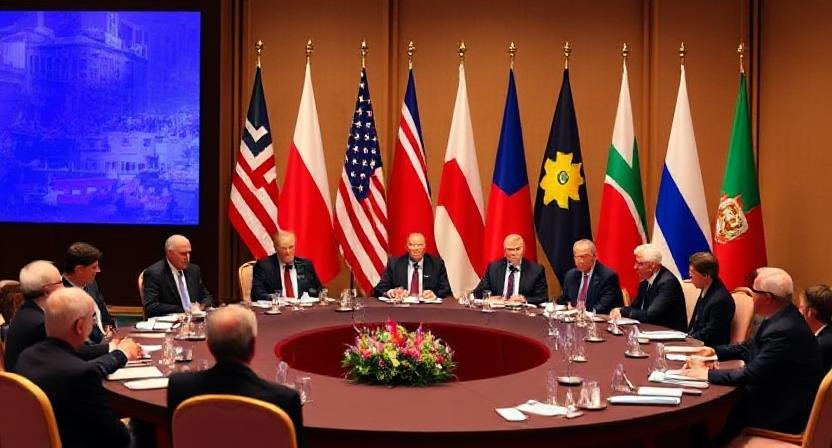
As world leaders convene in the serene Canadian Rockies for the 2025 G7 Summit, the stakes could not be higher. Far from a ceremonial photo-op, this year’s summit is unfolding under the shadows of intensifying global conflicts and mounting economic uncertainty. Against the backdrop of two ongoing wars—Iran-Israel and Russia-Ukraine—and a fierce international trade standoff, the G7 has become a crucial theatre where geopolitics and commerce collide.
Sources close to the summit say the Israeli-Iranian war and the protracted Russia-Ukraine conflict are expected to dominate the security agenda. At the same time, trade friction—particularly the U.S. imposition of sweeping tariffs—will headline economic discussions among G7’s five largest economies: the U.S., Japan, Germany, the U.K., and Canada.
Why This G7 Summit Matters
This isn’t just another summit—it’s a moment of recalibration in a world spinning toward multipolar disorder. With President Donald Trump returning to office in January, his confrontational trade stance has unsettled allies and adversaries alike. Trump’s unilateral tariff hikes on steel, aluminum, and especially automobiles have infuriated Japan, rattled Germany, and thrown a wrench into North American economic cooperation.
In the Shadows of War: Iran Refuses Ceasefire Amid Relentless Israeli Strikes
Meanwhile, the Middle East is engulfed in a brutal regional war that has turned airspace over Iran, Israel, and the Gulf into a no-fly zone. The economic ripple effects have been severe: oil prices have surged past $120 a barrel, energy infrastructure across the Levant has been targeted, and commercial maritime routes remain vulnerable. For the G7, restoring geopolitical stability isn’t just a diplomatic ideal—it’s a necessity for global economic survival.
Trade First: Tariffs Take Center Stage
While war and conflict loom large, the G7’s first battle is economic. President Trump’s aggressive tariff policy is front and center, particularly for Japan, the EU, and host nation Canada.
Trump met Monday with Canadian Prime Minister Mark Carney to hash out what both called a “differing tariff concept.” Trump wants higher tariffs to rebalance what he calls “decades of unfair trade,” while Carney is pushing for concessions that could restart long-stalled negotiations over U.S. duties on Canadian steel and aluminum.
READ MORE: Middle East on the Edge: Israel-Iran War Escalates, Ground Shakes from Tel Aviv to Tehran
Officials from Ottawa confirmed that Canada has offered a massive boost to its defense spending—promising to meet NATO’s 2% GDP target by year’s end—as part of a broader deal to win Trump’s favor. Much of the military budget, insiders say, is expected to benefit U.S. defense manufacturers.
The Canadian leader is also using the summit to push for early talks on revisiting the 2020 U.S.-Mexico-Canada Agreement (USMCA), which is due for review in 2026.
Japan, another major U.S. trade partner, is grappling with Trump’s new auto tariffs. Tokyo is pushing for a deal similar to the one struck between the U.S. and U.K., which capped car exports at 100,000 units annually at a reduced 10% tariff. But with Japan exporting over 1 million vehicles to the U.S. annually, Prime Minister Shigeru Ishiba’s minority government sees the issue as politically explosive.
ALSO READ: Nations Head to G-7 Hoping to Reach Trade Deals With Trump
Mexican President Claudia Sheinbaum, though not part of the G7, has been invited to the summit alongside leaders from India, South Korea, South Africa, Brazil, Australia, and Ukraine. Mexico hopes to secure an exemption from U.S. metal tariffs by arguing that it’s the only country running a steel trade surplus with Washington.
Wars in Iran and Ukraine: High on the Security Docket
In parallel to the trade disputes, security issues are boiling over. With Israeli jets targeting Iranian infrastructure and Tehran retaliating with drone and missile strikes, fears of a regional conflagration dominate summit side conversations.
European leaders are particularly worried about the humanitarian fallout in the Middle East. Germany and France are expected to push for an emergency diplomatic initiative—potentially involving Turkey and Qatar—to mediate between Iran and Israel.
Ukraine’s President Volodymyr Zelensky is also attending the summit amid renewed Russian offensives in Kharkiv and Donetsk. Kyiv hopes to secure fresh commitments of military and financial aid from the West, especially as U.S. congressional approval for new Ukraine funding faces stiff opposition from Trump’s nationalist bloc.
A senior European diplomat told The Islamabad Telegraph that “the twin crises of Iran and Ukraine will test the unity and relevance of the G7 like never before. The world cannot afford a divided West.”
The Road Ahead: Fragile Unity, Complex Challenges
Despite deep divisions, the G7 nations share one common goal: preventing global disorder from spiraling further out of control. But forging consensus will be difficult. Trump’s America First doctrine, Europe’s internal fragmentation, and Asia’s balancing act between Washington and Beijing have made multilateralism more fragile than ever.
As the summit proceeds behind closed doors in the forests of Alberta, what emerges may not be a grand bargain—but even incremental progress on trade, security, and energy coordination will be a win in today’s fractured world.