



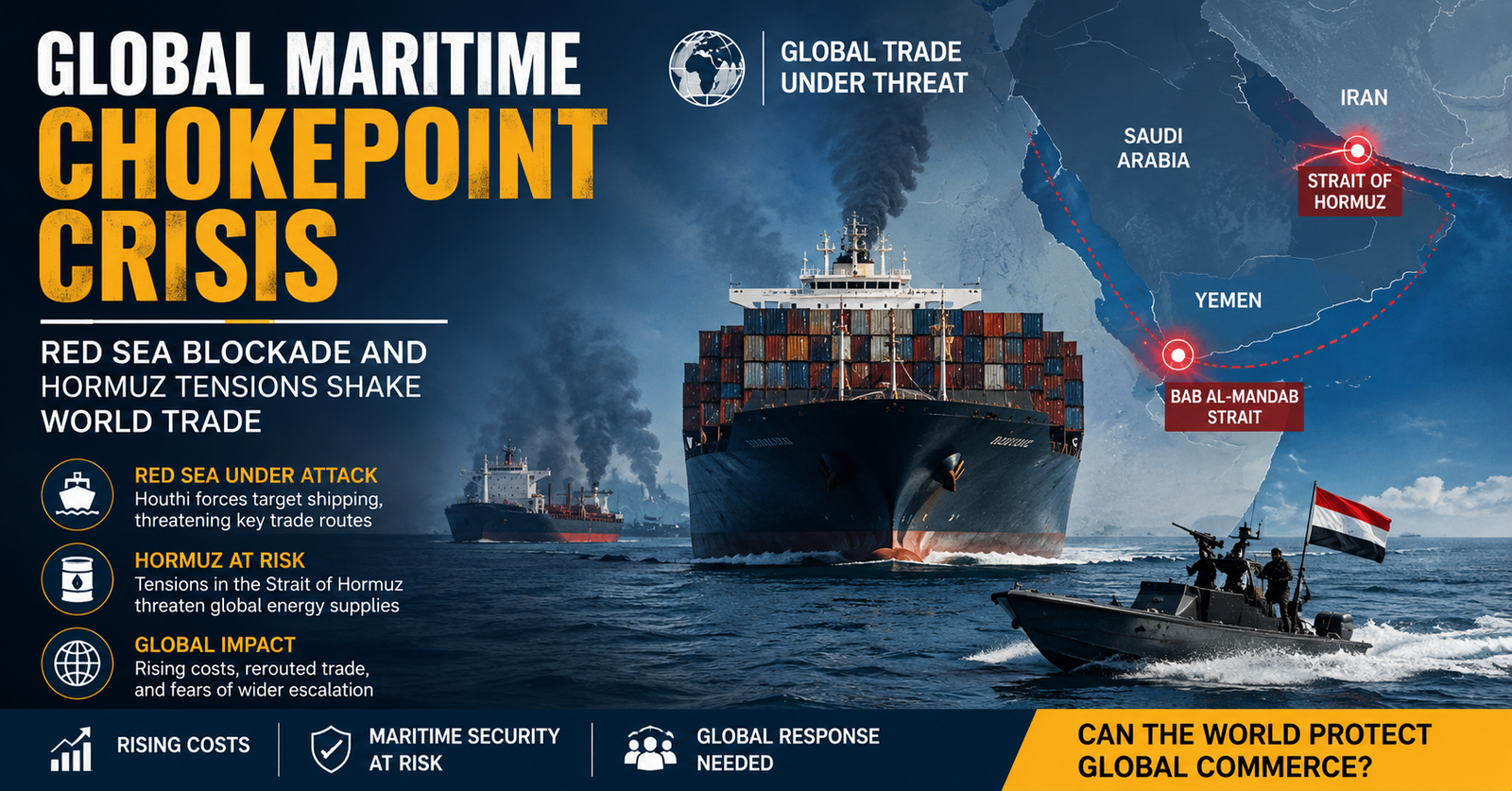
- Global maritime chokepoint crisis intensifies as Houthi attacks in the Red Sea and tensions in the Strait of Hormuz disrupt critical global shipping routes.
- The escalating global maritime chokepoint crisis is driving up oil prices, insurance costs, and forcing major rerouting of international trade flows.
- The global maritime chokepoint crisis raises the risk of military escalation as world powers struggle to protect commerce without triggering wider conflict.
The global maritime chokepoint crisis entered a dangerous new phase on July 20, when Houthi forces announced a blockade targeting Saudi-linked shipping in the Red Sea, escalating fears of systemic disruption to global commerce.
Initial reports of attacks have heightened concerns that the Bab al-Mandab Strait—already under strain—may no longer be reliably navigable. With instability also gripping the Strait of Hormuz, the global maritime chokepoint crisis now spans three of the world’s most vital shipping arteries, placing unprecedented pressure on international trade systems.
At stake is not only the movement of goods but the credibility of the global order that underpins maritime security. Nearly a third of global container traffic flows through the Suez Canal, while Hormuz carries a fifth of global oil supplies. The convergence of these threats has transformed regional tensions into a full-scale global maritime chokepoint crisis.
“This is a structural shock to global trade,” said Dr. Lina Khatib, a Middle East security expert. “The global maritime chokepoint crisis reflects a breakdown in deterrence across multiple theaters simultaneously.”
Red Sea Oil Crisis: Can MBS Safeguard the Last Artery of Global Oil?
Shipping firms have already begun rerouting vessels, adding significant costs and delays. Insurance premiums are rising sharply, reinforcing the economic impact of the global maritime chokepoint crisis even before sustained military escalation occurs.
Yet the deeper challenge lies in how governments respond. The global maritime chokepoint crisis forces policymakers to confront a difficult question: how much disruption can be tolerated before military intervention becomes unavoidable?
READ NEXT: Middle East War Expands to Yemen: Pakistan and China Push Urgent Talks as US-Iran Conflict Deepens
The Houthis’ role highlights the evolving nature of conflict. While aligned with Iran, their strategy reflects independent ambitions. By contributing to the global maritime chokepoint crisis, they gain leverage over Saudi Arabia, enhance their domestic legitimacy, and position themselves as a central actor in regional geopolitics.
“The Houthis are exploiting the asymmetry of maritime warfare,” said Michael Singh, a senior fellow in Washington. “In the global maritime chokepoint crisis, they don’t need dominance—they just need disruption.”
READ MORE: After Strait of Hormuz and Red Sea, has Iran war now reached Caspian Sea?
Indeed, the Houthis’ objective is not total السيطرة of sea lanes but the creation of uncertainty. Even sporadic attacks can amplify the global maritime chokepoint crisis by forcing companies to reroute shipments and governments to absorb rising costs.
Meanwhile, Iran’s actions in Hormuz suggest a calculated strategy. By intensifying the global maritime chokepoint crisis, Tehran appears to be pursuing an “escalate to de-escalate” approach—raising the stakes to compel negotiations on favorable terms.
Washington’s response mirrors this logic but carries its own risks. The United States has signaled readiness to strike Houthi positions again if necessary, raising the possibility that the global maritime chokepoint crisis could expand into a broader military confrontation.
“If deterrence falters, escalation becomes politically inevitable,” Singh warned. “And that is how the global maritime chokepoint crisis could spiral into a wider conflict.”
For major economies such as China, India, Japan and South Korea, the consequences are immediate. Prolonged disruption in the global maritime chokepoint crisis could destabilize supply chains, inflate energy prices, and slow economic growth worldwide.
At the same time, the crisis is testing international cohesion. Some states and private firms are reportedly exploring side agreements to secure safe passage, a development that risks undermining collective responses to the global maritime chokepoint crisis.
Such fragmentation could embolden both state and non-state actors, reinforcing the perception that maritime disruption is an effective tool of coercion.
Still, coordinated solutions exist. Multinational naval coalitions, European maritime operations, and expanded escort missions offer pathways to mitigate the global maritime chokepoint crisis. These frameworks, if strengthened, could restore confidence in global shipping lanes.
But success depends on clarity of purpose. Governments must define what resolution looks like in the global maritime chokepoint crisis—and how far they are willing to go to achieve it.
For Iran and the Houthis, the calculation is equally stark. At what point do the costs of sustaining the global maritime chokepoint crisis outweigh the strategic benefits?
The answer will determine not only the duration of this disruption but the future of maritime security itself.
For now, the global maritime chokepoint crisis remains unresolved—its trajectory shaped by fragile deterrence, competing ambitions, and a world increasingly vulnerable to the weaponization of trade routes.