



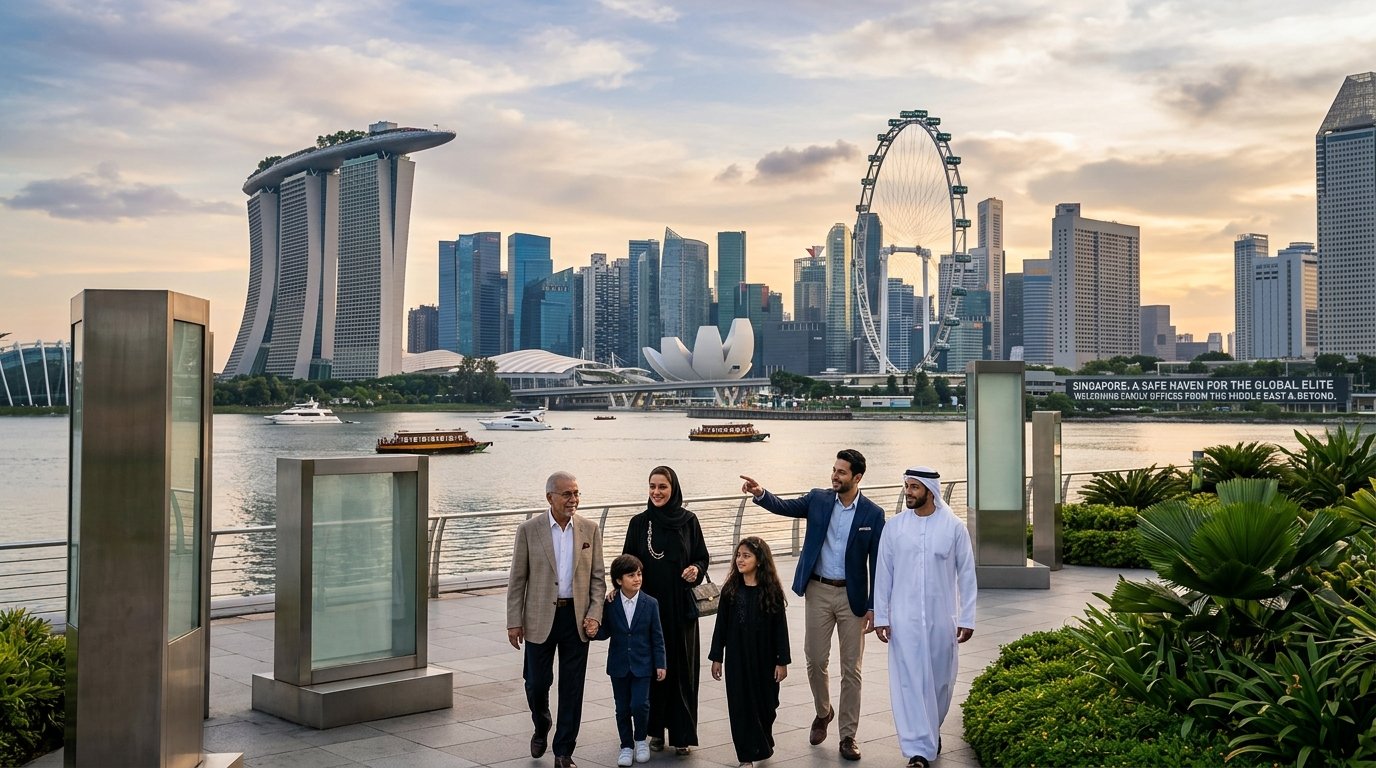
- Gulf’s Super Rich Families Move to Singapore: Wealthy families in Singapore are expanding rapidly as ultra-high-net-worth individuals from the UAE, Qatar, Bahrain, and mainland China execute capital flight to secure institutional stability.
- Gulf Reversal: Six months of kinetic conflict involving Iran have rattled Dubai’s status as a safe haven, prompting private wealth transfers from the Middle East into Singapore’s financial ecosystem.
- China Offshore Scrutiny: Heightened regulatory oversight from Beijing on offshore trusts and brokerage accounts has pushed Chinese families to seek physical and financial distance.
- Refined Frameworks: The Monetary Authority of Singapore (MAS) fine-tuned its single-family office tax incentives (13O and 13U), combining flexible investment mandates with uncompromising regulatory checks.
Singapore is flexing its financial and regulatory muscle to welcome a massive new wave of ultra-high-net-worth individuals and super-rich families relocating from across the Middle East—including the UAE, Qatar, Dubai, and Bahrain—as well as affluent mainland Chinese reconsidering their global offshore bases.
What began as a trickle of asset diversification has turned into a decisive capital flight. Six months of grueling kinetic conflict involving Iran and the wider Middle East, coupled with mounting regional instability, have forced global tycoons to re-evaluate jurisdictions once thought to be inviolable. For the global elite searching for an unassailable sanctuary, all roads once again lead to Singapore.
       GLOBAL CAPITAL RE-ALLOCATION: DUAL PUSH FACTORS

  [ GULF REGION ]                   [ MAINLAND CHINA / HK ]
  • 6-Month Iran War Escalation     • Tax & Offshore Trust Scrutiny
  • Security & Collateral Risks     • Regulatory Proximity Concerns
                │                                 │
                └───────────────┬─────────────────┘
                                │
                                ▼
                   [ SINGAPORE SAFE HAVEN ]
                   • Neutrality & Rule of Law
                   • Fine-Tuned Family Office Rules
                   • Unmatched Safety & Lifestyle
The Gulf Reversal: Shattered Calm and Collateral Fear
For years, the Gulf Cooperation Council (GCC) states—led by the dazzling skyline of Dubai and the financial centers of Qatar and Bahrain—offered tax-free living, luxury, and frictionless wealth creation. Wealthy Chinese entrepreneurs, European industrialists, and regional magnates flooded into the United Arab Emirates, converting Dubai into a buzzing rival to traditional Western and Asian wealth hubs.
READ NEXT: Singapore Maritime Disruption: Singapore Navigates Global Supply Chain Friction Amid Prolonged Middle East Conflict
However, the lingering six-month war involving Iran across the region has fundamentally upended the calculus. As military fallout, maritime blockades, and economic instability ripple through Gulf commerce, the perception of security—the bedrock of any wealth hub—has been deeply shaken.
Advisers and private bankers across the region report that families who moved to Dubai are actively unwinding multi-million-dollar positions to relocate to Asia.
“My clients are afraid that Dubai may potentially be easy collateral damage,” noted Ryan Lin, director at Bayfront Law in Singapore, who advises ultra-high-net-worth families on cross-border residency and structural compliance. “Their sense of security will not be there. They will be frantic. At least mentally, they won’t feel very safe. Their mindset of managing money in Dubai has changed.”
According to reporting on international capital shifts by The Wall Street Journal, the vulnerability of Middle Eastern logistics and financial centers has turned Singapore’s strict political neutrality into its primary competitive asset. Where conflict threatens regional stability, Singapore offers absolute legal certainty, institutional predictability, and military calm.
China’s Wealth Scrutiny and the Limitations of Tokyo
The influx from the Gulf coincides with a broader return of affluent mainland Chinese families who had briefly dispersed to alternative hubs. Following Singapore’s $3 billion money-laundering crackdown in 2023, tighter compliance checks and lengthy bank onboarding drove many Chinese investors toward Hong Kong, Tokyo, and Dubai.
READ MORE: Live Q&A: Singapore Versus Hong Kong as Asia’s Top Financial, Trading Hub
Today, that trajectory is reversing. Beijing’s intensifying oversight of offshore trusts, combined with strict disclosure requirements on global tax liabilities, has unsettled families attempting to manage wealth close to home. Comprehensive geopolitical analyses from The Islamabad Telegraph highlight how Singapore’s long-term regional positioning as a diplomatic bridge and its resilience during broader maritime disruptions reinforce its reputation as Southeast Asia’s most formidable institutional anchor.
Simultaneously, alternative destinations have revealed their own friction points:
-
Tokyo’s Integration Barriers: While Japan’s weak yen initially lured property buyers, foreign families have struggled with severe language barriers, corporate tax complexities, and social integration challenges.
-
Hong Kong’s Regulatory Proximity: Investors increasingly feel Hong Kong’s financial ecosystem operates under the direct shadow of mainland policy, eroding its status as an independent buffer.
Iris Xu, CEO of Jenga Business Consulting Group, observed: “After going to Japan, going to Dubai, going to Hong Kong, there remains the Singapore option. Before, maybe they were looking for an opportunity. Now they are looking at safety.”
The Fine-Tuned Fortress: Redefining Family Offices
Rather than resting on its laurels, Singapore’s central bank—the Monetary Authority of Singapore (MAS)—has strategically recalibrated its stance. Recognizing the global demand for stability, MAS updated its single-family office tax incentive rules, giving families greater flexibility over hiring and investment mandates while maintaining rigorous screening against illicit funds.
                     SINGAPORE VS. ALTERNATIVE HUBS
┌──────────────────┬──────────────────────┬──────────────────────────────────┐
│ Jurisdiction     │ Key Draw             │ Emerging Friction Point          │
├──────────────────┼──────────────────────┼──────────────────────────────────┤
│ Dubai / GCC      │ Zero Income Tax      │ Regional Geopolitical Instability│
│ Tokyo            │ Asset Value / Safety │ Language & Cultural Barriers     │
│ Hong Kong        │ Capital Markets      │ Tightening Beijing Oversight     │
│ Singapore        │ Rule of Law & Peace  │ Higher Cost of Entry & Compliance│
└──────────────────┴──────────────────────┴──────────────────────────────────┘
The response has been immediate. Premium real estate inquiries from Chinese and Middle Eastern buyers surged by 35% in the first half of the year, while family office applications continue to climb.
As detailed in global policy coverage by The Guardian, the modern ultra-wealthy priority list has shifted permanently from maximum yield to maximum preservation. Overseas updates carried by CNN confirm that high-net-worth mobility is now overwhelmingly driven by safe-haven resilience, state-of-the-art healthcare, and top-tier international education—all areas where Singapore excels.
Gulf’s Super Rich Families Moves To Singapore
Beyond capital structuring and asset protection, Singapore’s physical beauty and lifestyle infrastructure play a pivotal role in cementing its dominance. Known as the “Garden City,” the island seamlessly blends ultra-modern architectural icons like Marina Bay Sands and Jewel Changi with lush urban canopy networks, world-class dining, and pristine public safety.
For dynastic families fleeing war zones or intrusive state oversight, Singapore represents more than just a tax home—it offers a permanent, serene home for future generations. In a world defined by geopolitical fractures and unpredictable wars, Singapore’s ironclad stability has converted temporary capital flight into a lasting global migration.
Gulf’s Super Rich Families: Another Options
For years, the Gulf Cooperation Council (GCC) states—led by the dazzling skyline of Dubai—offered tax-free living and frictionless wealth creation. However, six months of military escalation across the Middle East have upended that calculus. As reporting by The Wall Street Journal notes, institutional predictability and strict political neutrality have become the ultimate luxury assets. Wealth managers report that clients are unwinding Gulf positions to relocate to Asia.
Simultaneously, alternative destinations present clear friction points:
- Tokyo’s Integration Barriers: A weak yen initially drew real estate buyers, but severe language barriers and complex tax integration proved restrictive.
- Hong Kong’s Regulatory Shadow: Investors fear capital markets are operating under tighter alignment with mainland policy decisions.
- The Singapore Alternative: Strategic geopolitical positioning detailed by The Islamabad Telegraph highlights how Singapore acts as a resilient buffer, even during times of global maritime disruption.
Overseas updates carried by The Guardian and policy coverage from CNN confirm that high-net-worth mobility is now overwhelmingly driven by capital preservation, state-of-the-art healthcare, and premier education. In an era of global volatility, Singapore’s garden city has cemented its position as the world’s premier wealth fortress.