



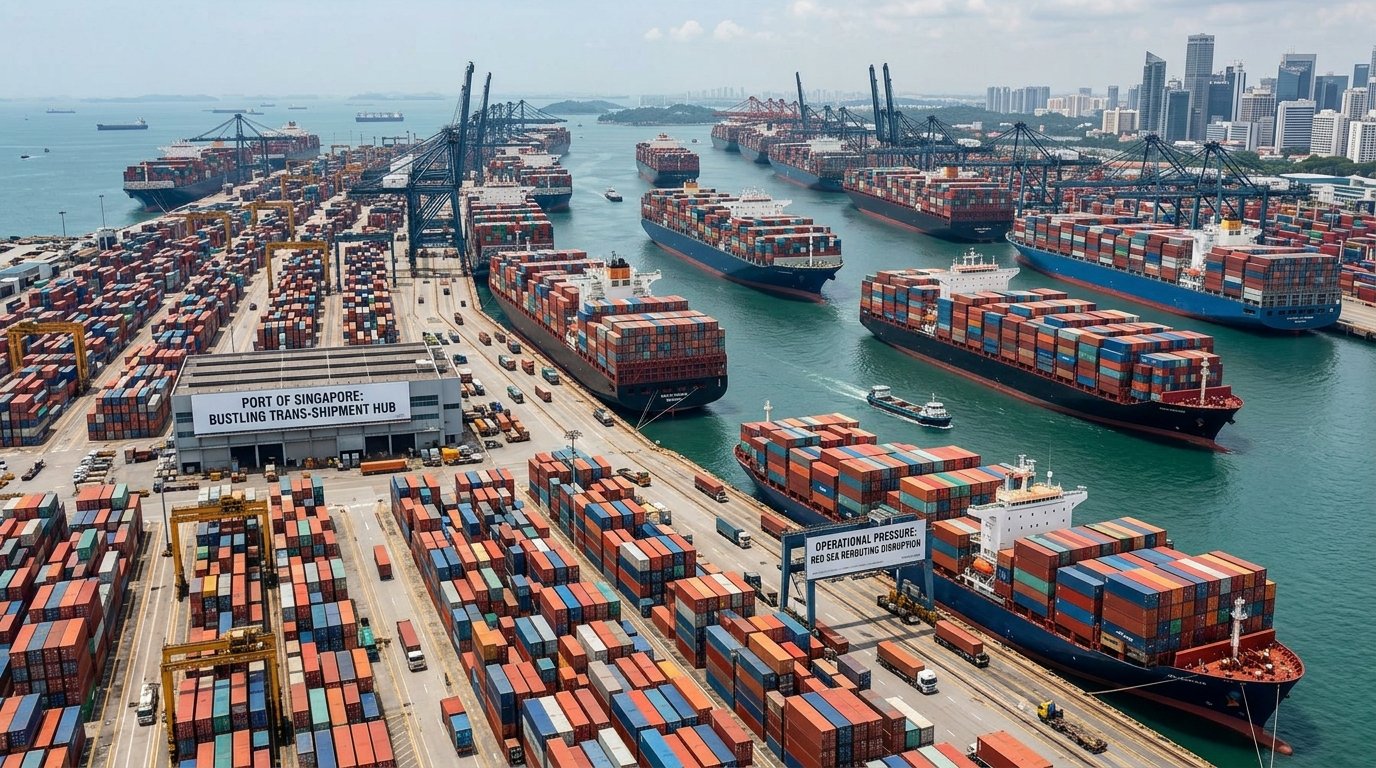
- Singapore Maritime Disruption: The bypass of Middle Eastern chokepoints and the Suez Canal has forced container lines around Africa’s Cape of Good Hope, adding 10 to 14 days to transit times and converting the Port of Singapore into a bottleneck for regional transshipment.
- Operational Gridlock: Vessel off-schedule arrivals peaked at 90 percent, while container dwell times spiked to 11 days, prompting the Maritime and Port Authority of Singapore (MPA) to reactivate legacy berths and fast-track Tuas Port expansions.
- Energy Market Spillovers: With Brent crude hovering above US$94 per barrel due to Strait of Hormuz supply constraints, bunkering overheads and global freight tariffs continue to face inflationary headwinds.
- Corporate Adaptation: The UOB H1 2026 study indicates Singapore business confidence has dipped to a three-year low, forcing enterprises to accelerate AI integration and pivot investment toward nearshoring within the ASEAN corridor.
Singapore Maritime Disruption has become a reality. The bypass of Middle Eastern chokepoints and the Suez Canal has forced container lines around Africa’s Cape of Good Hope, adding 10 to 14 days to transit times and converting the Port of Singapore into a bottleneck for regional transshipment, as analyzed in The Islamabad Telegraph‘s coverage on trade disruptions.
Operational Gridlock: Vessel off-schedule arrivals peaked at 90 percent, while container dwell times spiked to 11 days, prompting the Maritime and Port Authority of Singapore (MPA) to reactivate legacy berths and fast-track Tuas Port expansions, according to reports by The Straits Times.
Energy Market Spillovers: With Brent crude hovering above US$94 per barrel due to Strait of Hormuz supply constraints, bunkering overheads and global freight tariffs continue to face inflationary headwinds, detailed comprehensively by the Financial Times.
Corporate Adaptation: The UOB H1 2026 study indicates Singapore business confidence has dipped to a three-year low, forcing enterprises to accelerate AI integration and pivot investment toward nearshoring within the ASEAN corridor, a trend monitored by The Wall Street Journal.
Geopolitical tensions surrounding the Strait of Hormuz and persistent security threats across the Red Sea continue to disrupt major ocean shipping corridors. With naval blockades constraining vessel transits through critical Gulf waterways, global energy markets have absorbed significant risk premiums. Brent crude futures settled near US87.06, driven by fears of sustained supply curtailments from major Gulf producers, as examined in The Washington Post.
Although alternative crude pipelines, expanded US shale output, and Venezuelan supply adjustments offer partial market workarounds, the structural bottleneck in the Strait of Hormuz remains an active vulnerability for Asia-bound energy flows, a topic detailed in depth by The Islamabad Telegraph‘s analysis on the Strait of Hormuz closure impact.
┌─────────────────────────────────────────────────────────────────────────┐
│                    GLOBAL OCEAN FREIGHT REROUTING                       │
│                                                                         │
│   Europe / Americas <──┐                           ┌──> North Asia      │
│                        │                           │                    │
│            [Suez / Red Sea] (Blocked)              │                    │
│                        │                           │                    │
│   Cape of Good Hope ───┴──> [PORT OF SINGAPORE] ───┴──> Southeast Asia  │
│   (+10 to 14 Days)          (Transshipment Hub)                         │
└─────────────────────────────────────────────────────────────────────────┘
Singapore Maritime Disruption: Operational Impacts on the Singapore Transshipment Hub
To recover delays from extended long-haul voyages, major liner alliances have radically restructured their schedules. Carriers increasingly bypass secondary regional port calls across Southeast Asia, offloading bulk volumes directly at PSA Singapore for subsequent feeder redistribution.
This operational shift has exposed the premier transshipment hub to severe operational pressures:
-
Yard Congestion and Dwell Spikes: In parliament, Singapore Minister for Transport Chee Hong Tat revealed that off-schedule ship arrivals reached roughly 90 percent during peak disruption windows. Port data showed transshipment dwell times spiking to nearly 11 days.
-
Bunkering Cost Escalation: Bypassing Middle Eastern ports has driven up demand at Singapore—the world’s primary marine refueling hub. Larger fuel intake requirements per vessel call have driven up local bunkering procurement costs.
Government Interventions and Infrastructure Responses
Addressing parliament, Minister Chee Hong Tat emphasized that Singapore’s strategic posture relies on proactive capacity expansion rather than passive containment. The Ministry of Transport (MOT) alongside the MPA have deployed state and private resources to mitigate supply chain bottlenecks:
-
Reactivating Legacy Terminals: PSA Singapore reopened older berths and re-purposed storage yards at legacy city sites, including Tanjong Pagar and Keppel Terminals, providing immediate overflow relief.
-
Accelerating Tuas Port Deployment: The expansion of Tuas Port was fast-tracked, bringing operational berths online months ahead of schedule to add long-term berth capacity well ahead of mid-2030 targets.
-
Digital Just-In-Time Integration: The MPA expanded its digital data-exchange infrastructure, integrating liner alliances directly into the port’s Just-In-Time (JIT) scheduling system. Real-time telemetry enables ships to adjust speed at sea, minimizing wait times at anchorage.
-
Supply Chain Buffering: Enterprise Singapore and multinational commodity trading desks have fortified domestic trade routes, expanding buffer inventories to insulate against persistent Middle East volatility.
Equity Projections and Macroeconomic Sentiment
The broader economic impact is reflected across capital markets and corporate outlooks. Financial analysis from DBS indicates that the Straits Times Index (STI) faces distinct trajectories depending on the resolution timeline of the Gulf conflict:
In response, 70 percent of surveyed businesses plan to expand overseas within the next three years, with 64 percent targeting the ASEAN region—particularly Malaysia, Thailand, Vietnam, and Indonesia—to build resilient, nearshored regional supply networks.
For additional context on the maritime conflict and its global implications, watch Telegraph’s report on the Strait of Hormuz closure, which provides visual analysis of how shipping lanes and trade routes are affected during escalating tensions.