



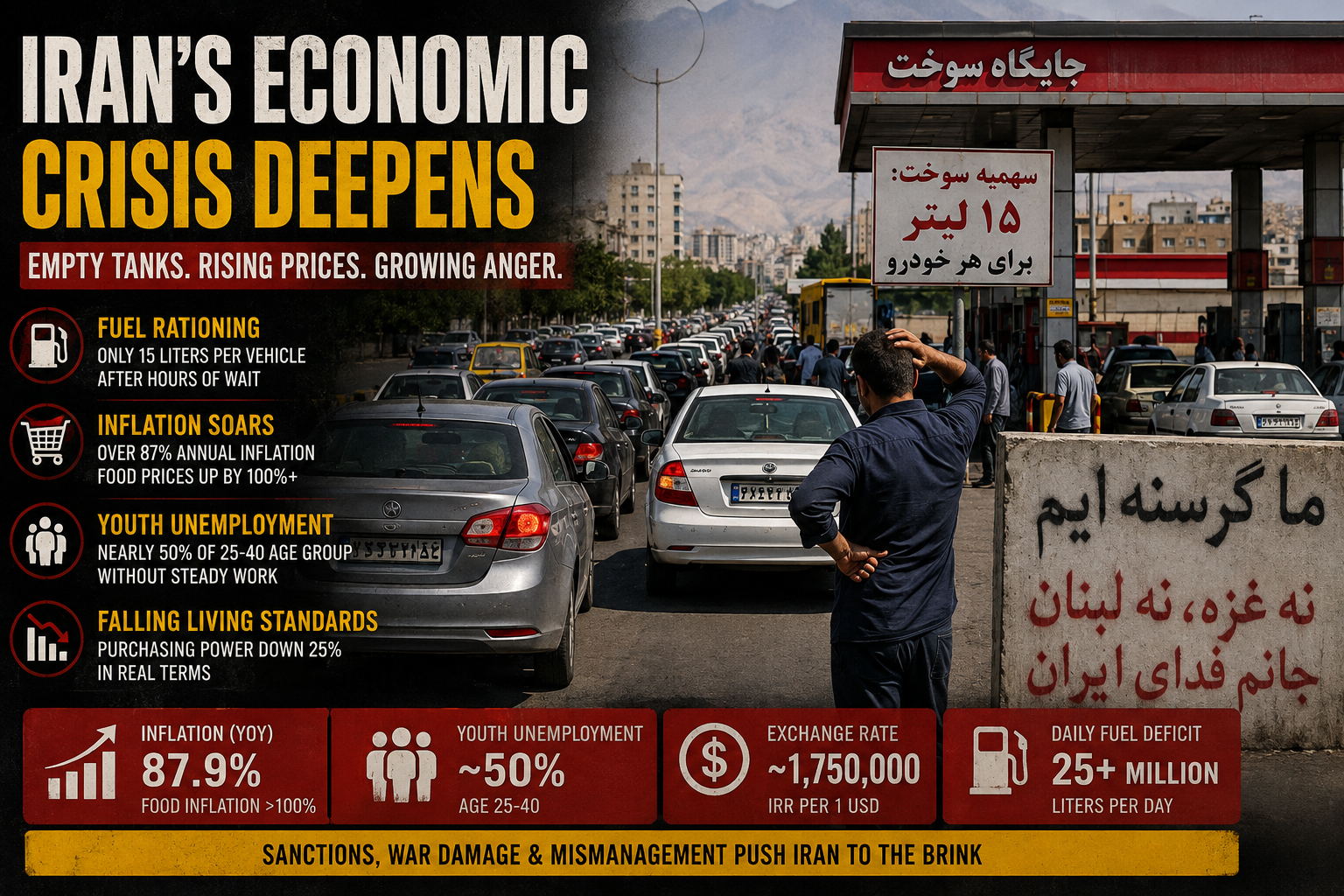
- Iran economic crisis: Long fuel queues and petrol rationing have exposed the severity of Iran’s worsening economic problems.
- Food inflation and the collapse of purchasing power are making basic commodities increasingly unaffordable for Iranian families.
- High youth unemployment, sanctions, wartime damage and structural economic weaknesses are increasing the risk of renewed anti-government protests.
TEHRAN — Long queues of vehicles stretching for kilometers have become an increasingly familiar sight at Iranian filling stations, turning the search for petrol into a daily test of patience. Drivers wait for hours, sometimes under intense summer heat, only to be told that supplies are limited. In some locations, motorists have reported being restricted to as little as 15 liters per vehicle.
For a country sitting on some of the world’s largest oil and gas reserves, the scene is deeply unsettling.
The fuel shortage is no longer simply an inconvenience. It is becoming a symbol of a much wider economic crisis in which shortages, inflation, falling purchasing power and unemployment are converging to create growing frustration among ordinary Iranians.
Reports from inside Iran indicate that motorists in several cities and along major routes are facing long waits and tighter fuel distribution. In May, residents reported stations limiting purchases to 15 liters, while some drivers said they were paying far higher prices through informal channels to obtain fuel.
The problem has intensified since the war that began in February. Iranian officials and analysts have acknowledged that damage to energy infrastructure reduced refining capacity, while disruptions to imports have made it harder to compensate for the shortfall.
Iran is now producing roughly 105 million liters of gasoline a day against consumption of about 135 million liters, according to figures cited by Iranian parliamentarian Reza Sepahvand. That leaves a gap of approximately 30 million liters a day.
Iran Economic Crisis: A Fuel Crisis in an Oil-Rich Country
The immediate causes of Iran’s fuel shortage are more complicated than sanctions alone.
Years of sanctions have restricted access to international finance, technology, equipment and replacement parts, contributing to chronic underinvestment and deterioration across parts of the country’s energy infrastructure. S&P Global has described Iran’s oil infrastructure as having suffered from years of underinvestment linked to Western sanctions, with the 2026 war causing additional damage.
The conflict compounded those problems.
Iranian petroleum officials said refineries, pipelines, storage facilities and aviation-fuel infrastructure were damaged during attacks. Tehran subsequently launched repair programs to restore damaged facilities.
That distinction matters. It would be misleading to attribute every current refinery outage exclusively to U.S. sanctions. The present fuel crisis is the product of several overlapping pressures: aging infrastructure, years of restricted access to foreign technology and finance, wartime damage, disrupted imports, rising domestic consumption and fuel smuggling.
But sanctions remain a critical part of the structural problem.
READ NEXT: BREAKTHROUGH IN ISLAMABAD: PAKISTAN PAVES THE WAY FOR RESUMPTION OF CRITICAL US-IRAN PEACE TALKS
The U.S. Treasury continues to maintain an extensive Iran sanctions regime, including measures affecting the country’s petroleum sector and transactions connected to Iranian oil.
For Iranian consumers, the technical explanation is ultimately less important than the result: there is not enough fuel moving through the system to meet demand reliably.
From the Petrol Pump to the Kitchen Table
The fuel shortage is now feeding directly into the cost of living.
When gasoline and diesel become scarce, transportation becomes more expensive. Trucks cost more to operate. Distributors face higher costs. Farmers pay more to move agricultural products. Retailers pass those costs to consumers.
In Iran, however, the problem goes much deeper than transport.
Official Iranian data showed annual inflation reaching 88.6 percent in June, while food prices rose dramatically. Bread and cereals increased by nearly 139 percent year-on-year, milk, cheese and eggs by almost 152 percent, and red meat and poultry by more than 178 percent.
READ MORE: Fuel Shortages, and Soaring Misery Index Push Iran’s Clerical Regime to the Brink
The figures are extraordinary even by the standards of an economy accustomed to chronic inflation.
An analysis based on Statistical Centre of Iran data found that the price index for cooking oil had increased more than 70-fold between May 2017 and May 2026. Chicken rose almost 57-fold, eggs more than 51-fold and rice almost 42-fold over the same period.
For a family living on a fixed salary, such increases fundamentally change daily life.
Meat is reduced or removed from meals. Cooking oil becomes something to purchase carefully. Families postpone medical treatment, cut spending on clothing and education, and search for cheaper housing.
In Tehran, residents have also reported rent increases approaching 50 percent in some cases despite official rent caps.
The Iranian rial’s collapse has made matters worse by eroding wages and savings.
The IMF estimates average consumer-price inflation at 68.9 percent for 2026, while its projected unemployment rate is 9.2 percent. Official Iranian figures tell a somewhat different story, with unemployment at 7.5 percent, but the country’s labor-force participation rate is only around 40 percent and youth unemployment exceeds 20 percent.
Those numbers reveal why the official unemployment figure does not fully capture the pressure facing young Iranians.
A person who has stopped looking for work, survives through informal employment or has left the formal labor market may disappear from conventional unemployment statistics without actually having a stable livelihood.
Iran Economic Crisis: A Generation Losing Patience
For Iran’s younger generation, the economic crisis is increasingly becoming a political issue.
The country already experienced nationwide protests beginning in late December 2025, initially driven by economic grievances and deteriorating living standards. Britain’s House of Commons Library reported that protests spread across all 31 Iranian provinces.
The danger for Tehran is that economic grievances are accumulating rather than disappearing.
Fuel shortages are one grievance. Food inflation is another. Unemployment, electricity disruptions, housing costs, declining wages and the falling rial add to the list.
There is also growing resentment over what some Iranians see as a widening gap between the priorities of the political leadership and the problems confronting ordinary households.
Among critics of the government, a recurring complaint is that Iran’s leadership remains heavily focused on regional military confrontation while ordinary citizens struggle to find fuel, food and employment.
Some Iranians privately accuse senior officials of being insulated from the consequences of policies made in Tehran’s political and military establishment. Such views are difficult to measure independently because political expression remains heavily constrained, but the underlying economic grievances are documented across multiple independent reports.
The question is no longer whether Iranians are angry.
The more consequential question is whether economic anger can again become organized political protest.
The Warning Signs
There is no reliable evidence yet that a nationwide uprising is imminent. Nor is it possible to establish independently the claims circulating among political insiders that large sections of the population are preparing for coordinated anti-government action.
But the ingredients for renewed unrest are visible.
Iran has a history of protests erupting when economic pressures collide with unpopular government decisions. Fuel prices, food shortages and currency depreciation have repeatedly acted as catalysts.
The present crisis combines all three.
A motorist waiting hours for 15 liters of petrol sees the problem immediately. A mother paying dramatically more for cooking oil sees it in the supermarket. A university graduate unable to find stable employment experiences it every morning.
And a government confronting those pressures must explain why an oil-rich country cannot reliably provide fuel for its own citizens.
That contradiction is becoming increasingly difficult to ignore.
Iran’s economic crisis did not begin with the current war, and it cannot be explained by sanctions alone. Decades of structural weaknesses, subsidy distortions, underinvestment, sanctions, currency deterioration, mismanagement and military conflict have all contributed to the deterioration.
But the latest fuel shortages have made the crisis tangible.
The kilometers-long queues are more than lines at petrol stations. They are a visible measure of a country under extraordinary economic pressure.
For Tehran, the challenge is therefore no longer simply restoring refinery capacity or securing additional fuel imports.
It is restoring public confidence before economic frustration once again spills onto the streets.