



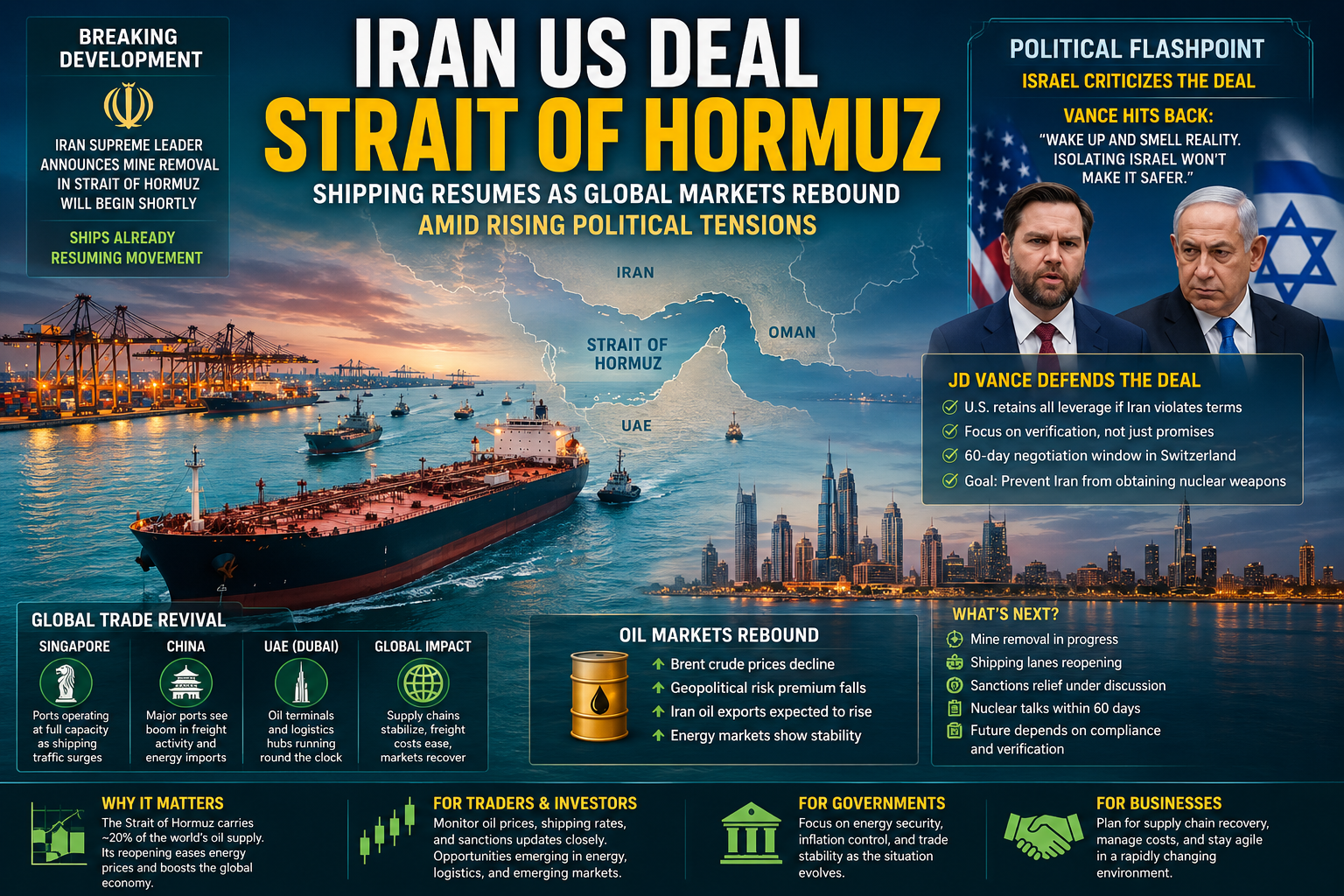
- Iran US Deal Strait of Hormuz triggers immediate reopening of global oil transit routes
- Supreme Leader announces mine removal as ships resume movement
- Major ports in Singapore, China, and UAE report surge in trade activity
- JD Vance defends deal amid Israeli criticism and US political backlash
Iran signaled the next phase of its tentative détente with the United States on Friday, with Supreme Leader Ali Khamenei declaring that the removal of naval mines in the Strait of Hormuz would “begin shortly,” a move already translating into renewed maritime activity in one of the world’s most critical energy chokepoints.
Within hours of the announcement, shipping trackers and regional port authorities confirmed that vessel movement had resumed through the Strait, which carries roughly a fifth of global oil trade. Tankers that had remained anchored during months of conflict are now cautiously re-entering transit lanes, signaling early confidence in the fragile U.S.-Iran understanding.
The immediate economic ripple effects are visible far beyond the Gulf. Major ports in Shanghai, Singapore, and Dubai are witnessing a surge in activity, as delayed shipments resume and energy cargo flows normalize. Shipping firms report a sharp uptick in charter rates for crude carriers, while port operators describe “round-the-clock operations” to manage backlog demand.
Oil markets, which had been rattled by supply disruptions, are already stabilizing. Brent crude has shown a steady downward trajectory, reflecting expectations that Iranian oil exports could return to pre-conflict levels if sanctions relief materializes. Analysts say the reopening of Hormuz alone has removed a significant geopolitical risk premium that had inflated global energy prices.
Oil Prices Down After US Iran Deal as Global Markets Surge and Pakistan Brokers Historic Breakthrough
“This is not just a regional reset—it’s a global economic recalibration,” said a Singapore-based commodities strategist, noting that Asian economies in particular stand to benefit from more predictable energy supplies.
Yet beneath the optimism lies a volatile political undercurrent, particularly in Washington and Tel Aviv. U.S. Vice President JD Vance has emerged as the chief public defender of the agreement, an unexpected role that has thrust him into the center of an increasingly polarized debate.
Hormuz Reopening Brings Relief for Global Economy
What began as a routine promotional tour for his book quickly evolved into a high-stakes diplomatic defense campaign. In multiple interviews, Vance urged Americans to “have a little bit of faith” in Donald Trump, insisting that the administration retains leverage despite early concessions to Tehran.
“The idea that he is going to strike a deal that’s bad for the American people is preposterous,” Vance said, emphasizing that enforcement and verification—not rhetoric—would define the agreement’s success.
However, critics within the Republican Party have been quick to challenge that narrative. Lawmakers such as Lindsey Graham and Ted Cruz have warned that the deal risks empowering Iran economically without securing firm guarantees on its nuclear program or regional activities.
The backlash has been even sharper from Israel, where officials have openly criticized the framework as dangerously incomplete. Vance responded bluntly, urging Israeli leaders to “wake up and smell reality,” arguing that continued opposition risks isolating Israel diplomatically at a time when global powers are aligning behind de-escalation.
The memorandum itself remains a work in progress, with a 60-day negotiation window to resolve contentious issues such as uranium enrichment, sanctions removal, and enforcement mechanisms. Western officials privately acknowledge that many provisions remain vaguely defined, raising concerns about implementation risks.
Still, for global traders, governments, and business leaders, the immediate focus is less on political fault lines and more on operational recovery. Freight costs are easing, insurance premiums for Gulf transit are beginning to decline, and energy-importing nations are recalibrating forecasts.
In Singapore, one of the world’s busiest transshipment hubs, officials describe the moment as a “controlled surge”—a rapid but manageable return to normalcy. For policymakers and investors alike, the message is clear: while the سياسي framework remains fragile, the الاقتصاد is already moving ahead.
The coming weeks will determine whether this cautious reopening evolves into a durable peace—or merely a pause in a longer cycle of confrontation. For now, the ships are moving again, and the world economy is breathing a little easier.