



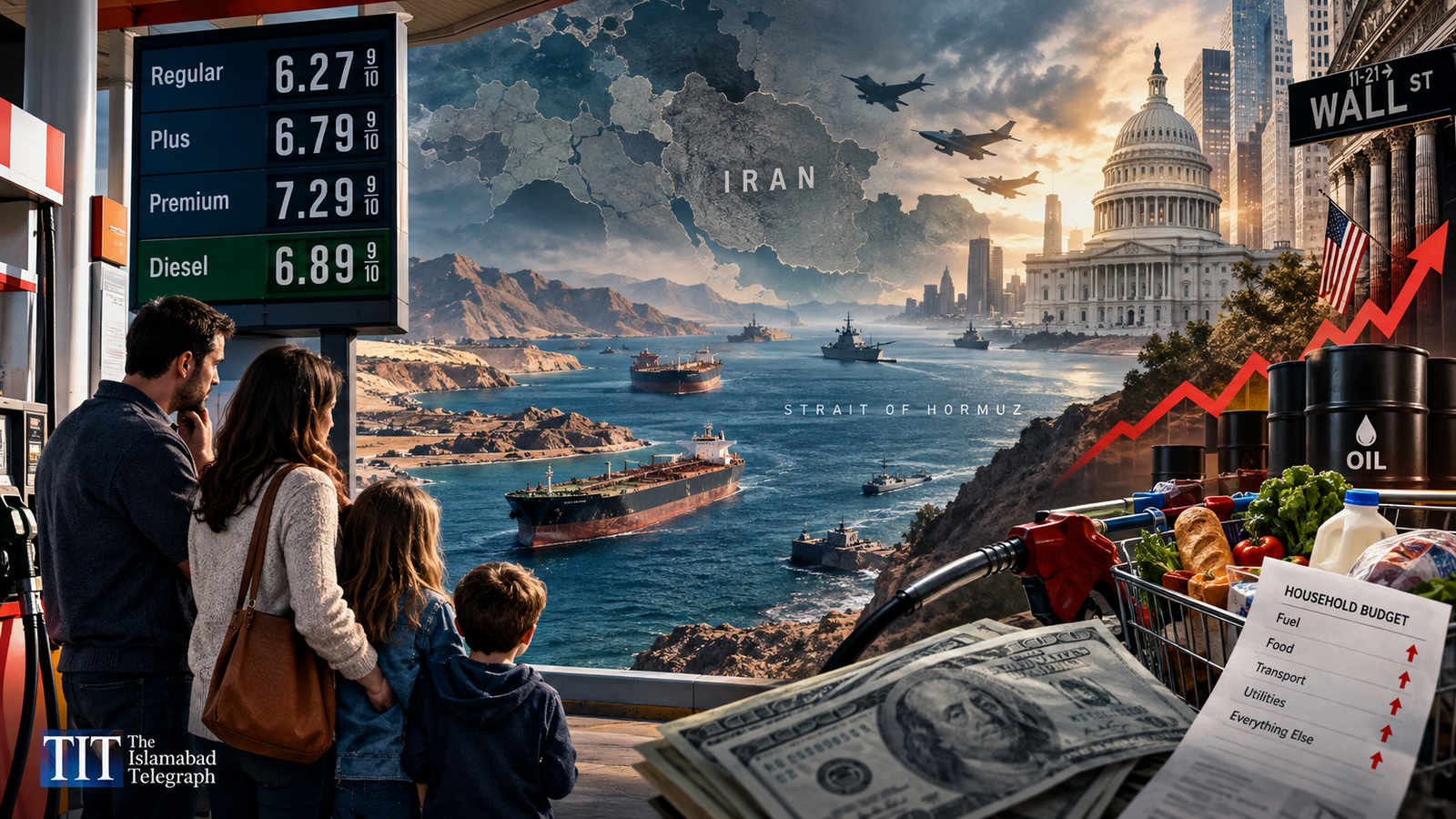
- Iran war cost to Americans has surpassed $107 billion in additional gasoline and diesel spending since February 28, according to Brown University’s Climate Solutions Lab.
- Oil disruptions around the Strait of Hormuz, combined with threats to Red Sea shipping and Russian refinery disruptions, are keeping global energy markets under severe pressure.
- U.S. diesel prices have crossed $6 a gallon, increasing transportation, agricultural and food-distribution costs and adding another layer of inflationary pressure.
WASHINGTON — The economic cost of the Iran war is no longer confined to Pentagon budgets, military deployments or damaged infrastructure in the Middle East. It is increasingly appearing in the daily finances of ordinary Americans, with consumers now estimated to have spent more than $107 billion extra on gasoline and diesel since the conflict began on February 28.
The estimate, based on the Climate Solutions Lab at Brown University, measures the difference between actual fuel prices and an estimated “no-war” price trajectory. Brown’s latest tracker shows the burden continuing to rise, with its cumulative estimate now substantially above $100 billion.
That means the Iran conflict is functioning not only as a geopolitical confrontation but also as an economic shock transmitted directly from the Persian Gulf to American households.
The figure is particularly striking because it represents money that consumers otherwise could have spent on groceries, housing, education, travel, entertainment or debt repayment. Brown estimates that the additional gasoline and diesel burden has exceeded $750 per U.S. household, while its latest tracker puts the figure even higher as fuel prices continue climbing.
The Wall Street Journal reported that Americans had spent approximately $107 billion more on gasoline and diesel amid the Iran conflict and continuing disruptions associated with the Russia-Ukraine war. The newspaper calculated that the additional burden amounted to more than $500 million a day at the time of its estimate.
Wall Street Journal: Americans Have Spent $100 Billion More on Fuel During the Iran War
From Hormuz to the American grocery aisle
The geopolitical mechanism behind the shock is straightforward. The Strait of Hormuz, through which roughly one-fifth of global oil supplies normally move, has experienced severe disruption since the war began. At the same time, threats to shipping through the Red Sea and Bab al-Mandeb have created a second layer of risk for global energy markets.
Foreign Policy warned earlier in the conflict that the disruption to Hormuz could become a major threat to global oil markets, while subsequent analysis highlighted the depletion of inventories and the diminishing supply buffers available to absorb prolonged disruption.
Foreign Policy: Trump’s Epic Fury Can’t Resolve His Iran Quagmire
For Americans, the consequences extend far beyond the gas station. Diesel is a critical input for trucking, agriculture, construction, shipping and industrial activity. When diesel becomes more expensive, transportation companies face higher operating costs, farmers pay more to operate machinery and retailers face higher costs for moving goods.
Those costs eventually move through supply chains to consumers.
The Washington Post has reported that higher oil prices can feed into grocery prices because agriculture depends heavily on diesel while food distribution relies on trucking, refrigeration and other petroleum-intensive infrastructure.
Iran War Cost to Americans: Diesel becomes the new pressure point
The latest phase of the crisis is particularly worrying because diesel prices have risen faster than gasoline in some markets. National U.S. diesel prices recently moved above $6 a gallon, while Brown’s tracker shows the cumulative diesel burden running into tens of billions of dollars.
The pressure comes at an economically sensitive moment. Farmers are approaching the harvest season, while logistics companies, manufacturers and retailers are already operating in an environment of elevated costs.
The geopolitical risk has also widened. Iranian-backed Houthi forces have threatened shipping around the Red Sea, while Ukrainian attacks on Russian refining infrastructure have further complicated global supplies. The result is an energy market facing simultaneous disruptions at several strategic points.
BILD has similarly highlighted how the Iran war has pushed crude prices above $100 and raised concerns about the impact of Hormuz and Bab al-Mandeb disruptions on consumers and the wider economy.
BILD: After tanker attacks, oil price breaks the $100 mark
Iran War Cost to Americans: The wider economic equation
The fuel bill is only one part of the economic cost.
The Congressional Budget Office estimates that the U.S. government’s direct war costs had already reached $38 billion by August 1, with expenses potentially increasing by about $3 billion a month depending on the intensity of operations.
Together, direct military spending and indirect consumer costs demonstrate how modern warfare can impose economic costs far beyond the battlefield.
Higher energy prices also complicate monetary policy. When fuel becomes more expensive, inflationary pressure increases even as higher household expenses reduce discretionary spending. That creates a difficult environment for the Federal Reserve because the economy can simultaneously experience weaker demand and stronger price pressures.
Brown’s Jeff Colgan has described the energy shock as an economy-wide burden on American households. The Washington Post has likewise reported that consumer confidence and spending have faced pressure as the conflict pushed energy prices higher.
The geopolitical question, therefore, is increasingly inseparable from the economic one. A prolonged conflict around Hormuz does not merely affect Tehran, Washington or Gulf governments. It affects the cost of moving a truck, operating a farm, flying an aircraft and putting food on an American family’s table.
If oil remains above $100 for an extended period, the $107 billion consumer bill could become only an early chapter in the economic cost of the Iran war.
The experience also demonstrates a central reality of energy geopolitics: America may be one of the world’s largest oil producers, but it remains exposed to global prices because crude is traded in an integrated international market.
For American households, the war is therefore no longer a distant geopolitical crisis. It has become an item on the monthly household balance sheet.