



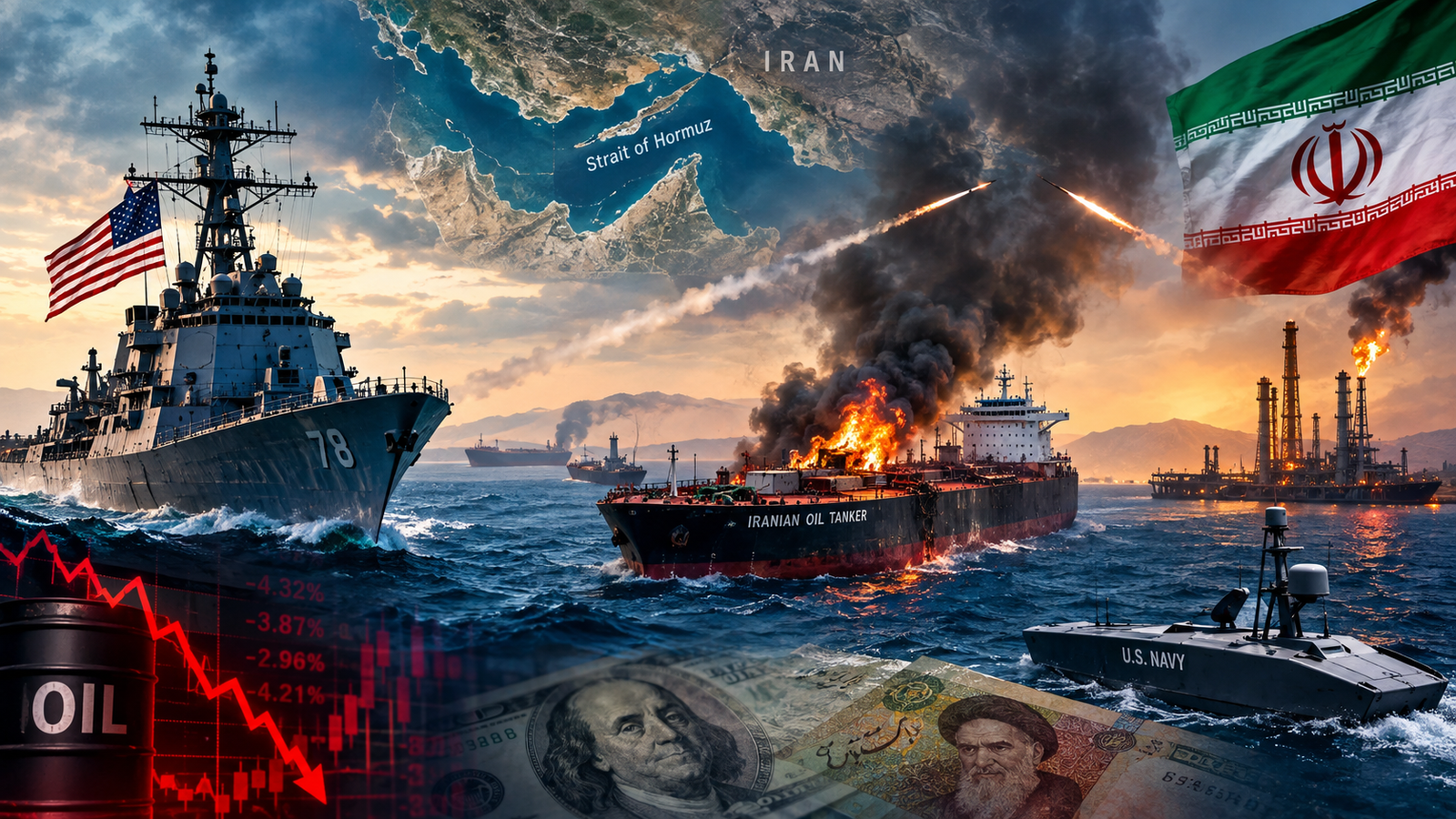
- The US-Iran conflict is escalating at sea, with Washington targeting Iranian oil tankers and Tehran retaliating against American military assets around the Strait of Hormuz.
- Iran’s economy is under mounting pressure as sanctions, disrupted oil exports, currency weakness and restricted access to foreign currency squeeze Tehran.
- The financial war has a surprising vulnerability: billions of dollars linked to Iranian networks have continued moving through international banks and U.S. correspondent accounts despite sanctions.
The Iran war is far from over. The conflict is entering a dangerous phase in which missiles, oil tankers, financial sanctions and Hormuz are interconnected weapons. On Saturday, U.S. forces struck three Iranian oil tankers after Iran fired ballistic missiles toward a U.S. aircraft carrier and guided-missile destroyer. On Sunday, Iran said its Islamic Revolutionary Guard Corps attacked a U.S. unmanned vessel attempting to enter the Strait of Hormuz, showing how quickly the maritime confrontation is expanding.
Washington says the tanker strikes were retaliation and part of a campaign to deprive Tehran of oil revenue. U.S. Central Command said two tankers were disabled near Kharg Island and Jask, while an unladen tanker was destroyed in the Gulf of Oman. Iran, meanwhile, has warned that continued attacks on its shipping will produce harsher retaliation. Hormuz is becoming a sustained military-economic battlefield.
Hormuz is a gateway for Gulf energy exports, and the crisis has sharply reduced commercial traffic. Reuters reports that Iranian crude loadings fell from roughly 2 million barrels a day in March to about 220,000-255,000 barrels a day in August after the U.S. naval blockade constrained shipments. At least 41 million barrels of Iranian crude were reportedly stranded on vessels inside the Gulf by mid-August.
READ NEXT: U.S.-Iran Iran War Takes Ugly Turn as Wedding Strike Triggers War-Crimes Questions
Oil prices have climbed as traders price in the possibility of prolonged disruption, while insurers and shipowners face rising risks around the waterway. Reuters reported that crude prices reached six-week highs after renewed U.S. strikes and escalating threats. OPEC+ is also weighing its production policy against a market already distorted by geopolitical uncertainty.
The rial has fallen to record lows, with the currency trading above 2.2 million rials to the U.S. dollar in the reports. Inflation has become a threat to household purchasing power, while shortages of fuel, electricity and foreign currency are compounding the damage. Reuters says Tehran’s oil blockade is depriving the government of its most important source of hard currency, creating a cash-flow crisis that will be difficult to reverse.
Washington’s sanctions campaign has exposed a contradiction: even while attempting to isolate Iran, Iranian-linked money has continued to pass through the financial system. FinCEN identified approximately $9 billion of potential Iranian shadow-banking activity that moved through U.S. correspondent accounts in 2024. These networks use exchange houses, shell companies and foreign banks in the UAE, Hong Kong and Singapore to disguise Iranian connections before dollar transactions are cleared through American institutions.
READ MORE: How Billions in Iranian Money Passes Through U.S. Banks
On August 28, the U.S. Treasury moved against Banque Misr’s UAE operation, proposing to revoke its correspondent access to American financial institutions. Treasury said the branch processed approximately $1.8 billion between January 2024 and June 2026 for 103 companies potentially connected to Iranian shadow-banking networks.
A company in Dubai or Hong Kong can appear commercially independent, use a foreign bank, and still ultimately rely on an American correspondent institution to settle dollar transactions. That structure gives Tehran avenues for moving money despite sanctions, while giving Washington leverage because dollar clearing remains dependent on U.S. banks. But excessive use could accelerate shifts toward the yuan, cryptocurrencies and other alternatives.
Iran therefore faces pressure on two interconnected fronts: its ability to export oil and its ability to access foreign currency. Washington can directly damage Iran’s revenue system, but every tanker strike or financial restriction can also deepen the global energy shock and increase incentives for alternative payment and shipping systems.
The next phase may be decided less by a single missile exchange than by endurance. If Tehran can preserve enough oil revenue, financial channels and military capacity to keep Hormuz contested, Washington’s blockade becomes expensive. If the blockade continues choking Iranian exports and the rial deteriorates further, economic pressure could become more decisive than airpower.
Every escalation around Hormuz raises the possibility of higher energy prices, disrupted shipping and wider regional instability. The conflict is no longer simply a war between Washington and Tehran. It is becoming a test of whether military power, financial sanctions and control of the world’s energy chokepoint can be combined without destabilizing the global economy they are designed to protect.