



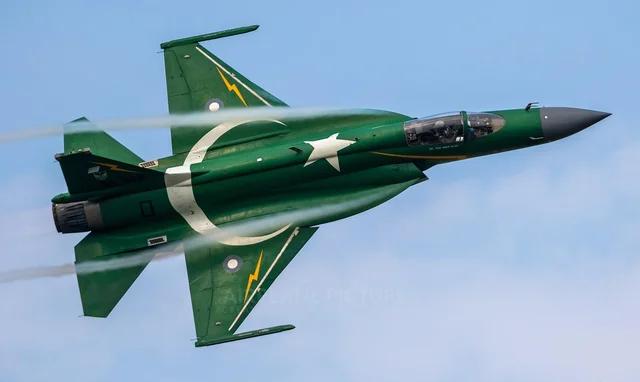
- Pakistan Air Force downed seven Indian fighter jets in just four days, with zero losses of its own.
- Chinese J-10C jets and PL-15 missiles saw their first combat use, proving lethal against India’s Rafales and Sukhois.
- PAF pilots displayed fearless precision and mastery, upholding a legacy of aerial dominance.
- The conflict reshaped South Asia’s balance of air power, with Pakistan-China cooperation emerging as a decisive force.
The night of May 7 was heavy with tension. Over the forests and fields of Punjab, a French-made Rafale fighter — India’s prized possession — cut through the darkness at supersonic speed. Inside the cockpit, the pilot scanned his screens nervously, sweat trickling down beneath his helmet. His radio crackled with static-filled Hindi commands from base: “Proceed. Pakistani defenses are weak. No resistance expected.”
But the radar told a different story. A faint blip appeared, then another, closing in faster than he could believe. His heart pounded. He banked left, climbed higher, tried to break the lock. The warning alarm shrieked — a missile was tracking him.
“Incoming! Missile incoming!” he shouted, panic rising. His wingman’s voice cut in, equally desperate: “Too fast! Too fast—”
There was no time to eject. The Chinese-made PL-15 missile, launched from a Pakistani J-10C miles away, pierced the night like a lightning bolt. In seconds, the Rafale — India’s billion-dollar answer to Pakistan — erupted in a fireball. Pieces rained down on the soil of Punjab, illuminating the night sky with an orange glow.
In another cockpit, far above, the Pakistani pilot remained calm. He had locked, fired, and destroyed his target with the quiet efficiency of years of training. Over the radio, his voice was steady, almost casual: “Splash one.”
It was the beginning of Pakistan’s most decisive aerial victory in decades. By the end of the four-day conflict, seven Indian aircraft would be destroyed. None of Pakistan’s would fall.
The night sky above Punjab on May 7 was restless. Stars flickered faintly, drowned by the low rumble of engines echoing through the darkness. Inside a dimly lit hangar, Pakistani pilots strapped into their cockpits, their movements swift but steady. The air was thick with anticipation. In moments, the silence would be broken by war.
“Eagle-1, cleared for takeoff,” the tower crackled. A J-10C roared forward, its nose pointed toward destiny. The pilot, barely out of his twenties, had trained for this moment all his life. Ahead of him, beyond the horizon, Indian Rafales and Sukhois probed Pakistan’s defenses, emboldened by political orders from New Delhi.
Within an hour, India’s pride would fall flaming from the sky. By the end of the four-day conflict, seven of its jets would be destroyed.
This was not just an aerial skirmish. It was a stunning revelation of courage and technology — fearless Pakistani pilots flying Chinese-designed jets, rewriting the rules of South Asian warfare.
A Spark in Kashmir
The war had been triggered by a tragedy in occupied Kashmir: an attack on Hindu tourists that India, without offering proof, blamed on Pakistan. Islamabad rejected the charge and called for a neutral probe. Instead, Indian warplanes crossed the Line of Control, bombing targets in Punjab and Azad Kashmir.
For Pakistan, it was provocation that demanded a response. For its air force, it was a test of valor and steel.
The Rafale’s First and Last Mission
At 2:43 a.m., radar screens at a PAF command center lit up. An Indian Rafale — the $200 million crown jewel of the Indian Air Force — had crossed into contested airspace.
In the cockpit of a J-10C, Eagle-1 adjusted his oxygen mask and fixed his eyes on the radar lock. “Target acquired,” he muttered. His co-pilot’s voice was steady: “PL-15 armed. Range optimal.”
A button pressed. A missile streaked into the night. For a few seconds, silence. Then a flash. The Rafale, which India had paraded as a symbol of invincibility, disintegrated before it had even fired a shot.
Indian radio channels erupted in panic. A veteran PAF controller later recalled: “You could hear their fear. The Rafale was supposed to be untouchable. Yet it burned on its first night.”
The Days of Fire
In the next seventy-two hours, the PAF repeated its deadly rhythm. Sukhoi Su-30MKIs and Mirage 2000s attempted to push deeper. Each time, they were met with precision Pakistani strikes.
Dogfights lit the sky. At supersonic speeds, PAF pilots twisted through radar locks, dove under enemy formations, and fired missiles with surgical accuracy. One pilot later described it as “flying through chaos, guided only by training and instinct.”
By May 10, the wreckage of seven Indian jets lay scattered across Punjab and occupied Kashmir. Pakistan had not lost a single plane.
The Man Behind the Machine
Last week, DG ISPR Lt Gen Ahmed Sharif Chaudhry offered more detail. Speaking to Bloomberg, he confirmed that Pakistan’s tally of downed Indian aircraft now stood at seven. He dismissed Indian propaganda about Pakistani losses, calling it “fiction.”
“Of course lately, recent Chinese platforms, they’ve demonstrated exceptionally well,” he said. “Pakistan has never played with figures and facts. Seven of theirs fell. None of ours.”
It was the clearest account yet of what insiders already knew: the J-10C and its PL-15 missile had not only worked — they had dominated.
China’s Silent Hand
For Beijing, the conflict was historic. The May war marked the first real-world combat use of the J-10C fighter jet and PL-15 missile. Initially, Chinese officials feigned ignorance, claiming they were “not familiar with the matter.” But by July, the Chinese air chief broke the silence, praising the PAF’s “exemplary performance” and calling the joint effort a “milestone for modern warfare.”
Markets noticed. Shares of Chinese defense manufacturers surged as analysts hailed Pakistan’s victories as proof that Chinese systems could outgun Western and Russian fighters.
Trump’s Confirmation, India’s Denial
Even Washington could not ignore the truth. U.S. President Donald Trump, who had intervened personally to prevent the conflict from spiraling, bluntly told reporters that the war had seen “seven aircraft shot down.”
It was a slap to India’s narrative. New Delhi’s generals grudgingly admitted to some losses but dismissed Pakistan’s tally as “inflated.” Yet, satellite imagery and eyewitnesses along the border confirmed what official communiqués could not hide: Indian wreckage scattered across fields and mountains.
The Human Edge
Technology mattered, but it was the human edge that tipped the balance. Pakistani pilots, trained in a tradition stretching back to the legendary M.M. Alam of 1965, carried themselves with calm precision.
“They never lost composure,” one observer said. “When the radar screamed, when missiles locked, they didn’t flinch. They fought like men who knew the skies belonged to them.”
For them, the J-10C was not just a machine. It was an extension of their will, a sword sharpened by discipline and patriotism.
India’s Bruised Pride
The political fallout in India was swift. Prime Minister Narendra Modi’s government, which had promised invulnerability through Rafales and Sukhois, faced ridicule at home. The jets meant to intimidate Pakistan had instead been reduced to wreckage.
Defence Minister Khawaja Asif did not mince words. “India faced a decisive defeat with a score of 6-0,” he declared. “If they try again, God willing, the score will be much better.”
A Message for the Future
The PAF’s triumph was not merely about numbers. It was a message to New Delhi — and to the world. Pakistan’s skies were not for the taking. Any misadventure would be met with “cataclysmic devastation,” as the military later warned.
The May conflict proved that courage and partnership can upend conventional wisdom. India’s billion-dollar imports were humbled by Pakistani grit and Chinese innovation. In just four days, the myth of Indian air superiority crumbled.
Epilogue in the Skies
At dawn on May 11, as the ceasefire took hold, a lone J-10C circled back to its base. The pilot, exhausted but unshaken, guided his jet to the tarmac. Removing his helmet, he whispered the words later repeated by his comrades: “We don’t fly for glory. We fly for Pakistan.”
And so, in the skies over Punjab and Kashmir, Pakistan rewrote the story of South Asia’s balance of power. Seven Indian jets destroyed. None lost in return. A battle where fearlessness met technology, and where the world learned, once again, that the masters of the sky wear green uniforms.