


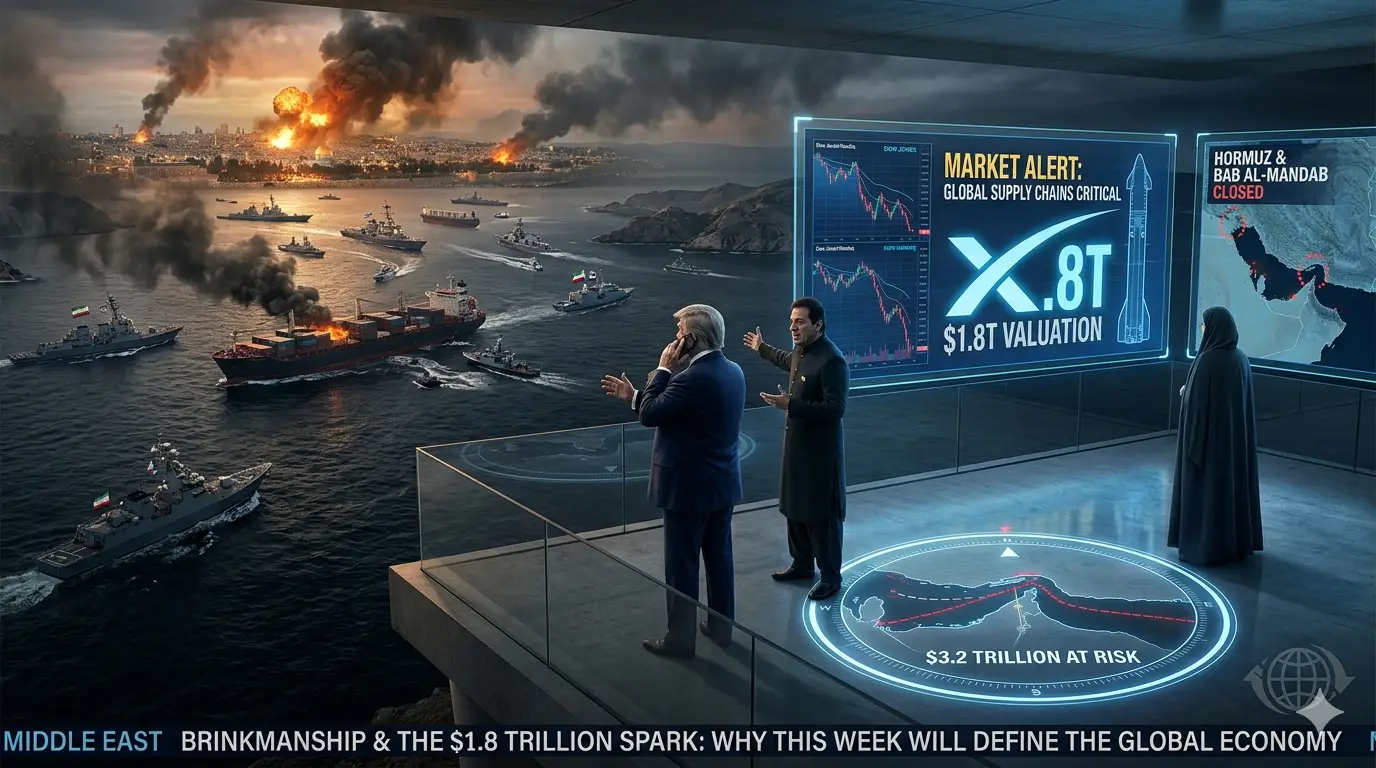
- Middle East And Global Maritime Blockade 2026 variables indicate a historic economic bottleneck, with the Kiel Institute warning of an aggregate $3.20 in global GDP loss for every $1 of direct maritime chokepoint disruption.
- Over 95% of standard Asia-to-Europe commercial shipping traffic has been forced to divert entirely around the Cape of Good Hope, stripping up down to 15% of total global vessel capacity overnight.
- A severe industrial and chemical supply cliff looms as the Arabian Gulf corridor remains frozen, cutting off 46% of global seaborne urea exports and threatening immediate worldwide food production shocks.
- The simultaneous closure of the Strait of Hormuz and the Bab al-Mandab Strait ends the era of “just-in-time” logistics, forcing a painful structural transition toward fragmented, high-cost regional supply networks.
The global economy is entering its most perilous stretch of 2026. This week, starting Monday, June 8, 2026, is poised to be an absolute make-or-break crossroads for global trade, maritime business, tech valuations, and energy security. If investors hoped for a quiet summer rebound following Friday’s brutal 1,100-point Nasdaq plunge—the worst chip-stock routing since the pandemic—they are facing a stark reality check.
1. The Geopolitical Powder Keg: Trump Demands Halt, Pakistan Mediates
The fragile April ceasefire has officially shattered. Marking the 100th day of the conflict, Israel and Iran have traded direct, heavy long-range missile salvos. The escalation ignited late Sunday when Israel conducted targeted airstrikes in Beirut’s southern suburbs, defying Washington’s warnings. Iran retaliated by firing ballistic missiles at Israel’s Ramat David Air Base, sending citizens scrambling for cover and triggering a sixth consecutive wave of missile launches on Monday morning.
The Diplomatic Firestorm: In an urgent message posted on Truth Social, President Donald Trump called for an immediate cessation of hostilities, stating: “Israel and Iran must immediately stop ‘shooting.’ Both sides are looking to do an immediate CEASEFIRE!”
While Trump fumes over the derailment of his U.S.-brokered peace talks, a major diplomatic backchannel has emerged. Pakistan has aggressively initiated hard work behind the scenes to broker an emergency summit between President Trump and Iran’s Supreme Leader, Ayatollah Mojtaba Khamenei.
The Backchannel Calculus: Why the Iran-Israel Missile Trade Won’t Re-Ignite Full-Scale War
Pakistan, which previously mediated the April 8 temporary truce, is trying to pull the world back from the brink of total war. However, the stakes could not be higher, and the path is fraught:
-
The Shipping Chokepoints: Yemen’s Houthi rebels have officially re-entered the fray, launching missiles at Israel and declaring a total ban on Israeli shipping in the Red Sea.
-
The Twin Blockades: Iranian state media warned that if Israel escalates, Tehran will enforce a total blockade on the Bab al-Mandab Strait on top of its existing stranglehold on the Strait of Hormuz.
If both chokepoints close, it will freeze the primary arterial pathways connecting European, Asian, and Middle Eastern trade, dealing an unprecedented blow to international maritime business.
2. Energy Shockwaves & The Prophecy for Oil
The immediate casualty of the collapsed truce is the energy market. Global oil prices surged more than 4% overnight, pushing Brent crude north of $97 a barrel, with analysts warning it will comfortably breach the $100 threshold if fighting continues through mid-week.
Israelis push Netanyahu to keep fighting in Lebanon, signalling long occupation
While heavyweights like Exxon Mobil and Chevron stand to profit from supply disruptions and declining inventories, the broader macroeconomic landscape faces severe stagflationary pressures.
The 2026 Energy Prophecy
If Pakistan’s diplomatic efforts fail and a Trump-Khamenei summit does not materialize this week, the conflict will morph from a localized war of attrition into a permanent global supply crisis. For every month the Strait of Hormuz remains contested or closed, JPMorgan estimates an additional $5 per barrel will be tacked onto Q3 forecasts, and a staggering $15 per barrel onto Q4 predictions—propelling oil toward a devastating $130 to $150 range by winter.
A prolonged maritime blockade will trigger an immediate 15% spikes in global shipping insurance premiums, causing severe disruptions to food, consumer goods, and industrial supply chains worldwide.
3. Wall Street’s Trillion-Dollar Tests: SpaceX and Apple
Simultaneously, the financial world is bracing for two monumental corporate events that will determine the trajectory of the tech sector.
| Event / Asset | Financial Scale | Key Market Impact |
| SpaceX IPO | $75B Raise / $1.8T Valuation | Expected Friday; the largest capital-markets event in history. Will automatically enter the Nasdaq 100 in 15 days, forcing massive passive buying. |
| Apple WWDC | $4.2T Value Created Under Cook | Keynote today marks Tim Cook’s final major AI rollout before stepping down in September; must prove Apple isn’t lagging in the global AI race. |
| Crude Oil (Brent) | $97+ per barrel | Driven by the failure of the Middle East ceasefire; threatening to upend inflation targets and Federal Reserve policy. |
Valuation experts, including NYU Professor Aswath Damodaran, have noted that while SpaceX dominates global space infrastructure via Starlink (boasting a 60% operating margin), its valuation is heavily weighted by its AI unit, xAI, which suffered an operating loss of $2.5 billion in Q1. Wall Street’s ability to absorb this historic IPO amidst a wider geopolitical panic will dictate whether the tech bull market survives or enters a prolonged gloom.
The Verdict for the Week
The coming days will either see a historic diplomatic breakthrough engineered by Islamabad and Washington, or a catastrophic collapse of global trade routing. With traders pricing in volatile 100-point swings for the S&P 500, the message from the markets is clear: the global economy is flying blind into a geopolitical thunderstorm.
The current geopolitical reality has presented the global economy with a worst-case maritime scenario: the simultaneous closure of both the Strait of Hormuz and the Bab al-Mandab Strait.
With the Strait of Hormuz effectively paralyzed since the outbreak of hostilities on February 28, 2026, and the recent re-entry of the Houthi militia into the war, the world’s two most critical Middle Eastern chokepoints are closed at the same time. The structural impact of this dual blockade acts as an economic multiplier, removing the “workarounds” that global supply chains relied on earlier in the year.
1. Projected Impact on Global GDP and Macroeconomics
Economic models calibrated by the Kiel Institute and the IMF reveal that standard trade models drastically underestimate the damage of a dual blockade because they look only at raw trade percentages, failing to account for the catastrophic “bottleneck transmission mechanism.”
-
Global GDP Contraction: According to the Centre for Advanced Supply Chain Analysis, a dual blockage triggers an aggregate global amplification multiplier of $3.20 in GDP loss for every $1 of chokepoint disruption. The OECD warns that a prolonged dual closure through the second half of 2026 will slash global GDP growth by 0.4% to 0.6%, putting heavily energy-dependent and debt-sensitive nations at immediate risk of technical recession.
-
The Asymmetric Burden: While the U.S. is cushioned by domestic shale production (facing a minor impact), the burden falls disproportionately on South Asia, Africa, and Europe. A United Nations study estimates a direct $120 billion to $194 billion GDP loss for Arab and Gulf nations alone due to completely stranded oil and LNG assets.
-
Monetary Policy and Stagflation: Central banks are facing an aggressive stagflationary shock. The European Central Bank (ECB) has already suspended planned interest rate reductions due to Dutch TTF gas benchmarks doubling to over €60/MWh following QatarEnergy’s declaration of force majeure.
2. Explosion in Maritime Shipping Rates & Logistics
With the Suez Canal route completely cut off via Bab al-Mandab, and the Persian Gulf unreachable via Hormuz, global maritime logistics have suffered a structural break.
-
The Cape Route Surcharge: Over 95% of Asia-to-Europe traffic has been forced to divert around the Cape of Good Hope. This adds 10 to 19 days of transit time per voyage, instantly removing 10% to 15% of global vessel capacity due to extended sailing times.
-
Skyrocketing Freight and Tanker Rates:
-
The cost of a VLCC (Very Large Crude Carrier) has ballooned from a baseline of $120,000 per day to a staggering $420,000 per day.
-
Container spot rates on Asia-Europe routes have surged to over $8,500 per FEU (Forty-Foot Equivalent Unit).
-
Shipping LNG costs have risen by 40% due to the sudden capacity deficit.
-
-
Insurance and “Ghost Equipment”: War-risk ship insurance premiums for the region have spiked by over 1,000%, adding up to $250,000 per transit for vessels seeking U.S. naval escort. Concurrently, thousands of empty shipping containers are physically trapped in Gulf ports like Jebel Ali (UAE), creating a severe global equipment shortage on unrelated transpacific and transatlantic routes.
3. The Industrial and Agricultural Supply Chain Crisis
The most insidious element of the dual blockade is that it extends far beyond crude oil, crippling fundamental non-oil commodity inputs required for global manufacturing and food security.
[Chokepoint Paralysis]
       │
       ├─► Stranded Hydrocarbons ──► Oil Spikes ($110+) & European LNG Force Majeure
       │
       ├─► Chemical Bottleneck  ──► Loss of 46% of Seaborne Urea ──► Global Food Price Spikes
       │
       └─► Material Starvation  ──► Shortage of Sulfur & Helium  ──► Semi-conductor & Auto Slowdowns
-
The Agricultural Food Shock: The Arabian Gulf supplies 46% of global seaborne trade for urea (the world’s most critical nitrogen fertilizer) and 30% of ammonia. Major agricultural economies like India, Brazil, and China are facing an unprecedented fertilizer supply cliff, which will directly trigger localized crop failure and severe food price inflation by the next harvest.
-
Semiconductor and Tech Disruption: The Gulf region accounts for 30% of global helium supply (primarily out of Qatar’s Ras Laffan complex) and nearly half of the world’s seaborne trade in sulfur—a core input for sulfuric acid. High-tech manufacturing hubs in Taiwan and South Korea are rapidly draining their inventory buffers, threatening localized shutdowns in microchip fabrication.
-
Automotive Material Starvation: The disruption to Emirates Global Aluminium and Aluminium Bahrain (ALBA)—the largest primary aluminum producers outside of China—has halted the export of automotive-grade aluminum. Global automotive giants, including BMW, Toyota, and Hyundai, are already extending factory lead times due to a lack of specialized raw alloys.
The Structural Reset: Logistics experts warn that if the dual blockades persist past September 2026, it will force a permanent structural reset of global trade. Lean, “just-in-time” supply chains will effectively cease to exist, replaced by highly localized, cost-heavy, and redundant regional trade blocks.