



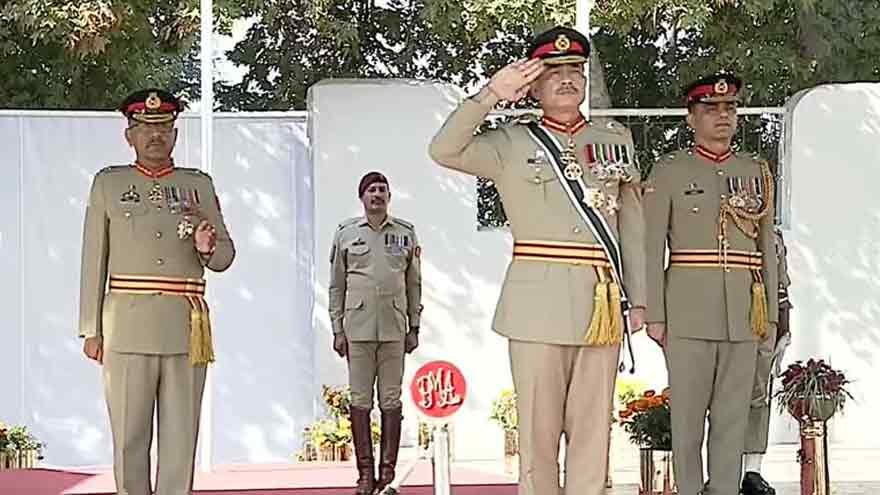
- Victory with Vision: Munir, Pakistan’s war-winning commander, urged peace and restraint despite overwhelming military strength.
- A Leader’s Aura: His fresh face, sharp eyes, and commanding presence captivated cadets who saw in him their future.
- Strength and Stability: After Operation Bunyān al-Mārsūs, Munir emphasized credible deterrence, not aggression, as Pakistan’s doctrine.
- Unity in Faith: He reminded Pakistanis that the bond between the people and their armed forces remains unbreakable, even amid global disinformation wars.
He walked to the podium like a man who had conquered the storm — calm, upright, perfectly composed. The morning sun spread across the parade ground at Kakul, glinting off bayonets and brass buttons. A cool breeze rippled through the ranks of immaculate cadets, their eyes fixed on one man — the Field Marshal who had led Pakistan to victory only months earlier.
Field Marshal Asim Munir’s body language radiated quiet power. There was something effortless about his composure — a balance between the authority of a commander and the humility of a soldier. His face, fresh and bright despite the long months since the May conflict, reflected both pride and peace. His eyes — sharp, alert, almost luminous — seemed to hold within them the memory of every battlefield he had walked through and every prayer he had whispered before dawn.
As he took his place behind the podium, the murmurs of the morning faded into a reverent silence. The air, crisp and electric, seemed to still itself in anticipation. Young cadets, who had just earned their commissions, stood like statues of resolve. They looked at him not merely as a leader, but as their future — the living embodiment of what Pakistan’s military stands for: discipline, courage, and conviction.
When he began to speak, there was no unnecessary grandeur in his voice. It was steady, clear, and commanding — the kind of voice that could rally a nation or quiet a battlefield. And though he stood there as the victor of a historic conflict — the man who had, in May, led Pakistan’s armed forces to a decisive triumph over its archrival India — his words were not of vengeance, nor pride, but of peace.
“I advise and firmly caution India’s military leadership,” he said, his tone even, “that there is no space for war in a nuclearised environment.”
That line — simple, deliberate — fell across the parade ground like a verdict and a warning all at once. The cadets stiffened, their chests swelling with restrained pride. Around them stood rows of officers, men who had fought, bled, and buried their brothers in the May conflict. They knew exactly what he meant. The war had been won, decisively and swiftly, but the cost of war had been seared into every soldier’s soul.
Munir’s message was unmistakable: Pakistan did not seek war. But it would never shy away from one either.
It was a speech born from victory but shaped by wisdom. In May, Pakistan had stunned the world. In a conflict that lasted barely four days, its forces — battle-hardened, disciplined, and unified — had turned back one of the world’s largest militaries. Operation Bunyān al-Mārsūs and Marka-i-Haq had not only secured the nation’s borders but restored its confidence. Advanced Indian Rafales were downed; the much-touted S-400 air defense systems were neutralized; multiple bases across the eastern front were hit with precision.
In global capitals, analysts and intelligence agencies — from the CIA to Mossad, from MI6 to the FSB — noted with surprise that the Pakistani military had displayed an integrated, multi-domain warfare capability that few nations could match. Pakistan had not only defended its soil; it had demonstrated a level of coordination between air, land, cyber, and space domains that placed it among the top tier of modern military powers.
And yet, the man who had orchestrated this victory stood on that podium and spoke, not of dominance, but of restraint.
“Our success,” he said, “must not make us arrogant. It should make us more responsible. We have proven our strength — now we must prove our wisdom.”
The Field Marshal paused, his gaze sweeping across the sea of khaki uniforms. “We will never be intimidated nor coerced by rhetoric,” he continued, “and we shall respond decisively, beyond proportions, to even a minor provocation. But remember — our goal is peace, our path is stability.”
He spoke of India’s continued militarism, its reckless political narratives, and its refusal to engage on Kashmir as per international norms. He warned that the “onus of ensuing escalation” would rest entirely on New Delhi’s shoulders, should it once again test Pakistan’s resolve. But then, almost like a philosopher amid soldiers, he shifted his tone — speaking about unity, national revival, and the youth.
For those who had seen him only as a military strategist, this was Asim Munir the reformer — the man who believed that Pakistan’s true strength lay not in its missiles or tanks, but in its people. “Our youth,” he said, “is the treasure of our future. Their minds are sharper than any weapon we possess.”
He praised the government’s economic efforts, describing the current moment as a “silver lining” — a time when the hidden wealth of the land was beginning to emerge and when global investors were finally returning to Pakistan’s markets. “The world,” he said, “is beginning to recognize the resilience of our nation — a resilience forged in sacrifice and held together by faith.”
There was also a warning about the war of ideas — about the digital battlefield where misinformation was being weaponized to divide the people from their army. “In the post-truth era,” he cautioned, “perceptions bear more weight than reality, and half-truths spread faster than facts. Your strength will lie in thinking critically and discerning fact from fiction.”
It was, perhaps, the most poignant moment of the day — a reminder that the next battle may not be fought on mountain ridges or deserts, but in minds and media feeds.
Then, as the Field Marshal’s voice rose again, it carried a charge of patriotism that could be felt like a pulse. He saluted the martyrs — the soldiers, sailors, airmen, and civilians who had stood as one during the May conflict. He praised the scientists, scholars, and journalists who had “stood firm against aggression.” And he reminded the cadets that their uniform was not a privilege, but a burden of honor.
“Nothing,” he said firmly, “should be more sacred to you than the safety and security of the people of Pakistan. No duty more binding than the defence of your country.”
Behind him, the mountains of Abbottabad stood in quiet grandeur — timeless witnesses to every generation of Pakistan’s soldiers. In that moment, Munir’s speech felt less like an address and more like a covenant. He was not merely marking the end of a parade; he was defining the ethos of an era.
As his words echoed over the ground, one could not help but think of how far Pakistan had come. Only months earlier, the region teetered on the brink of a larger war. India’s reckless strikes, driven by domestic politics, had ignited a fire that could have engulfed South Asia. But Pakistan’s measured and surgical response had not only restored deterrence — it had redefined it.
And now, as the world reeled from conflicts in other regions — from Gaza to Eastern Europe — Pakistan stood as a rare example of a state that had emerged from war as a stabilizer, not an instigator.
Before concluding, Munir’s voice softened. He spoke of Gaza, of Palestine, of Pakistan’s role in pushing for a lasting ceasefire. He hailed the recent peace in the Middle East and reaffirmed Pakistan’s commitment to the two-state solution — a free, sovereign Palestine with Al Quds as its capital. He spoke, too, of brotherhood with Muslim nations, of Pakistan’s strategic partnership with China, and of renewed ties with the United States under President Trump’s peace-focused diplomacy.
And then, in his closing words, he returned to the theme that defines his command — unity. “Our enemies,” he said, “are hell-bent upon driving a wedge between our people and our armed forces. Let me remind them — this bond is unshakable.”
When he stepped down from the podium, the applause was not thunderous but profound — the kind that begins in the chest and lingers in silence. The cadets saluted; their faces glowed with purpose.
In that moment, Field Marshal Asim Munir was not just a victorious commander. He was the custodian of Pakistan’s future — a man who had proven that power, when guided by faith and wisdom, could be both a shield and a light.