



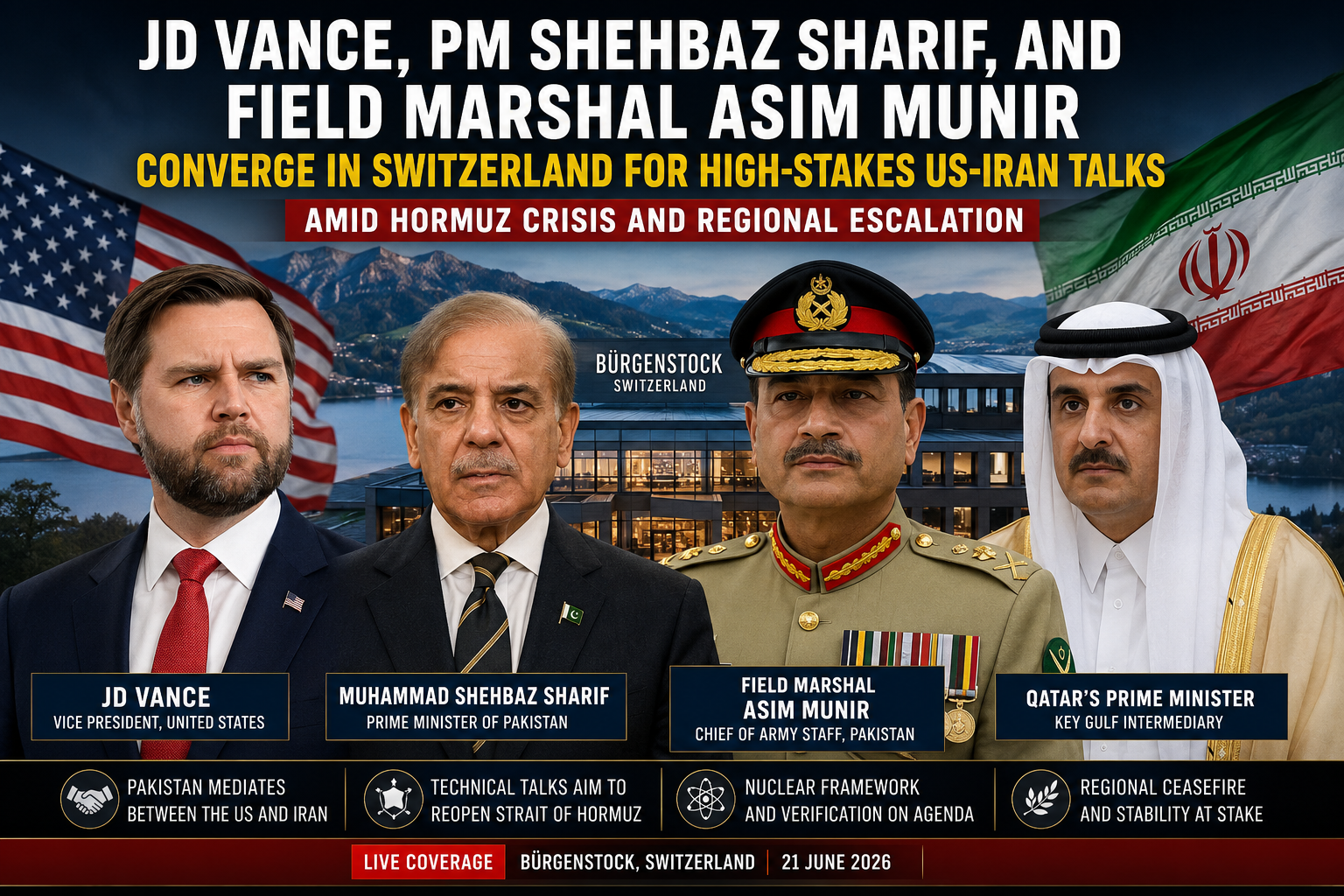
- Pakistan mediates US Iran talks Switzerland at a critical moment following the Islamabad Memorandum
- High-stakes meeting in Bürgenstock includes JD Vance, Asim Munir, Qatar PM and Swiss officials
- Iran’s Strait of Hormuz move and Israel-Hezbollah clashes raise stakes of negotiations
- Technical talks aim to stabilize nuclear deal framework and regional ceasefire commitments
A high-stakes and potentially volatile round of technical-level negotiations is set to take place today in Bürgenstock, Switzerland, where Pakistan will assume a pivotal mediating role between the United States and Iran as fragile diplomacy faces mounting regional pressure.
The talks, convened as a follow-up to the recently signed Islamabad Memorandum of Understanding, are widely viewed as a decisive moment in determining whether the broader U.S.-Iran détente can withstand escalating geopolitical tensions. These include Iran’s announcement regarding the closure of the Strait of Hormuz and the renewed outbreak of hostilities between Israel and Hezbollah in southern Lebanon.
Prime Minister Muhammad Shehbaz Sharif and Chief of Army Staff and Chief of Defence Staff Field Marshal Syed Asim Munir have arrived in Switzerland alongside a high-level Pakistani delegation, underscoring Islamabad’s deepening diplomatic engagement and its strategic intent to position itself as a credible bridge between Washington and Tehran.
On the American side, Vice President JD Vance is leading the delegation, supported by senior envoys already engaged in preliminary technical consultations. Qatar’s Prime Minister, representing a key Gulf intermediary, and Swiss officials are also participating, highlighting the multilateral importance of what diplomats have described as a critical phase of negotiations.
READ MORE:Strait of Hormuz Closure 2026: Israel’s Lebanon Strikes Trigger Iran’s Strategic Chokepoint Move Ahead of Switzerland Talks
The urgency of the meeting has intensified following Iran’s military command announcing the closure of the Strait of Hormuz, a vital maritime corridor through which nearly one-fifth of the world’s oil supply passes. While U.S. Central Command has indicated that maritime traffic continues under close monitoring, the announcement has already unsettled global energy markets and added uncertainty to the diplomatic process.
Iran has justified its position by citing Washington’s inability to restrain Israeli military actions in Lebanon, where a ceasefire between Israel and Hezbollah collapsed within hours, triggering a renewed wave of violence. The latest clashes, including Israeli airstrikes around Nabatieh and retaliatory fire from Hezbollah, have effectively undermined one of the central pillars of the U.S.-Iran understanding: regional de-escalation.
Speaking before departure, Vice President Vance expressed cautious optimism, stating that the talks aim to advance progress on both the nuclear issue and the stabilization of the Lebanon front. However, officials acknowledge that significant trust deficits remain, with both Tehran and Washington accusing each other of failing to meet commitments outlined in the memorandum.
RELATED:Vance Heads to Peace Talks, After Iran Says It Closed Strait of Hormuz
At the core of the Switzerland talks is a complex technical agenda, including mechanisms for reopening and securing the Strait of Hormuz, verification frameworks for nuclear compliance, and enforcement guarantees linked to regional ceasefire arrangements. Iranian negotiators, led by senior political and energy officials, are expected to seek firm assurances, particularly regarding U.S. influence over Israeli military conduct.
Pakistan’s role is being closely observed. Having hosted the initial breakthrough talks in Islamabad, the country now faces the delicate task of maintaining credibility with both sides while advancing a framework that prevents escalation into a broader regional conflict. The presence of Field Marshal Asim Munir adds a critical security dimension to the mediation, reflecting the increasingly strategic nature of the negotiations.
Analysts suggest that the outcome of the Bürgenstock talks could shape the trajectory of Middle East stability in the coming months. A successful technical framework could pave the way for the phased reopening of the Strait of Hormuz, the restoration of stable energy flows, and renewed confidence in diplomatic engagement. Conversely, failure could harden positions, prolong maritime uncertainty, and increase the risk of wider confrontation.
Further complicating the situation is the evolving posture of the Trump administration toward Israel, which has alternated between strong support and pointed criticism, introducing an additional layer of unpredictability. Tehran is likely to assess Washington’s willingness and ability to translate diplomatic commitments into tangible restraint on its regional ally.
As delegations convene in the calm setting of Switzerland, the contrast with the tensions they carry is striking. Beneath the formal structure of technical dialogue lies a deeper contest of strategy, credibility, and timing.
For now, global attention is focused on Pakistan’s efforts to guide two adversaries toward a narrow and uncertain path of cooperation—one that may ultimately determine not only the future of the Strait of Hormuz, but also the broader security architecture of the Middle East.