



- Peace negotiations are currently centered on a revised 20-point plan intended to provide security guarantees for Ukraine.
- The proposed framework includes a demilitarized buffer zone in the Donbas region monitored by international forces.
- Discussions involve a massive $800 billion post-war recovery fund to support economic reconstruction.
- Trump confirmed a productive call with Vladimir Putin to discuss ending the hostilities immediately.
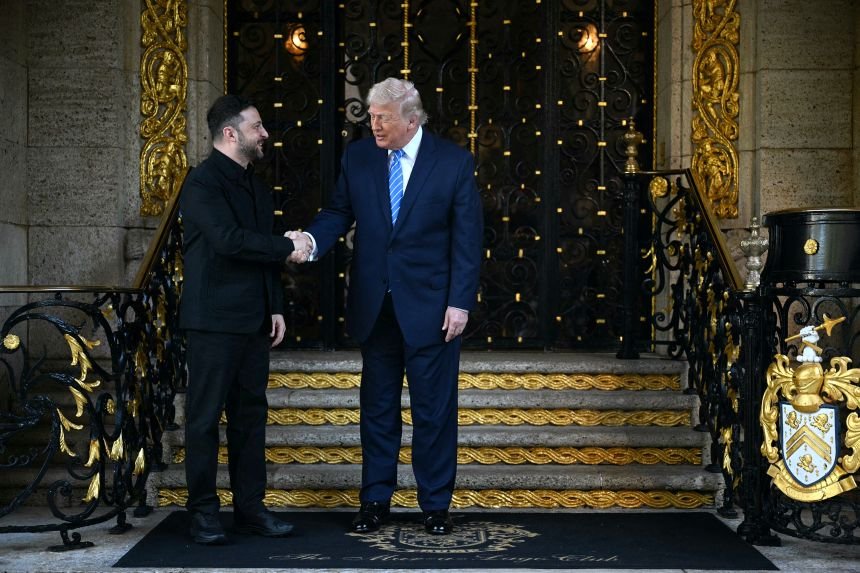
U.S. President Donald Trump and Ukrainian President Volodymyr Zelensky met Sunday at Mar-a-Lago for what both leaders described as one of the most consequential rounds of diplomacy since Russia’s full-scale invasion of Ukraine nearly four years ago. The meeting, held in Palm Beach, Florida, came amid escalating Russian attacks on Kyiv and growing international pressure to secure a ceasefire.
The talks centered on Zelensky’s revised 20-point peace plan, a proposal that has been under negotiation for weeks between U.S. and Ukrainian envoys and is now reportedly “about 90 percent ready” for presentation to Moscow. The plan includes a mix of security guarantees, territorial arrangements, and economic reconstruction commitments, including an $800 billion post-war recovery fund.
Ukraine Peace Deal: Zelenskiy and Trump Meet in Florida To End Conflict
Trump opened the meeting by expressing optimism that the conflict could be brought to an end, telling reporters, “I do believe we have the makings of a deal that’s good for Ukraine, good for everybody.” He praised Zelensky as “very brave” and said both the Ukrainian and Russian presidents “want to make a deal” despite ongoing hostilities.
The U.S. president also revealed that he had spoken with Russian President Vladimir Putin earlier in the day, describing the call as “good and very productive” and indicating he planned to speak with Putin again after the meeting with Zelensky concluded. Trump said his message to Putin was straightforward: “You’ve got to make a deal. Too many people dying.”
READ MORE: Trump says progress made after Ukraine peace plan talks but ‘thorny issues’ remain
Zelensky arrived at Mar-a-Lago shortly before 1:30 p.m., greeting Trump outside the residence before the two leaders sat down with their respective delegations. The Ukrainian president said he came prepared to discuss “security guarantees, air defense missiles, and sanctions” as part of the broader framework for ending the war.
A major point of negotiation remains the future of eastern Ukraine. Zelensky has signaled a willingness to consider a demilitarized buffer zone in the Donbas, monitored by international forces, if Russia withdraws its troops from the region. Moscow, however, has continued to insist that Ukraine relinquish the remaining territory it still controls in Donetsk and Luhansk—an ultimatum Kyiv has repeatedly rejected.
ALSO READ: Trump Ukraine Peace Plan: A Strategic Breakthrough at Mar-a-Lago
Despite the tensions, Zelensky emphasized the importance of maintaining diplomatic momentum. “These are some of the most active diplomatic days of the year right now, and a lot can be decided before the New Year,” he wrote on social media before the meeting.
The talks took place against the backdrop of intensified Russian strikes. In the days leading up to the meeting, Russia launched more than 2,100 attack drones, 800 guided aerial bombs, and over 90 missiles at Ukraine, according to Zelensky’s public statements. At least one person was killed in Kyiv over the weekend, and dozens were injured in the latest wave of attacks.
Trump acknowledged the violence but maintained that Putin is “serious” about pursuing peace, a position he repeated several times during the press availability. “It’ll either end, or it’s going to go on for a long time and millions of additional people are going to be killed,” he said. “Nobody wants that.”
The U.S. delegation included Secretary of State Marco Rubio, Defense Secretary Pete Hegseth, Special Envoy Steve Witkoff, and senior adviser Jared Kushner. Zelensky, for his part, coordinated with European leaders ahead of the meeting, including U.K. Prime Minister Keir Starmer and Canadian Prime Minister Mark Carney, both of whom reaffirmed their support for Ukraine’s diplomatic efforts.
One unresolved issue is the question of frozen Russian assets. Trump said discussions are ongoing about whether those funds could be used to support Ukraine’s reconstruction, but no decision has been reached. Another key component of the negotiations is a proposed U.S.-Ukraine security agreement modeled on NATO’s Article 5, which would obligate the U.S. and its allies to respond collectively if Ukraine is attacked in the future.
While Trump had previously vowed to end the war “on day one” of his presidency, he moderated expectations on Sunday, saying he has “no deadlines” for finalizing a peace agreement. “We’re in final stages of talking, and we’re going to see,” he said. “Otherwise, it’s going to go on for a long time.”
Zelensky echoed the urgency but cautioned that major obstacles remain. “Our teams must talk about strategy,” he said, emphasizing that Ukraine wants European nations involved in the final agreement, though he acknowledged that coordinating such participation on short notice may be difficult.
As the meeting concluded, Trump reiterated his belief that a breakthrough is possible. “We’re going to get it done,” he said. “This gentleman has worked very hard, and his people are very brave.”
Whether the optimism translates into concrete progress will depend on the next round of communications with Moscow—and on whether the Kremlin is willing to accept the emerging framework now under discussion.