



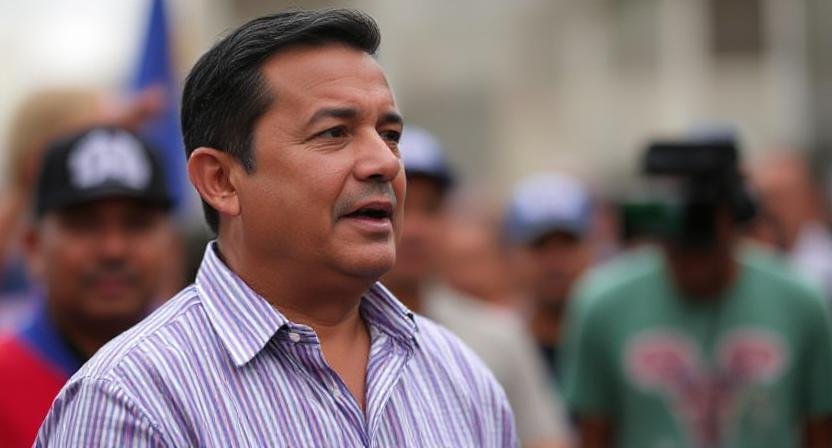
- Senator Miguel Uribe Turbay, a right-wing presidential hopeful, was shot during a campaign rally in Bogotá, reigniting fears of Colombia’s violent political past.
- Authorities have arrested one suspect, but are investigating possible involvement of multiple attackers as Bogotá’s security forces go on high alert.
- The attack comes amid heightened political tensions, with critics blaming President Petro’s rhetoric for fostering a hostile climate toward opposition figures.
- The incident draws international concern, with the U.S. condemning the attack and calling for protection of democratic institutions in Colombia.
In a chilling reminder of Colombia’s violent political past, Senator Miguel Uribe Turbay, a rising star of the right-wing Centro Democrático party and declared presidential pre-candidate for 2026, was shot on Saturday evening during a campaign stop in Bogotá’s working-class Fontibón neighborhood. The gunmen struck just hours after Uribe publicly recounted the death of his mother, journalist Diana Turbay, who was killed during a rescue operation after being kidnapped by Pablo Escobar’s Medellín Cartel over three decades ago.
Now, the violence that defined his childhood threatens to derail both his life and Colombia’s fragile democratic process.
Trump’s Immigration Crackdown Escalates: National Guard Deployed in Los Angeles Amid Protests
Authorities say Uribe was shot from behind at close range around 5 p.m., while mingling with constituents. He was rushed to a nearby hospital, where he remains in critical condition. A suspect has been apprehended, but investigators are exploring the possibility of additional accomplices. Bogotá’s mayor, Carlos Fernando Galán, confirmed the city’s entire hospital network was placed on high alert in anticipation of further incidents or necessary medical transfers.
The attempted assassination comes at a time of heightened political polarization in Colombia. Uribe, 39, is a staunch opponent of President Gustavo Petro’s left-wing government, often casting himself as the ideological heir to former President Álvaro Uribe, under whom he once served. Though unrelated by blood, the two share a political lineage steeped in hardline security policies and an adversarial stance toward Colombia’s armed leftist movements.
READ MORE:Colombian presidential hopeful shot at campaign event in capital
Uribe Turbay’s own family history is one of sacrifice and symbolism. His grandfather, Julio César Turbay Ayala, was president from 1978 to 1982. His mother’s death, long etched into Colombia’s collective memory, has served as both a political talisman and personal motivator in his campaign. At an event earlier on Saturday, Uribe held up a photo of himself as a boy with his mother, telling the audience, “Her murder shaped my destiny — to fight so that no Colombian child grows up in a country that normalizes violence.”
Yet, hours later, that same violence found him.
President Petro swiftly condemned the attack, calling it an assault on democracy itself. “This act of violence is an attack not only on the senator’s personal integrity, but also on democracy, freedom of thought, and the legitimate exercise of politics in Colombia,” read an official government statement. On social media, Petro lamented, “Ay, Colombia and its eternal violence.”
But the political fallout quickly turned bitter.
U.S. Secretary of State Marco Rubio issued a sharply worded statement condemning the attempted assassination. “This is a direct threat to democracy and the result of the violent leftist rhetoric coming from the highest levels of the Colombian government,” he wrote. His remarks echoed a growing concern among Colombian conservatives that Petro’s administration has failed to contain — or even incited — anti-opposition hostility.
READ MORE:Nuclear Misinformation! Can You Imagine a Nuclear-Armed State Faking a Nuclear Attack? India Just Did
Defense Minister Pedro Arnulfo Sánchez Suárez struck a more neutral tone, announcing a 3 billion peso (approx. $730,000) reward for information leading to the attackers. He convened an emergency meeting with top military and police officials, vowing to “redouble efforts to protect life, ensure free political participation, and bring justice.”
Still, the attack has revived haunting memories. The 1989 assassination of presidential candidate Luis Carlos Galán by cartel-hired gunmen is often cited as one of the darkest days in Colombian democracy. His son, Carlos F. Galán, now serves as Bogotá’s mayor and has had to revisit that trauma once again.
“The atrocious attack against Sen. Miguel Uribe is a new and deep wound in our democracy,” Galán wrote on social media. “On this issue, we must unite without reservations: we cannot allow violence that seeks to eliminate those who think differently.”
Though Colombia signed a peace deal with the FARC in 2016, ending the hemisphere’s longest-running internal armed conflict, political violence persists, particularly in rural areas. Until now, the capital had largely been insulated from such targeted attacks on national figures. Uribe’s shooting changes that calculus.
As investigations unfold and speculation swirls over the motives and masterminds behind the assassination attempt, Colombia faces a reckoning: will it allow the ghosts of its past to reclaim the present, or can it rally across political divides to protect what remains of its democratic order?
Whether Miguel Uribe Turbay survives or not, his shooting has already become a national inflection point — one that may define the run-up to 2026, and Colombia’s struggle to break free from a history written in blood.