


- Vladimir Putin warned that European troops deployed to Ukraine would be “legitimate targets” for Russia, escalating tensions with the West.
- His remarks came after European leaders in Paris signaled readiness to send troops to secure a peace deal, though only after a cease-fire.
- In China earlier this week, Putin said Ukraine must negotiate peace or Russia would end the war “by force.”
- Kyiv dismissed Putin’s offer of talks in Moscow, calling it an unacceptable proposal aimed at undermining Ukraine’s sovereignty.
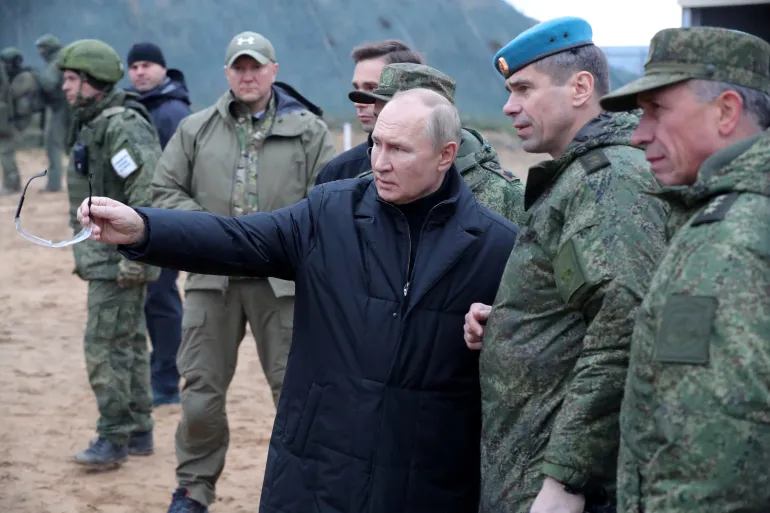
President Vladimir V. Putin on Friday dropped a geopolitical bombshell, declaring that any European forces deployed to Ukraine before a peace deal is reached would become “legitimate targets” for Russian strikes. His statement — issued just a day after European leaders gathered in Paris to discuss sending troops to secure a future peace in Ukraine — has escalated fears of direct confrontation between Russia and the West.
The warning came during an economic conference in Vladivostok, shortly after Putin’s return from China, where he stood shoulder-to-shoulder with President Xi Jinping, North Korea’s Kim Jong-un, and Pakistan’s Prime Minister in a choreographed display of anti-Western solidarity. The timing of his words underscored both Russia’s confidence and the mounting tension in Europe’s capitals, where leaders have been struggling to balance deterrence with diplomacy.
A Threat with Global Resonance
Putin’s words carried unmistakable menace. “If any Western troops appear in Ukraine, especially now, during the fighting, we assume that these will be legitimate targets,” he declared. His remarks directly contradicted reassurances from French President Emmanuel Macron, who had told reporters on Thursday that Western forces would only deploy “the day after a cease-fire or peace” to safeguard Ukraine against renewed Russian aggression.
Trump’s Gamble for Peace: A New Map, Old Foes, and the High Stakes of the Ukraine War
To Putin, however, the line between deterrence and intervention is clear-cut. The presence of European soldiers on Ukrainian soil — regardless of timing or mission — represents, in his eyes, an escalation tantamount to war. “If they arrive afterward, their presence wouldn’t make any sense,” he added, hinting that Moscow would only consider long-term security guarantees if they were reciprocal, applying both to Russia and Ukraine.
European leaders, already uneasy about the prospect of a frozen conflict, now face a starker reality: their commitments to Ukraine could drag them into a direct clash with Russia, something NATO has been keen to avoid since the war erupted in February 2022.
The Long Shadow of War
The Russia–Ukraine conflict is now in its third year, with no sign of resolution. What began as Moscow’s full-scale invasion in 2022 has morphed into a grinding war of attrition, stretching across Ukraine’s east and south. Tens of thousands of soldiers have been killed, millions of Ukrainians displaced, and vast tracts of infrastructure reduced to rubble.
READ MORE: Trump Administration to End Security Programs Protecting European Allies From Russia
Western military aid has sustained Kyiv’s resistance, but Moscow’s capacity to absorb losses, coupled with a wartime economy increasingly tied to China, has made Russia resilient. Ukraine’s much-vaunted counteroffensive of 2023 failed to achieve decisive breakthroughs, and political fatigue in Western capitals has raised fresh questions about the long-term sustainability of support.
Putin has seized on this uncertainty. In China earlier this week, he argued that Ukraine must return to the negotiating table or face consequences. “Ukraine should negotiate to end the war, or we will end it by force,” he said in Beijing, standing alongside Xi and Kim in a carefully staged moment of defiance against U.S. and European pressure.
Talks, But Only on Moscow’s Terms
On Friday, Putin dangled the possibility of direct talks with Ukrainian President Volodymyr Zelensky — but only in Moscow. “The Ukrainian side wants a meeting. We are ready. And the best place for it would be the capital of our country,” he told the Vladivostok audience.
ALSO READ: Is “Freedom Edge” the Dawn of a U.S.-China Cold War?
Kyiv immediately dismissed the offer as a trap. Ukraine’s foreign minister, Andrii Sybiha, wrote on social media that Putin was “messing around with everyone by making knowingly unacceptable proposals.” Zelensky, for his part, argued that Russia’s insistence on hosting talks proved that Moscow was not serious about peace but intent on humiliating Ukraine into submission.
Former U.S. President Donald Trump has repeatedly promoted the idea of direct talks as a shortcut to peace, but Putin’s insistence on dictating the venue highlights the gulf between Kyiv’s demand for sovereignty and Moscow’s drive for dominance.
Europe at a Crossroads
For European leaders, Putin’s comments pose a dangerous dilemma. Macron’s initiative to gather 26 countries in Paris on Thursday was designed to show unity and determination to guarantee Ukraine’s future security. Yet the lack of specifics about what such a mission would entail — and Putin’s swift, menacing rebuttal — underscores the fragility of Western resolve.
The prospect of Western troops being branded “legitimate targets” risks turning Ukraine into the spark of a broader conflict. It is a scenario reminiscent of the Cold War but with even higher stakes, as Russia leans on nuclear rhetoric and China positions itself as a global counterweight to U.S. influence.
At the Vladivostok conference, Putin went further, suggesting Russia was open to cooperation with American companies in Alaska and the Arctic, a bid to entice Washington with economic opportunities while isolating Europe. His message was clear: Russia is not without options, and the West must choose between confrontation and accommodation.
A Serious Moment
Putin’s latest statement cannot be dismissed as mere bluster. For nearly three years, Moscow has demonstrated its willingness to escalate militarily despite sanctions, isolation, and heavy battlefield losses. His growing alignment with China and North Korea, combined with Europe’s wavering unity, gives him confidence to issue threats that might once have seemed unthinkable.
The war in Ukraine has already reshaped global geopolitics, pushing Russia into Asia’s orbit, destabilizing Europe’s security architecture, and straining the transatlantic alliance. Now, with Putin declaring Western troops fair game, the risk of a wider war has moved from the hypothetical to the plausible.
As the dust settles from the Paris summit and the Vladivostok conference, one thing is certain: the path to peace in Ukraine is narrowing, and the cost of miscalculation could be catastrophic.