



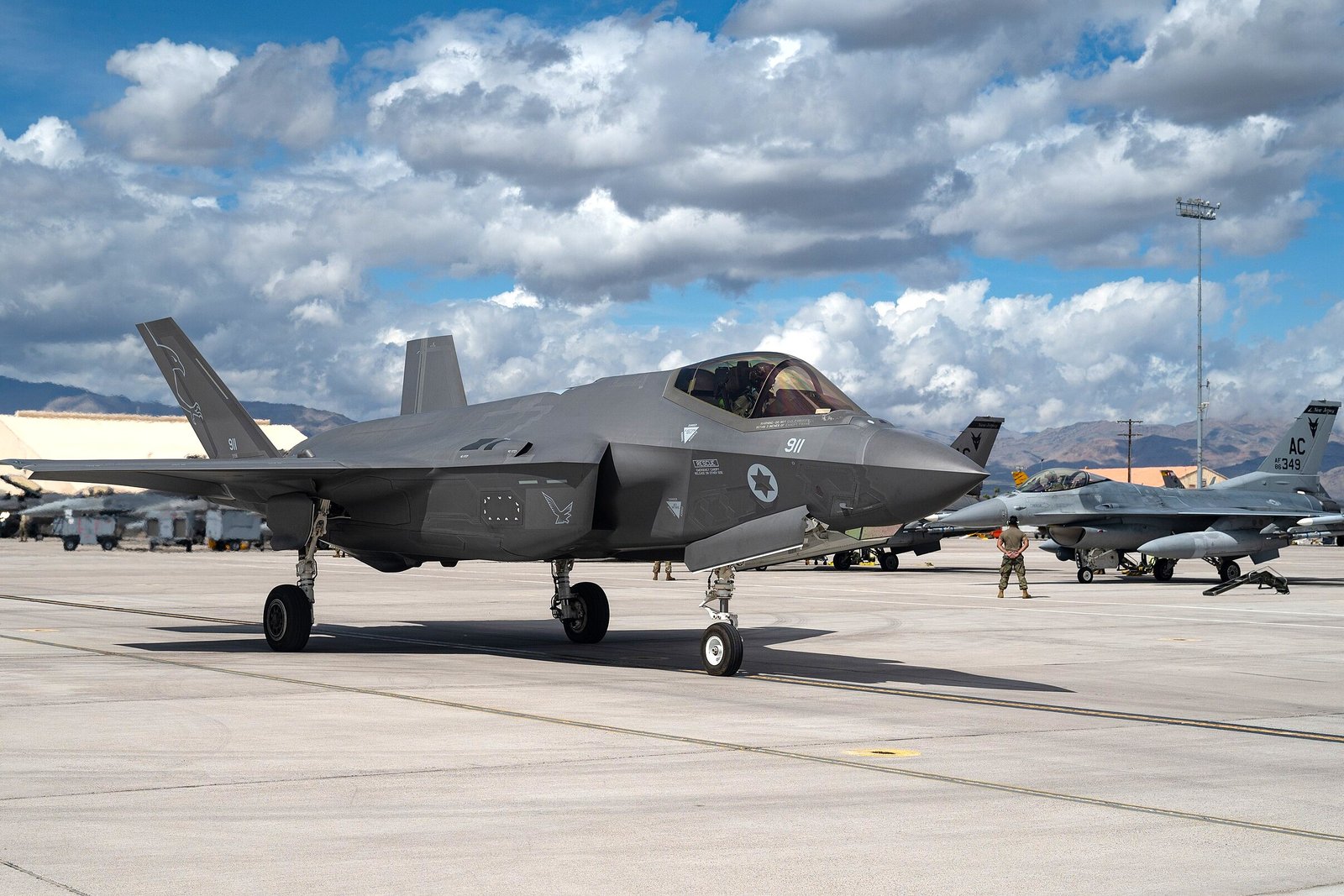
- Riyadh’s Quest for the F-35: Saudi Arabia has relied on U.S.-made jets, missiles, and weapons systems for decades; the F-35 is a natural continuation of that partnership.
- Israel’s unrivaled aerial dominance, powered by its heavily modified F-35 fleet, has tilted the regional balance and pushed Riyadh to modernize.
- The Kingdom seeks upgrades to secure deterrence, protect critical infrastructure, and maintain military relevance amid rapid regional militarization.
- Washington can preserve Israel’s qualitative military edge while still equipping Saudi Arabia with next-generation capabilities under strict protocols.
For decades, Saudi Arabia has flown the skies of the Middle East with American wings. U.S.-made F-15s, advanced missile defense batteries, precision-guided munitions, and cutting-edge radar systems have defined the backbone of the Kingdom’s military arsenal.
Riyadh’s reliance on American jets and weaponry is neither new nor controversial. What is new is the scale and pace at which the region around Saudi Arabia is shifting—and the urgent need for the Kingdom to upgrade its air force, missile systems, and overall military posture to stay relevant in this turbulent era.
Today, Saudi Arabia stands at the center of a geopolitical transformation where the Middle East’s security balance is once again being reshaped—largely from the air. And at the heart of this shift is a single aircraft: the U.S.-made, fifth-generation F-35.
Israel Has Rewritten the Rules of the Sky
Whether one agrees with Israeli policies or not, there is no denying Israel’s mastery of aerial warfare. Over the past two years, Israel has demonstrated unchallenged aerial dominance across Lebanon, Syria, Yemen, and even deep inside Iran—without losing a single aircraft. This supremacy has been powered almost exclusively by the F-35, a fighter jet that combines stealth, deep penetration, long range, and an unmatched sensor suite.
Trump–MBS Alliance : The New Architects of the Middle East’s Destiny
Israel’s air force is not just strong—it is the strongest in the Middle East by an overwhelming margin. It is also the only regional military equipped with the F-35, giving it what Israeli officials themselves call “an insurance policy” against uncertainty in a volatile region.
The stealth jet’s ability to travel more than 1,300 miles, carry heavy payloads, merge radar images from multiple sources, jam enemy defenses, and seamlessly coordinate with drones makes it a weapon that changes the nature of war itself. Israel has taken the F-35 even further, upgrading it with domestic electronic warfare systems, artificial intelligence–driven targeting, external fuel tanks for extended range, and unique helmet displays allowing pilots to see through the aircraft.
READ MORE: Saudi Arabia Wants American F-35s. Israel’s Success With Them Shows Why.
In other words: Israel has built an air force that not only dominates its neighborhood—it shapes it.
Riyadh’s Quest For the F-35 Is Logical, Strategic, and Necessary
Against this backdrop, the Trump administration’s willingness to sell the F-35 to Saudi Arabia is being met with predictable anxiety in Israel. But for Saudi Arabia, the calculus is simple: the Kingdom must modernize or risk falling irreversibly behind.
Saudi Arabia is not seeking new jets to threaten Israel. Rather, Riyadh is seeking to maintain military relevance in a region where fourth-generation aircraft—however powerful—are now technologically outdated.
Saudi Arabia’s current fleet of F-15 variants, Eurofighter Typhoons, and Tornados can carry massive payloads, but lack stealth, advanced sensors, and integrated AI capabilities. Against modern air defenses and fifth-generation fighters, these jets simply cannot perform the missions that the future battlefield will demand.
ALSO READ: MBS’s Visit To USA: A White House Welcome That Mirrors Trump’s Royal Reception in Riyadh
Moreover, the Middle East today is not the Middle East of 20 years ago. Iran continues to pursue advanced air defenses and long-range missiles. Turkey is expanding its fleet and military reach. Egypt has undergone rapid modernization. And Israel, with 75 F-35s on order, remains far ahead of everyone else.
In this environment, Saudi Arabia seeking the F-35 is not an escalation—it is self-preservation.
Israel’s Concerns Are Real, but Not a Reason to Freeze Riyadh’s Progress
Israel’s apprehension is understandable. If Saudi Arabia acquires the F-35, others—Turkey in particular—will surely demand the same. Israeli officials fear that F-35s in Arab skies could detect Israeli jets, thereby eroding the “qualitative military edge” that Washington is legally required to maintain.
But this fear ignores a deeper reality: weapons outlive regimes, but so do alliances. Today, Saudi Arabia is not an enemy of Israel. In fact, normalization—though stalled—remains a strategic priority for Washington, and a growing necessity for Riyadh.
If anything, a structured and conditional F-35 sale could bring Saudi Arabia and Israel closer to a long-term understanding, where both states benefit from deeper U.S. technology sharing and security cooperation.
Furthermore, Congress will have the final say. Any deal would require a long list of safeguards, usage restrictions, and technology security protocols. Israel would likely receive new upgrades in return. This is how Washington has always managed the balance—and will continue to do so.
Saudi Arabia Wants More Than Jets—It Wants a 21st-Century Security Architecture
Crown Prince Mohammed bin Salman’s visit to Washington is about more than aircraft. Saudi Arabia is seeking:
- Advanced AI infrastructure
- Next-generation computer chips
- A civilian nuclear cooperation agreement
- Integrated defense partnerships that endure beyond U.S. political cycles
The Kingdom’s vision is to build an ecosystem of military, technological, and economic strength that can support its regional leadership and protect its long-term interests.
Upgrading its air force is only one piece of that puzzle—but a critical one.
The Bottom Line: Riyadh Is Not Asking for Privilege—It Is Asking for Fairness
For decades, Saudi Arabia has been the U.S.’s most important security partner in the Arab world. It has purchased hundreds of billions in American defense systems. It has cooperated deeply on counterterrorism. It has hosted U.S. forces. It has stabilized oil markets. And today, it supports Washington’s Gaza plan and broader regional vision.
If Israel is allowed to maintain the region’s most advanced air force—and it will—Saudi Arabia should be allowed the capability to defend itself against the threats it faces.
Israel’s dominance is not in danger. But the region’s stability is—if Saudi Arabia is left technologically behind.
And in today’s Middle East, falling behind is not an option.