



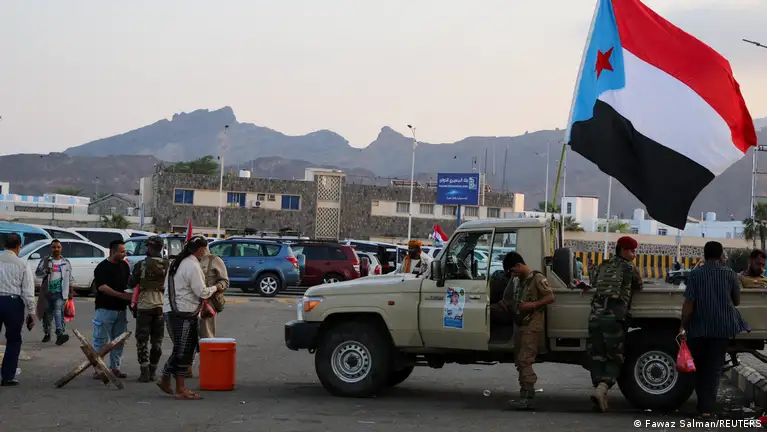
The situation in Yemen has taken a volatile turn in early 2026, as the fragile alliance within the anti-Houthi coalition experiences its most significant fracture in years. On Sunday, January 4, 2026, Yemen’s Saudi-backed government formally accused the Southern Transitional Council (STC)—a separatist movement supported by the United Arab Emirates (UAE)—of blockading the vital port city of Aden. This development follows a weekend of intense military maneuvering and shifting territorial control in the country’s eastern provinces.
The Yemeni presidency warned that it would “take all necessary measures” to restore order after government forces successfully recaptured strategic territory in the east. Specifically, Saudi-backed “National Shield” forces retook the city of Mukalla in the Hadramaut province on Saturday, reversing gains made by the STC during a surprise offensive in December 2025. While the STC has denied restricting movement into Aden, the government’s accusations underscore a deepening hostility that threatens to ignite a “war within a war.”
The Power Struggle for Southern Yemen
The current crisis was sparked by the STC’s sudden bid for independence, which included the announcement of a new “southern constitution” and plans for a referendum on self-determination. This move represents a direct challenge to the Presidential Leadership Council (PLC), the internationally recognized government led by Rashad al-Alimi. For years, the STC and the government were uneasy partners against the Iran-backed Houthi rebels, but those ties have reached a breaking point.
Reports from the ground indicate that STC fighters have established numerous checkpoints around the perimeter of Aden, effectively isolating the city that has served as the government’s temporary capital since the Houthis seized Sanaa in 2014. Government officials claim the separatists are conducting a campaign of arrests against political opponents, though the STC maintains the city is stable and the accusations are a “distortion of facts.”
The military escalation has been deadly. Since Friday, at least 80 STC fighters have reportedly been killed in clashes and Saudi-led airstrikes. The Saudi-led coalition, which traditionally focused its air power on Houthi targets, has shifted its sights toward STC military camps in Hadramaut to assist government ground forces.
The Geopolitical Rift: Saudi Arabia vs. UAE
Beyond the local factions, the situation in Yemen is a reflection of a growing geopolitical divide between Saudi Arabia and the UAE. While both nations intervened in 2015 to restore the Yemeni government, their long-term visions for the country have diverged. Riyadh seeks a unified Yemen to stabilize its southern border, while Abu Dhabi has historically supported southern groups that seek autonomy, partly to secure strategic maritime interests in the Gulf of Aden.
The recent Saudi airstrikes on UAE-backed forces mark a rare and dangerous direct confrontation between the two Gulf allies. Analysts suggest that the UAE’s recent announcement of a full troop withdrawal may have been a tactical move to distance itself from the immediate fallout, yet its influence remains potent through its local proxies.
A Dire Humanitarian Landscape
As political and military leaders vie for control, the Yemeni people continue to endure what the United Nations describes as one of the world’s most severe humanitarian crises. The Yemen Crisis Response Plan 2026 estimates that 23.1 million people—nearly 65% of the population—require urgent assistance.
The recent fighting in the south has disrupted aid corridors and closed critical infrastructure. Aden International Airport was forced to halt operations following disputes over flight paths between the city and the UAE. In a country where over 18 million people face acute food insecurity, any disruption to port or air traffic is potentially catastrophic.
Furthermore, the “National Shield” forces’ advance into oil-rich regions like Hadramaut and Al-Mahra adds an economic layer to the conflict. Control over Yemen’s limited natural resources is essential for any faction hoping to sustain a governing body, making these eastern provinces the ultimate prize in the current struggle.
The Path to Dialogue in Riyadh
Despite the escalating violence, a small window for diplomacy remains open. Saudi Arabia has extended an invitation to all southern factions, including the STC, to attend a “comprehensive dialogue” in Riyadh. The Saudi Foreign Ministry framed the “southern cause” as an issue with historical dimensions that must be solved within the framework of a broader Yemeni peace process.
The STC has expressed a cautious welcome to the talks, though its leaders insist that any negotiation must acknowledge their mandate for southern independence. Meanwhile, the Houthi rebels in the north remain entrenched, watching from the sidelines as their primary opponents fight amongst themselves. The international community, including the U.S. and regional neighbors like Pakistan and Qatar, have urged all parties to engage in good faith to prevent a total collapse into chaos.