



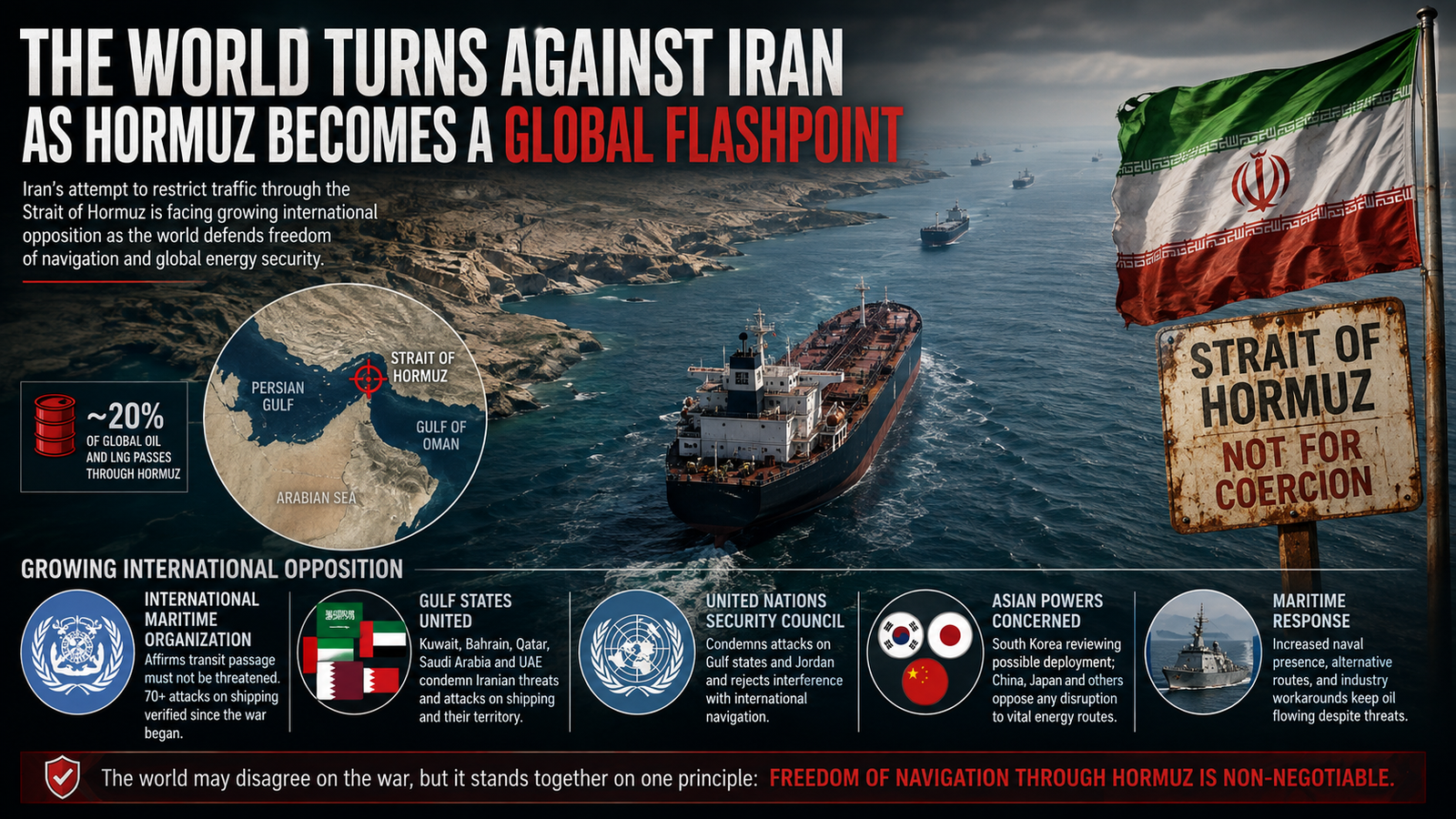
- Strait of Hormuz: Iran’s Hormuz strategy is facing growing international opposition as Gulf states and major energy-importing nations demand freedom of navigation.
- The Strait remains strategically vital, carrying a major share of global oil and LNG supplies despite efforts to develop alternative routes.
- Tehran retains significant asymmetric capabilities, but prolonged disruption risks strengthening international cooperation against Iran.
The Strait of Hormuz has become more than a battlefield in the U.S.-Iran confrontation: it is a test of whether any state can use a global maritime chokepoint as a political weapon. Six months into the conflict, evidence increasingly suggests that Tehran’s attempt to restrict navigation has damaged Iran’s diplomatic position.
The strongest opposition has come from the international maritime community. The International Maritime Organization has repeatedly reaffirmed that transit passage through straits used for international navigation must not be threatened, impeded, denied or suspended. In August, IMO Secretary-General Arsenio Dominguez warned that as many as 400 ships carrying about 6,000 seafarers remained unable to leave the Gulf safely. The organization has verified at least 70 attacks on international shipping since the conflict began, with 19 seafarers killed.
Hormuz is not simply an Iranian-Gulf waterway. The narrow passage connects the Persian Gulf with the Gulf of Oman and Arabian Sea, carrying a major share of energy trade. Before the war, roughly one-fifth of global oil and LNG supplies moved through it. Any prolonged obstruction therefore affects Asian importers, European consumers, Gulf producers and the wider global economy.
READ NEXT: U.S. Firepower Shortage After Iran War Raises Fears Over China and Russia
Iran’s regional position has also suffered. Gulf Arab governments have increasingly framed unrestricted navigation as a collective security interest rather than a bilateral dispute with Tehran. Kuwait, Bahrain, Qatar, Saudi Arabia and the United Arab Emirates have condemned Iranian attacks or threats affecting their territory and shipping. The United Nations Security Council has likewise condemned attacks on Gulf states and Jordan and rejected attempts to interfere with international navigation through Hormuz.
Iran’s pressure campaign has encouraged international coordination Tehran would prefer to avoid. The United States has intensified maritime operations around the waterway, while commercial operators have developed workarounds. Oil has continued to move, although at sharply reduced levels. Reuters reported this week that only four commodity vessels crossed Hormuz on Thursday, compared with a 10-day average of 15, while observed oil exports during the war have generally remained between four and six million barrels a day.
READ MORE: Time Is No Longer on Iran’s Side in the Battle of the Blockades
Those numbers show both Iran’s leverage and its limits. Tehran can make shipping slower, costlier and more dangerous, but completely stopping the waterway is difficult. Tankers can move under naval protection, use alternative Gulf and Gulf of Oman facilities, conduct ship-to-ship transfers, or exploit periods when security conditions improve. Gulf producers have invested in pipelines and export terminals outside the strait, although these alternatives cannot replace Hormuz entirely.
The diplomatic signal from Asia matters. South Korea is reviewing possible military and non-combat contributions supporting freedom of navigation, although Seoul has stressed that no final deployment decision has been made. Reports have mentioned maritime patrol aircraft, a logistics support ship and mine-clearance capabilities. For an Asian energy importer, the debate shows how Hormuz disruption is becoming a national-interest issue.
China, Japan, South Korea and other Asian economies have commercial exposure to Gulf energy. Their governments therefore have strong incentives to oppose any precedent under which a coastal power can determine which ships may pass, on what terms and under whose supervision. Iran’s argument that it is defending sovereignty may resonate domestically, but internationally the issue is increasingly framed around freedom of navigation.
This does not mean Tehran has lost the strategic contest. Iran retains geography, missiles, drones, mines and the ability to threaten shipping at relatively low cost. Nor has the U.S. blockade forced Iran to surrender or produced an immediate political collapse. The conflict remains dangerous, and escalation could still push oil markets sharply higher. The Islamabad Telegraph: U.S.-Iran war takes an ugly turn
But the political balance is changing. Iran once possessed powerful asymmetric leverage because the world depended on Hormuz remaining open. Now that dependence is generating a coalition determined to prevent Tehran from controlling the chokepoint. The more Iran restricts navigation, the stronger the argument becomes for international patrols, alternative routes, sanctions and collective maritime security.
That is Tehran’s central dilemma. Hormuz can still impose economic pain, but using it aggressively risks turning Iran’s geographic advantage into an international liability for governments and markets alike today. The world may not be united behind Washington’s war, but it is increasingly united behind one principle: the Strait of Hormuz cannot become the property of any single power. For Iran, that may prove to be the most consequential strategic cost of the blockade.