



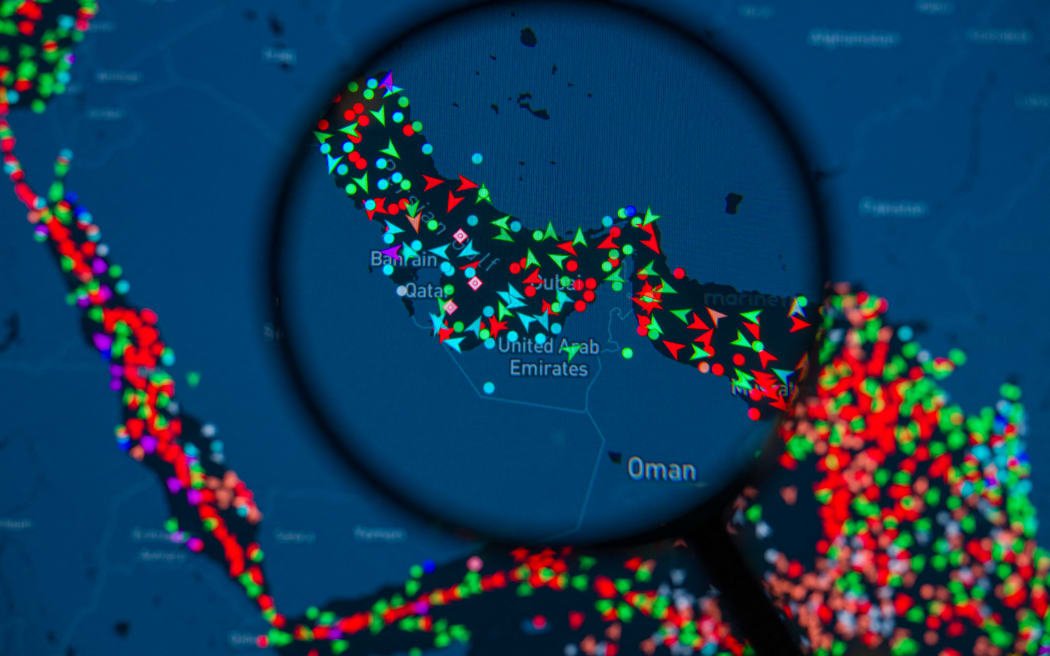
- Strait of Hormuz blockade disrupts nearly 20% of global oil supply
- Oil prices surge past $100 as markets react to escalating US-Iran tensions
- Millions risk falling into poverty due to energy, food, and inflation shocks
- Diplomatic breakdown after Islamabad talks raises fears of wider conflict
The collapse of high-stakes negotiations in Islamabad has pushed an already volatile Gulf crisis into dangerous new territory, as Donald Trump’s announcement of a sweeping maritime blockade against Iran threatens to choke one of the world’s most critical energy arteries. With the Strait of Hormuz effectively shut, the consequences are no longer confined to regional geopolitics—they are rapidly becoming a global economic emergency.
At first glance, Washington’s strategy appears designed to exert maximum pressure. By targeting all maritime traffic linked to Iranian ports and penalizing vessels that pay Tehran transit tolls, the United States is attempting to cripple Iran’s economic lifelines while forcing it back to the negotiating table. Yet this approach carries profound risks. The Strait of Hormuz handles roughly 20 percent of global oil shipments; any sustained disruption transforms a bilateral confrontation into a worldwide shock.
Markets have already delivered their verdict. Oil prices surged past $100 per barrel within hours of the announcement, and shipping traffic through the strait has thinned dramatically. Tankers are rerouting or halting altogether, insurance premiums are spiking, and global supply chains—still fragile from previous crises—face renewed strain. For energy-importing economies across Asia, Africa, and parts of Europe, this is not merely a price fluctuation; it is the beginning of an inflationary spiral that could destabilize entire economies.
The deeper concern lies in the second-order effects. Energy shocks cascade into food prices, transportation costs, and industrial production. The United Nations has already warned that tens of millions could be pushed into poverty under a “triple shock” scenario—rising energy costs, food insecurity, and slowing growth. If the blockade persists for weeks, those projections may prove conservative. Developing nations, many already burdened by debt and currency volatility, are particularly vulnerable.
Strategically, the blockade raises difficult questions about sustainability and escalation. Enforcing such a sweeping maritime restriction requires not only naval dominance but also sustained international cooperation—something Washington does not fully command in this crisis. As former officials have noted, unilateral enforcement risks overextension. More critically, it invites retaliation.
Middle East crisis live: US blockade of Iran’s ports to begin later today as Trump says he doesn’t care about further talks
Tehran has signaled exactly that. The Islamic Revolutionary Guard Corps has warned that any military presence near the strait could be treated as a violation of the ceasefire. In such a tightly constrained waterway, the margin for miscalculation is dangerously thin. A single incident—whether a misidentified vessel or an exchange of fire—could trigger a broader ռազմական confrontation that neither side may be able to control.
US-Iran Talks: Inconclusive Historic Negotiations Reduce Mistrust, Key Issues Still Unresolved as Both Sides Continue Dialogue
Diplomatically, the situation reflects a breakdown not just in talks, but in trust. Iranian officials have accused Washington of “maximalism” and shifting demands, particularly over uranium enrichment and regional alliances. From Tehran’s perspective, the blockade reinforces a narrative of coercion rather than compromise. From Washington’s standpoint, Iran’s refusal to concede on nuclear and regional policies justifies escalation. The result is a classic impasse: both sides believe time and pressure favor their position, even as the global cost mounts.
What makes this moment particularly consequential is the contradiction at its core. The Islamabad talks—despite ending without agreement—were historic in themselves. They marked the first direct engagement between the two adversaries at such a high level in decades. That fragile diplomatic opening has now been overshadowed by military posturing, raising doubts about whether dialogue can resume under current conditions.
For the international community, the stakes extend far beyond the Gulf. A prolonged closure of the Strait of Hormuz would not only disrupt energy markets but also accelerate geopolitical fragmentation. Countries may be forced to choose sides, secure alternative supply routes, or increase military presence in contested waters. The risk of a localized conflict expanding into a wider regional—or even global—crisis becomes increasingly real.
Ultimately, the blockade is a high-risk gamble. It may succeed in forcing Iran back to negotiations, but it could just as easily harden positions and deepen confrontation. What is clear is that the economic fallout is already underway, and its impact will be felt far beyond the Middle East. In a globalized world, the closure of a narrow strait has the power to widen inequality, strain governments, and push millions closer to the edge of poverty.
The question now is not whether the world can afford this standoff—but how long it can endure it.