



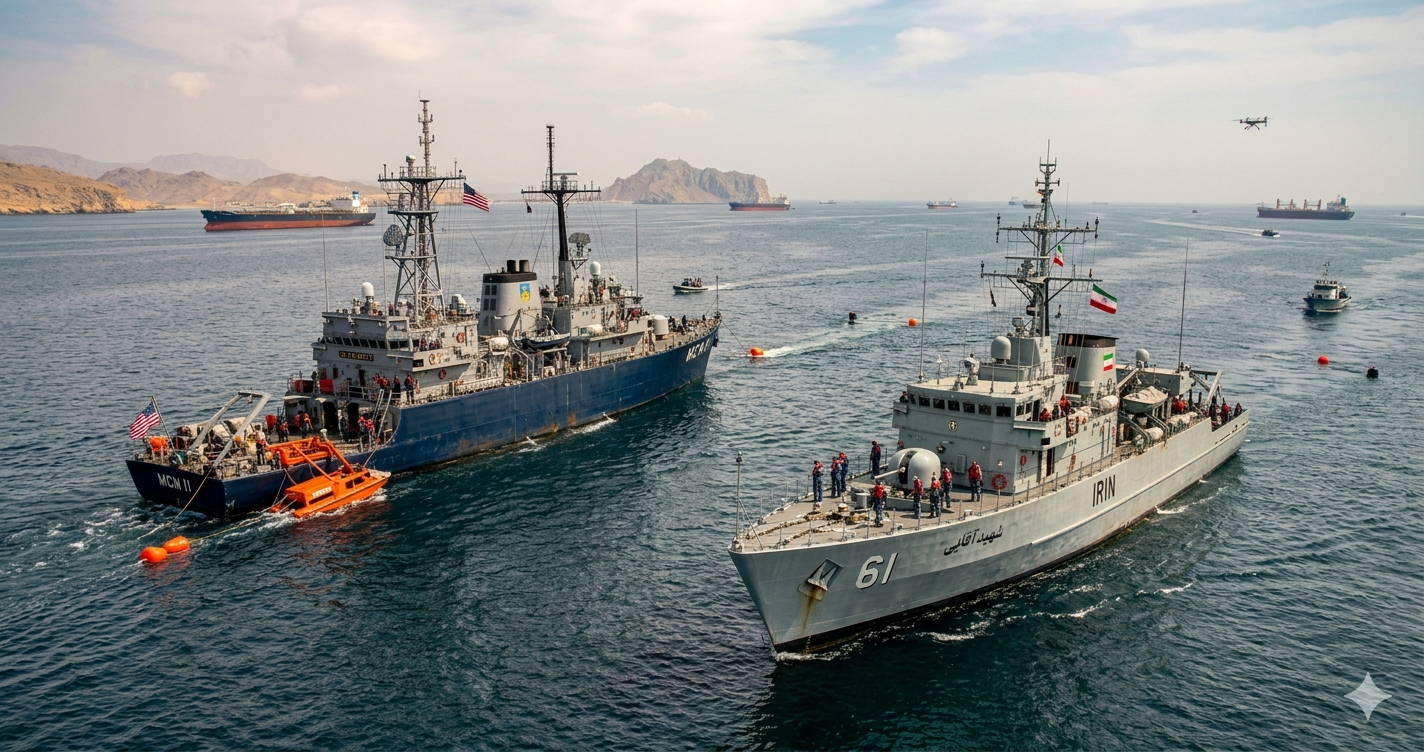
- Strait of Hormuz mine clearing cooperation marks a historic moment between Iran and the U.S.
- Pakistani leadership plays a quiet but crucial role in facilitating backchannel diplomacy
- Global oil prices drop sharply amid optimism over reopening of vital shipping route
- Uncertainty persists as Iran and the U.S. issue conflicting statements before Islamabad talks
A rare and extraordinary maritime scene unfolded in the early hours of Saturday in one of the world’s most volatile waterways, as vessels from Iran and the United States were seen working side by side to remove naval mines and clear safe passage through the Strait of Hormuz—an image that seasoned tanker crews described as “almost unimaginable.”
The joint operation, witnessed by multiple commercial shipping crews navigating the chokepoint, comes just days before the second round of high-stakes U.S.-Iran talks scheduled to take place in Islamabad, underscoring what diplomats say is a fragile but notable thaw between two longtime adversaries.
“It was surreal,” said a senior officer aboard a Singapore-flagged tanker who spoke on condition of anonymity due to company policy. “You had Iranian boats and U.S. naval units coordinating movements, sweeping for mines. For decades, they’ve been on opposite sides of every conflict. Seeing them cooperate like that—it caught everyone off guard.”
Pakistan’s Quiet Diplomacy Delivers a Strategic Breakthrough
The Strait of Hormuz, through which roughly one-fifth of the world’s oil and gas supplies transit, has been at the center of escalating tensions following recent military confrontations involving Iran, the United States, and regional actors. Iran’s earlier decision to restrict access to the waterway had sent global energy markets into turmoil, triggering price spikes and supply anxieties across Asia and Europe.
According to two people familiar with the development, the coordinated mine-clearing effort was made possible through intense backchannel diplomacy led by Pakistan, whose military and political leadership have been working “around the clock” to bring Tehran and Washington closer ahead of the Islamabad talks.
Trump says Iran has agreed to his demands. Iran says he’s lying.
“Pakistan played a pivotal quiet role in making this happen,” said one regional security official with direct knowledge of the negotiations. “This was not a spontaneous cooperation—it was carefully negotiated to build confidence before the next round of talks.”
A day earlier, U.S. President Donald Trump had declared that Iran had agreed to “virtually all” of Washington’s demands to end its nuclear program permanently, adding that final negotiations “should go very quickly.” In a series of social media posts and media appearances, Trump said the United States would work with Iran “at a leisurely pace” to recover buried highly enriched uranium and transport it out of the country, without deploying ground troops.
He also claimed that Iran had agreed never to close the Strait of Hormuz again and confirmed that joint efforts to remove sea mines were already underway.
When The Strait Becomes a Weapon
However, Iranian officials swiftly pushed back, rejecting Trump’s characterization of the negotiations. Chief Iranian negotiator Mohammad Ghalibaf dismissed the claims as “false,” accusing Washington of engaging in “media warfare.”
“The President of the United States made seven claims in one hour, all seven of which were false,” Ghalibaf wrote on social media late Friday. “They did not win the war with these lies, and they will certainly not get anywhere in negotiations either.”
Iran’s Foreign Ministry echoed that sentiment, insisting that “there is no new agreement,” while Foreign Minister Abbas Araghchi clarified that any reopening of the strait would be temporary and conditional, tied to a fragile two-week ceasefire set to expire in the coming days.
Despite the conflicting narratives, markets reacted swiftly to Trump’s announcement. Brent crude prices fell more than 10 percent, dropping below $89 per barrel in futures trading, reflecting cautious optimism about the restoration of energy flows.
Yet uncertainty remains high. Maritime tracking organizations reported no immediate surge in vessel traffic through the strait following the announcement.
“The strait normally handles more than 100 vessel crossings per day,” said Brett Erickson, managing principal at Obsidian Risk Advisors. “A single designated corridor with Iranian authorization requirements cannot replicate that volume.”
“Reopening the strait on paper and vessels actually transiting it are two very different things,” he added. “Captains and shipping companies make decisions based on crew safety, not diplomatic announcements.”
Complicating matters further, the U.S. naval blockade of Iranian ports remains in place. Trump indicated that the blockade would only be lifted once a formal agreement is signed. Defense officials confirmed that at least 19 ships have been turned back since the blockade began earlier this week.
Meanwhile, the broader geopolitical picture continues to shift. The Trump administration quietly extended a sanctions waiver allowing the sale of Russian oil already at sea, a move analysts say could benefit Moscow financially while stabilizing global energy markets.
European allies, caught off guard by Trump’s announcements, welcomed the reopening of the strait but called for a durable and verifiable framework to ensure long-term freedom of navigation. A Western diplomat familiar with the discussions described the timing of Trump’s declaration as “embarrassing,” noting that it came during an ongoing allied meeting on the crisis.
As preparations intensify for the Islamabad talks—where senior U.S. officials are expected to meet their Iranian counterparts—the sight of American and Iranian vessels working together in the Strait of Hormuz offers a rare, if tentative, symbol of de-escalation.
Whether it marks the beginning of a lasting breakthrough or merely a brief pause in a long-standing rivalry may depend on what unfolds in Pakistan’s capital in the coming days.