



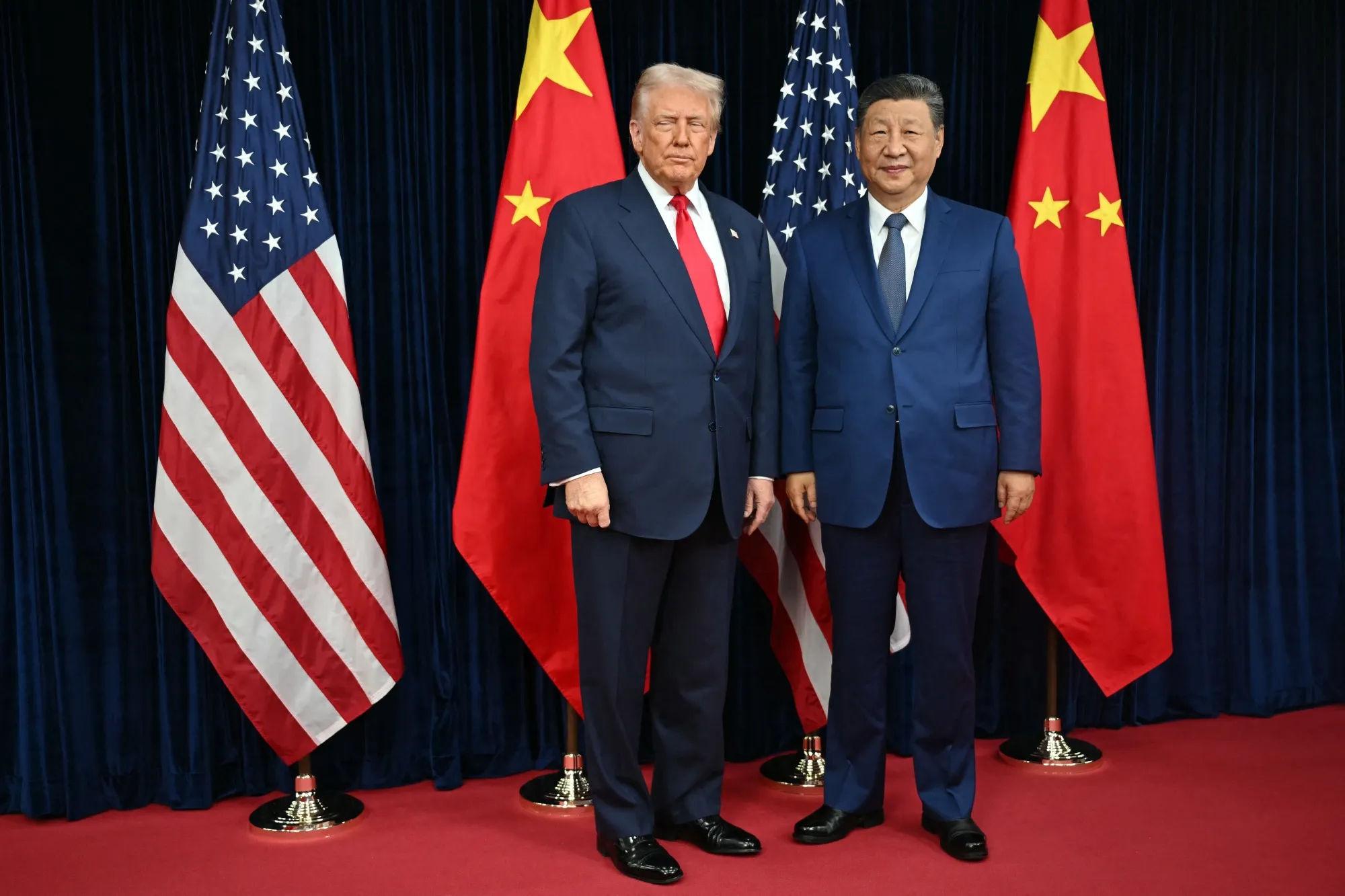
Trump And Xi Meeting Slashed Tariffs: U.S. cuts fentanyl-related tariffs on Chinese goods from 20% to 10%, and overall tariffs from 55% to 45%.
China’s Response: Beijing pledges to buy $50 billion in U.S. soybeans and farm products and to ease restrictions on rare-earth exports.
Market Rally: Wall Street surges 2.1%, Shanghai up 3.4%, Tokyo up 2.8%, and Paris and London rise more than 1.5%.
Global Impact: OECD projects the trade thaw could add $700 billion to global GDP over five years.
BUSAN, South Korea — In a stunning diplomatic breakthrough that could reshape the global economy, U.S. President Donald Trump and Chinese President Xi Jinping have agreed to a broad framework to normalize trade and political tensions between the world’s two largest economies.
After two days of high-stakes talks in Busan, South Korea, both leaders announced a dramatic shift toward cooperation. The U.S. will slash tariffs on Chinese goods by half, while China has pledged large-scale purchases of American agricultural products and stronger enforcement against the export of fentanyl precursors.
“This is an amazing day for global peace and economic stability,” President Trump told reporters aboard Air Force One. “We’re cutting tariffs, opening trade, and protecting American lives by stopping the flow of deadly fentanyl.”
Historic Tariff Cuts and China’s Response
Under the new agreement, the U.S. will lower the fentanyl-related tariff on Chinese goods from 20% to 10%, while the average tariff on all Chinese imports will fall from 55% to about 45%—the sharpest reduction since Trump’s initial trade war measures in 2018.
In return, Beijing has agreed to purchase “tremendous amounts” of American soybeans and farm products, which are expected to exceed $50 billion in the next fiscal year. China will also ease restrictions on rare-earth mineral exports, a crucial step that could stabilize supply chains for the tech and defense industries worldwide.
READ MORE: Game-Changing Takeaways from the Xi–Trump Meeting in South Korea: The ‘Deal of the Century’ That Could Reshape Global Trade
Chinese state media described the deal as “a step toward a balanced relationship” and said that China’s Ministry of Commerce will roll out phased tariff reductions on select U.S. goods within weeks. These could include machinery, semiconductors, and certain agricultural products.
President Xi’s top trade adviser, Liu He, said Beijing “welcomes the U.S. gesture and is committed to reciprocal measures that strengthen bilateral trust.”
Global Markets React with Enthusiasm
The global financial markets erupted in optimism after the news broke early Thursday.
-
Wall Street’s Dow Jones Industrial Average surged 2.1%, its best single-day gain in two months.
-
The Shanghai Composite Index rose 3.4%, signaling strong investor confidence in China’s export sector.
-
Tokyo’s Nikkei jumped 2.8%, while Paris’s CAC 40 and London’s FTSE 100 both closed more than 1.5% higher.
-
In currency markets, the Chinese yuan strengthened to 7.05 per dollar, its highest level since mid-2024, while the U.S. dollar index slipped slightly, reflecting a return of global risk appetite.
“This is the biggest sigh of relief global investors have taken in years,” said Marcela Hoyt, chief strategist at Global Markets Research. “The world has been suffocating under trade tensions, and today we finally see light at the end of the tunnel.”
ALSO READ: Trump Meets With Xi, Declares Immediate Cut to Fentanyl Tariffs
Background: From Trade War to Trade Peace
The U.S.-China trade war, launched in 2018 during Trump’s first term, disrupted global commerce for years. The U.S. had imposed tariffs of up to 60% on Chinese goods worth over $500 billion, accusing Beijing of unfair trade practices and intellectual property theft.
China retaliated with tariffs on American soybeans, cars, and technology products, triggering a trade freeze that cost both economies billions. Supply chains were fractured, and multinational corporations scrambled to relocate manufacturing bases.
Although the Biden administration later eased some restrictions, tensions reignited when Trump returned to power in 2025 with a vow to “renegotiate America’s future.” His new approach, however, has surprised many observers for its pragmatism and balance.
What’s Next: A New Chapter in U.S.-China Relations
Trump confirmed that he would travel to China in April 2026 to formalize the agreement, followed by a reciprocal visit from President Xi later next year. The upcoming meetings are expected to address technology transfer rules, cybersecurity, and digital trade, areas left unresolved in Busan.
Interestingly, the sensitive issue of Taiwan was not discussed during the summit—an omission that analysts say was deliberate to keep the talks focused on economic cooperation.
“This marks a reset moment,” said Dr. Henry Lee, a former U.S. trade negotiator. “Both sides seem ready to compete economically, not politically.”
The White House described the framework as “a roadmap for strategic economic stability,” while Beijing called it “a sign of maturity between two great powers.”
A Boost for the World Economy
The normalization of trade between the U.S. and China is expected to add nearly $700 billion to global GDP over the next five years, according to preliminary estimates by the OECD. Emerging markets, especially those dependent on manufacturing and exports, are forecast to benefit from increased trade flows and reduced shipping costs.
For millions of consumers worldwide, this could mean lower prices on electronics, cars, and food products, ending a years-long period of inflation driven by tariffs and supply shortages.
In the words of President Trump:
“We’re not just making a deal for America and China—we’re making a deal for the world.”