



- conomic Pivot: The Trump Central Asia Strategy focuses on critical minerals, securing tungsten and uranium deals to diversify America’s high-tech supply chains.
- Diplomatic Maneuver: Trump’s outreach under the Trump Central Asia Strategy challenges decades of Chinese and Russian influence through new investment and trade agreements.
- Strategic Balancing: Central Asian states use the Trump Central Asia Strategy to practice multi-vector diplomacy—leveraging Washington without abandoning Moscow or Beijing.
- Long-Term Gamble: The success of the Trump Central Asia Strategy depends on sustained U.S. investment, security engagement, and credible follow-through beyond photo-ops.
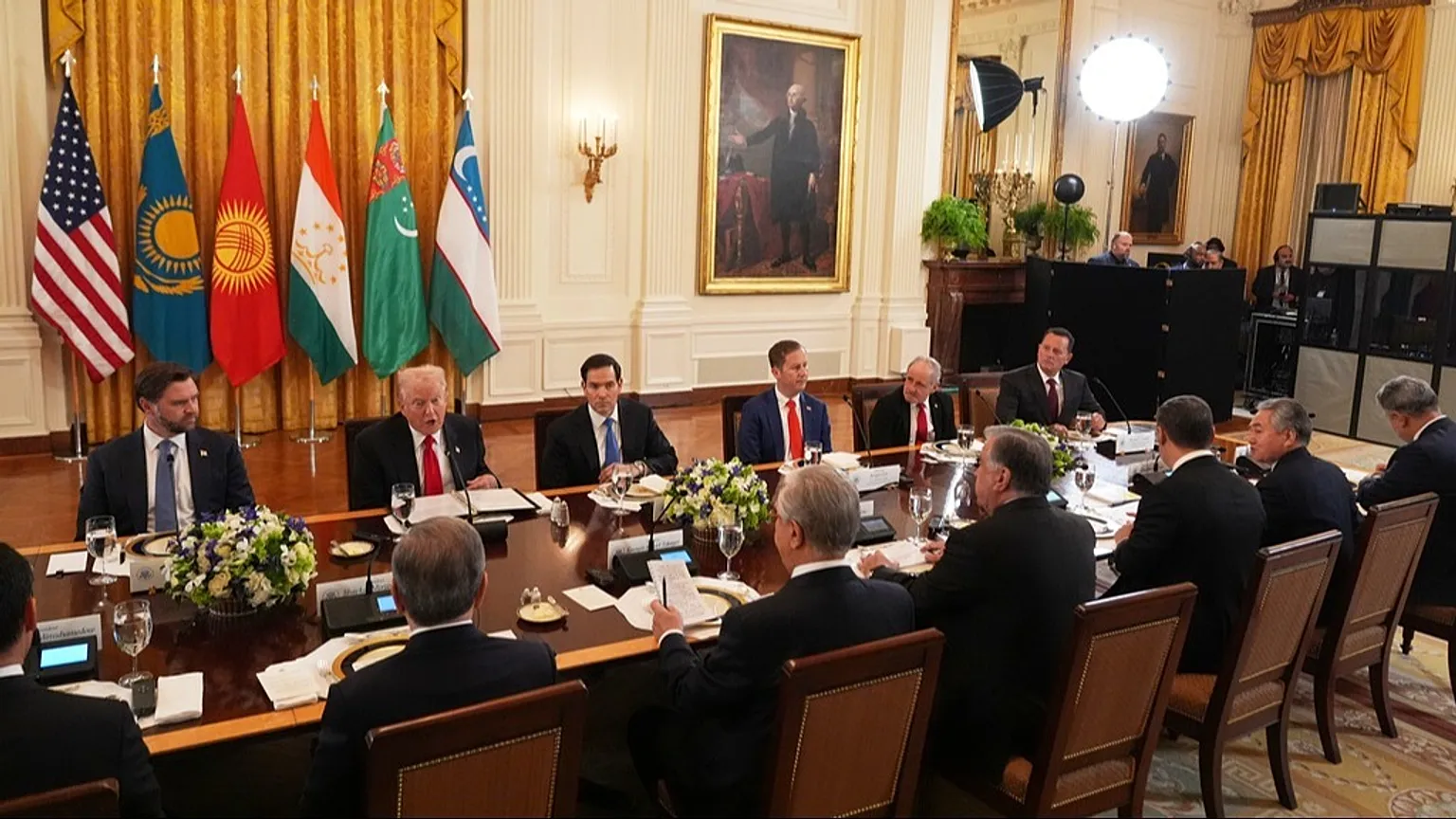
Donald Trump’s White House dinner with the presidents of Kazakhstan, Uzbekistan, Kyrgyzstan, Tajikistan, and Turkmenistan was far more than ceremonial. The November 6 meeting was the public debut of what is fast being described as the Trump Central Asia Strategy — a calculated move to pry open a region long dominated by China and Russia and redirect its mineral wealth toward American supply chains.
Trump’s objective is not subtle: diversify America’s access to rare earths and critical minerals essential for semiconductors, electric vehicles, and fighter jets. For decades, these supply lines have been controlled by Beijing, and the Trump Central Asia Strategy aims to break that monopoly. Hosting the five Central Asian presidents in the White House was symbolic power play, but also a strategic bid to redraw the resource map of Eurasia.
Birlik 2025: Central Asia’s First Step Toward Its Own NATO?
For Washington, Central Asia represents the last great untapped frontier — rich in tungsten, uranium, and lithium, and sitting between two uneasy powers: China and Russia. “Sadly, previous American presidents neglected this region completely,” Trump declared, framing himself as the first U.S. leader to understand its value. The Trump Central Asia Strategy seeks to change that neglect into opportunity — economic, diplomatic, and military.
The tangible results came swiftly. Kazakhstan’s President Kassym-Jomart Tokayev signed a deal with U.S.-based Cove Kaz Capital to develop one of the world’s largest tungsten deposits. Valued at $1.1 billion and backed by the U.S. Export-Import Bank, the project exemplifies the Trump Central Asia Strategy:
Trump and leaders of Central Asian countries meet in Washington in strategic partnership boost
American financing, U.S. technology, and Central Asian minerals — a triangle designed to circumvent Chinese processing power. Uzbekistan’s Shavkat Mirziyoyev pledged an even larger commitment: up to $100 billion in U.S. investments over the next decade. Trump called it “an incredible deal,” the centerpiece of his Trump Central Asia Strategy.
But beneath the optimistic photo-ops lies a more complicated reality. Central Asian leaders have mastered the art of “multi-vector diplomacy” — balancing ties between Washington, Beijing, and Moscow without committing to any. While Trump’s deals give them capital and visibility, they won’t sever decades of Russian military cooperation or Chinese infrastructure dependence overnight. The Trump Central Asia Strategy may succeed in creating short-term economic footholds, but shifting long-term loyalties will demand far more than investment announcements.
China, which poured billions into Belt and Road corridors through Kazakhstan and Uzbekistan, remains the dominant infrastructure partner. Russia, meanwhile, continues to shape the region’s security architecture through the Collective Security Treaty Organization and deep cultural ties. Against that backdrop, Trump’s message — that the U.S. can offer both prosperity and independence — is enticing but untested. The Trump Central Asia Strategy walks a fine line between partnership and provocation.
Trump’s diplomatic flair was evident in Kazakhstan’s decision to join the 2020 Abraham Accords — a move clearly inspired by U.S. persuasion. Symbolically, it aligns the Central Asian republic with Trump’s broader Middle East peace architecture. Practically, it signals an openness to new alliances that could dilute Russian or Chinese dominance. Still, as part of the Trump Central Asia Strategy, such symbolic wins must be followed by hard economic and security commitments to sustain momentum.
The success of the Trump Central Asia Strategy will depend on consistency — something previous U.S. administrations failed to deliver. Central Asia has seen waves of Western attention rise and fall: post-9/11 military basing, energy diplomacy in the early 2000s, and now the minerals rush of the 2020s. What differentiates Trump’s approach is its transactional clarity — deals first, diplomacy later — but that clarity also exposes its vulnerability. Without a sustained framework, these nations may pocket American capital while staying loyal to Moscow and Beijing.
If Washington wants to turn the Trump Central Asia Strategy into more than a media moment, it must commit to patient engagement — building refining capacity, legal stability, and genuine strategic partnerships. The region’s leaders have welcomed the attention; now they will test whether the U.S. can back its words with endurance.
For Trump, this initiative is a chance to reshape U.S. influence where it has long been absent. For Central Asia, it’s a rare opportunity to balance great powers on their own terms. The coming years will decide whether the Trump Central Asia Strategy becomes a cornerstone of a new geopolitical order — or just another flash in America’s restless foreign policy cycle.