



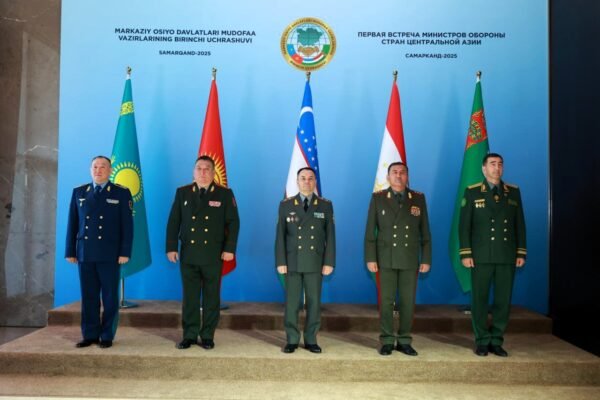
- The Samarkand defense ministers’ meeting was the first-ever purely Central Asian military summit since independence.
- Birlik 2025 exercises marked the region’s first coordinated field operation involving multiple national militaries.
- The move reflects regional unease over Russia’s declining influence, China’s growing presence, and the U.S.’s limited reliability.
- Central Asia’s leaders are cautiously exploring the idea of a regional defense framework that prioritizes self-reliance and unity over dependence.
When the defense ministers of Kazakhstan, Kyrgyzstan, Tajikistan, Turkmenistan, and Uzbekistan gathered in Samarkand on October 20, 2025, it marked not just a ceremonial milestone but a geopolitical tremor in the heart of Eurasia. For the first time in their 34 years of post-Soviet independence, all five Central Asian states sat together—without Russia, China, or the United States looking over their shoulders—to discuss defense cooperation, mutual training, and regional security under their own banner.
The meeting, chaired by Uzbekistan’s Defense Minister Lt. Gen. Shukhrat Kholmuhamedov, was followed the next day by a large-scale regional military exercise called Birlik 2025—meaning “unity” in Turkic languages. Fighter jets from Uzbekistan and Kazakhstan soared above desert landscapes, while ground troops conducted coordinated operations in simulated urban environments. The symbolism was unmistakable: Central Asia was practicing how to stand on its own feet.
Why Now?
The question that echoes from Samarkand to Washington is: why now?
The trigger lies in a convergence of anxieties. The war in Ukraine has shaken the post-Soviet security order to its core. Russia, long seen as the ultimate guarantor of regional stability through the Collective Security Treaty Organization (CSTO), is now distracted, militarily stretched, and economically weakened.
Trump’s Bold Gaza Gambit: A Risky Bet or the First Step Toward Lasting Peace?
At the same time, Afghanistan’s instability has crept northward again, with the Islamic State–Khorasan Province (IS-K) stepping up operations near the Tajik and Uzbek borders. Meanwhile, China’s expanding security footprint through the Shanghai Cooperation Organization (SCO) and its Belt and Road corridors has made regional leaders uneasy about becoming too dependent on Beijing’s military and intelligence structures.
The result is a newfound pragmatism. As Uzbek President Shavkat Mirziyoyev’s message—read aloud during the Samarkand meeting—put it, “cooperation between the defense ministries is more important than ever.” In diplomatic code, that means: we can no longer outsource our security.
A Prototype for a “Central Asian NATO”?
No one in Samarkand openly called it that, but the undertones were clear. A NATO-style alliance may still be far-fetched, yet the Birlik meeting marks the first tangible step toward what might eventually resemble a Central Asian Defense Cooperation Council. The ministers discussed joint training, exchange of tactical expertise, and coordination on defense education. They even spoke of establishing a permanent working group—a bureaucratic seed that, in geopolitical terms, could one day sprout into an alliance.
READ MORE: The Trump Doctrine of “Peace Through Pressure”: Tomahawks, Back Channels, and the Ukrainian Pivot
The exercises that followed—Birlik 2025—added muscle to the message. For the first time, troops from four Central Asian countries trained side by side on Uzbek soil. Turkmenistan, maintaining its “permanent neutrality,” sat out—but Azerbaijan stepped in as an observer and participant, underscoring how the Turkic world’s military bonds are quietly expanding under Ankara’s watchful eye.
Although Uzbekistan avoided any direct reference to Turkey, it is no secret that Ankara’s defense industry has already supplied Bayraktar drones to Kyrgyzstan and Turkmenistan, and its military academies have become training hubs for young Central Asian officers. The symbolism of Birlik, a Turkic term, is thus not accidental—it reflects both cultural solidarity and strategic coordination inspired, in part, by the Turkish model of defense cooperation among equals.
The U.S., China, and Russia: Competing Shadows
Every move in Central Asia is watched by three global giants.
Russia, despite its weakening hand, still retains deep roots. Kazakhstan’s officer corps remains heavily trained in Russian academies. Tajikistan hosts Russia’s 201st Motor Rifle Division—its largest military base abroad. Kyrgyzstan still depends on Moscow for equipment and intelligence sharing. Yet even in these strongholds, quiet disillusionment is growing. Moscow’s inability to prevent instability in the Caucasus or to fulfill arms contracts delayed by the Ukraine war has pushed the region’s militaries to diversify.
ALSO READ: Five Countries Complete Large-Scale ‘Birlik-2025’ Military Exercises in Uzbekistan
China, meanwhile, plays the long game. Through the SCO and the Belt and Road Initiative (BRI), Beijing has built roads, pipelines, and data networks that double as strategic arteries. In Tajikistan’s Gorno-Badakhshan region, Chinese security personnel have reportedly operated joint outposts under counterterrorism cover. Beijing’s investments in border surveillance and digital monitoring systems have become the new levers of control. But for all its economic clout, China’s military presence remains limited—a deliberate choice to avoid provoking nationalist backlash or Moscow’s paranoia.
Then comes the United States, which after the 2021 Afghan withdrawal lost its regional military foothold but is now quietly rebuilding diplomatic and security ties. Washington’s C5+1 format—bringing together all five Central Asian foreign ministers—has evolved into a modest but consistent channel for dialogue. Its new security agenda, unveiled in 2024, emphasizes counterterrorism training, border control modernization, and cyber defense support. Still, the U.S. faces credibility issues: many Central Asians remember how abruptly America exited Afghanistan, leaving behind chaos and unanswered questions.
Security Flashpoints: The Region’s Growing Pains
Central Asia’s newfound military coordination comes amid a worsening regional security climate. The Islamic State affiliate in Afghanistan, IS-K, has carried out multiple cross-border attacks since 2022, including an assault on Tajik border posts and rocket strikes aimed at Uzbek territory. Kyrgyz-Tajik border clashes in 2021–2022 left hundreds dead, exposing the fragility of peace between the two mountainous neighbors. Water scarcity, drug trafficking, and energy disputes continue to fuel tension.
In this volatile landscape, regional militaries have realized that their historical reliance on Russia—or their fragmented national doctrines—is no longer sustainable. The Birlik 2025 drills therefore carried both symbolic and practical value: they tested how quickly Central Asian forces could coordinate reconnaissance, air support, and urban operations without external command structures.
What Lies Ahead In Central Asia?
For now, Birlik is a beginning, not a bloc. No mutual defense treaty, no unified command, no standing army—just the first glimmer of cooperation. But the psychological shift is enormous. For three decades, Central Asia’s defense outlook was externally anchored—first in Moscow, later partially in Beijing. Samarkand suggests that, for the first time, the region’s leaders are exploring what collective self-reliance might look like.
Future plans, according to Uzbek officials, include establishing a permanent Joint Coordination Group of defense ministries, increasing joint exercises, and possibly creating a Central Asian Peacekeeping Battalion under UN auspices—a concept reminiscent of NATO’s Partnership for Peace era in the 1990s.
The key challenge will be trust. Historical rivalries between Kyrgyzstan and Tajikistan, or Kazakhstan’s ambivalence toward Uzbek leadership, could quickly derail integration. Moreover, Turkmenistan’s self-declared neutrality remains a major structural obstacle. Yet the momentum from Birlik 2025—and the shared realization that no outside power will permanently guarantee their security—has created a rare window for regional unity.
Samarkand’s Signal to the World
The Samarkand meeting may not herald a Central Asian NATO, but it unmistakably signals the end of the region’s strategic adolescence. For years, the five republics preferred to align with whoever offered money, weapons, or infrastructure. Now, they are beginning to align—with each other.
In a region long viewed as the “backyard” of empires, that’s a quiet revolution.