



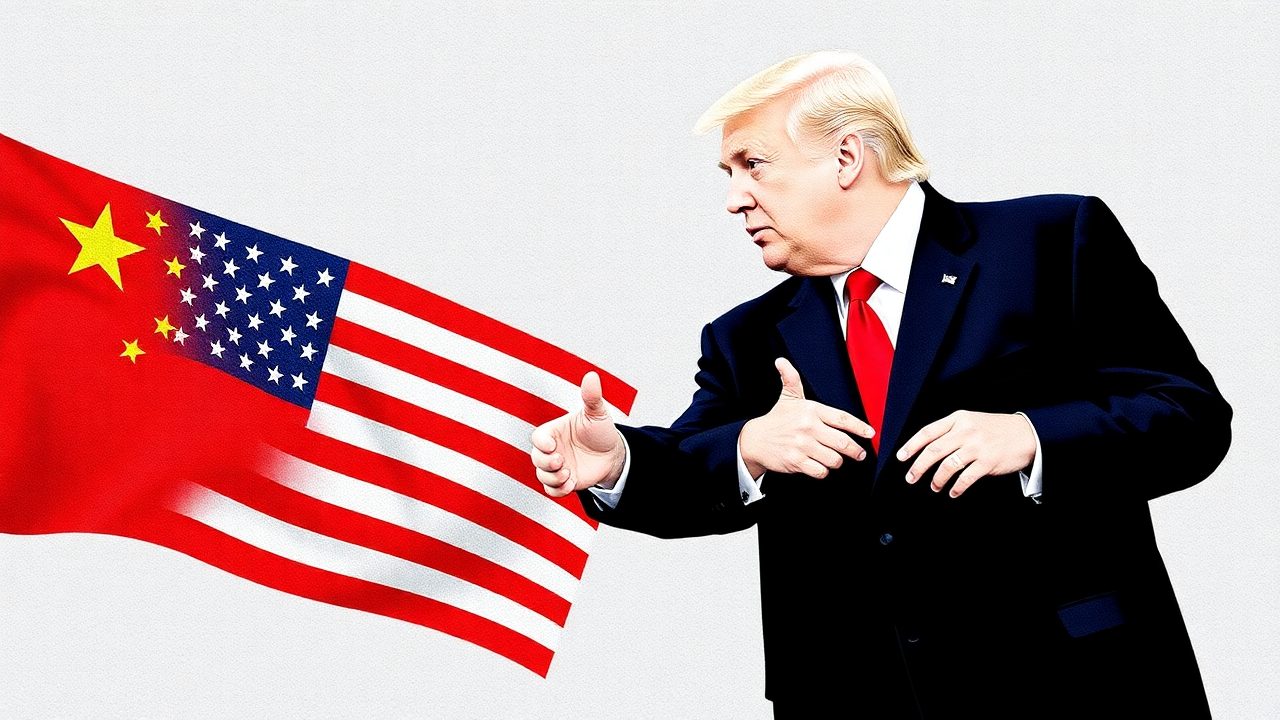
- The $550 billion tariffs imposed by Trump reshaped global trade dynamics.
- Military tensions surged with China’s assertive South China Sea policies and Taiwan’s support.
- Key initiatives like the Belt and Road Initiative challenged US-led global influence.
- US-China competition in technology, including AI and semiconductors, defined a new rivalry frontier.
The relationship between the United States and China dates back to 1784, when Western states first began conducting trade through China’s Guangzhou port. After the end of the Second Chinese Civil War in 1949, the People’s Republic of China (PRC) emerged under Mao Zedong’s leadership. Initially, relations between the two countries were marked by hostility.
The United States recognized the Kuomintang (KMT) government in Taiwan as the legitimate Chinese government, and China’s alignment with the communist bloc posed a significant challenge to the United States in a bipolar world. Further straining ties were China’s involvement in the Korean War (1950–53) and its nuclear tests in the 1960s. However, the Sino-Soviet split in the 1950s created an opportunity for the United States to exploit tensions between China and the USSR.
By the 1970s, improved relations, driven by U.S. financial aid and investment, contributed to China’s economic rise. Leveraging its massive labor force, China became a hub for cost-effective manufacturing, attracting American industries. After the Soviet Union’s disintegration in 1991, China sought to fill the power gap left by the USSR, while the United States exercised unparalleled influence in a unipolar world. China’s integration into the global economy was solidified when it joined the World Trade Organization (WTO) in 2001 with substantial U.S. support.
America’s Debt Crisis and Global Power Struggle: A Nation on the Brink of Change
According to John Mearsheimer’s offensive realism, “a hegemon should prevent rising powers from challenging its dominance.” During this period, China was the only state with the potential to rival U.S. hegemony, driven by rapid economic growth, technological advancement, military modernization, and initiatives like the Belt and Road Initiative (BRI) under Xi Jinping.
By 2009, China had surpassed the United States as the largest exporter in the WTO. Additionally, Chinese-led institutions like BRICS and the Shanghai Cooperation Organization (SCO) offered platforms to challenge the U.S.-led international order. While previous U.S. presidents pursued engagement or rational strategies, Donald Trump adopted a more confrontational approach toward China.
Trajectory of Great Power Politics
The United States and China, two dominant players in contemporary international relations, shape the geopolitical landscape, economic systems, and security paradigms of the 21st century. Since the end of World War II, the United States, as a liberal democratic superpower, has led global institutions through military dominance, technological innovation, and the promotion of liberal democracy, free markets, and human rights.
In contrast, China’s rapid economic ascent, strategic initiatives like the BRI, and military modernization pose significant challenges to U.S. unipolarity. While China seeks to reshape the global order, the United States aims to counter Beijing’s rise. Under Trump, U.S. foreign policy marked a significant departure from previous strategies of international engagement, favoring direct confrontation.
Have Trump’s tariff threats helped China boost its exports?
The ongoing power struggle between the United States and China is characterized by competition in diverse domains, including the Indo-Pacific, the Middle East, and North America. China’s militarization of the South China Sea, investment in North American states, and role as a mediator in the Saudi-Iran peace deal directly threaten U.S. influence. Economically, the U.S.-China trade war exemplifies their competition for global market dominance and supply chain control.
Technological advancements in artificial intelligence and quantum computing further underscore their rivalry. Foreign policy experts contend that both superpowers have distinct visions for global governance: the United States seeks an order serving its interests, while China advocates a system accommodating broader global interests, including its own.
Mustansar Klasra, a lecturer in International Relations at Mirpur University of Science and Technology, observes, “The United States views China as a strategic competitor, while China regards the U.S. as a strategic partner.” He also highlights China’s enduring challenge to U.S. economic interests, as evidenced by China’s $1 trillion trade surplus in 2024, driven by dominance in sectors such as automobiles, electronics, and solar technology.
Trump 1.0 and the Shift in U.S.-China Relations
During his 2016 presidential campaign, Trump spotlighted the $346 billion trade deficit with China. Upon assuming office, he faced a critical decision: engage in a costly military confrontation or adopt measures to curb China’s growth and technological dominance. Guided by the principle of rational state behavior, Trump opted for the latter.
Trump’s Return: What His Foreign Policy Means for China, Russia, and Global Trade
His administration imposed over $550 billion in tariffs on Chinese goods, targeting sectors like steel, aluminum, electronics, and textiles. Restrictions on Chinese tech giants, including Huawei’s inclusion on the “Entity List,” disrupted China’s access to U.S. semiconductor technology. Additionally, bans on apps like TikTok and WeChat were framed as privacy and security measures. These actions hindered China’s technological advancement and sent shockwaves through global supply chains.
Beyond economic measures, Trump waged a narrative battle, accusing China of “debt-trap diplomacy” through its BRI and blaming China for the COVID-19 pandemic, labeling it a “biological warfare strategy.” The Taiwan issue emerged as another flashpoint. While China views Taiwan as an integral part of its territory, Trump strengthened ties with Taipei, supporting Taiwan’s semiconductor industry as a strategic move to curb China’s technological ambitions.
His policies heightened military tensions in the Taiwan Strait and reinforced alliances like QUAD (comprising the U.S., Japan, India, and Australia) and AUKUS (Australia, the UK, and the U.S.) to counter China’s influence in the Indo-Pacific.
In summary, as Donald Trump prepares for a potential second term in 2025, his approach to China remains a critical topic for economists and foreign policy analysts. Trump advocates imposing 60% tariffs on China, despite claims from Chinese authorities that earlier tariffs had limited impact. China remains a formidable competitor on the global stage.
Trump’s return to the White House could redefine international relations through assertive policies and strategic economic engagement. His future strategies will determine whether U.S.-China relations take a cooperative or competitive trajectory.