



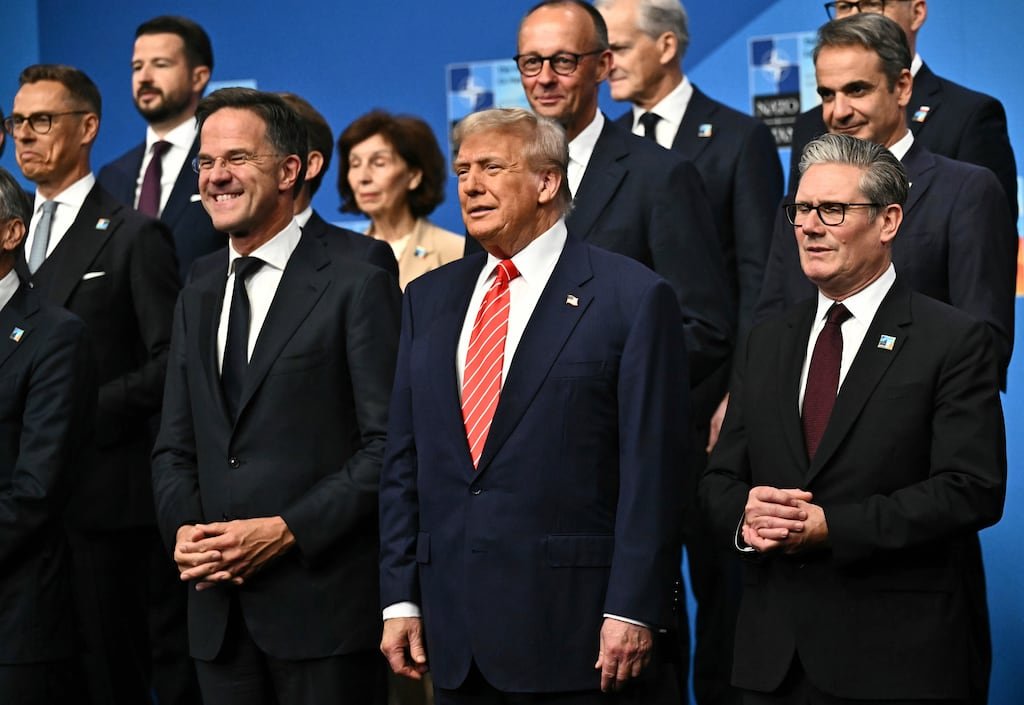
- Trump NATO Paper Tiger Moment warning exposes deep cracks in alliance unity and Europe’s defense posture
- Iran’s expanding missile range places major European capitals within potential strike distance
- NATO’s slow, fragmented response raises serious questions about deterrence credibility
- Europe’s reliance on U.S. security guarantees is increasingly challenged in a shifting war landscape
President Trump has never been shy about confronting NATO’s shortcomings, but his latest remarks—delivered in the aftermath of Iran’s attempted longrange missile strike toward Diego Garcia—carried a sharper edge than usual. He accused the alliance of “hiding behind statements while America carries the burden,” and, in a line that ricocheted across European capitals, declared NATO had become “a paper tiger—loud on paper, quiet in reality.”
The timing of the critique was no accident. Iran’s attempted strike toward the joint U.S.–U.K. base in the Indian Ocean was more than a symbolic gesture. It was a demonstration of reach. A demonstration of intent. And a demonstration that the war many European leaders hoped to observe from a safe distance has now expanded far beyond the Middle East.
Trump NATO Paper Tiger Moment: NATO Is Watching a War That Now Reaches Them
Trump’s frustration has been building for weeks, but the Diego Garcia incident gave him the strategic leverage to say what he has long implied: NATO is not acting like a military alliance facing a shared threat. He criticized European governments for “waiting for someone else to make the hard decisions,” and he singled out the U.K. for its hesitation in granting access to key bases early in the conflict.
His message was unmistakable: If Iran can reach Diego Garcia, it can reach Europe. And if Europe won’t defend itself now, when will it?
Europe in the Strike Zone: How Many NATO Countries Are Now Within Range?
The attempted strike—roughly 4,000 km from Iran—has forced analysts to reassess the true reach of Tehran’s missile program. For years, Iran publicly claimed to cap its missile range at around 2,000 km. But the Diego Garcia launch attempt, even though intercepted, suggests development of longerrange systems capable of reaching far beyond the Middle East.
If Iran can reliably fire missiles in the 3,500–4,000 km class, then most of NATO’s European members are now within potential strike distance, including:
- Greece
- Bulgaria
- Romania
- Hungary
- Poland
- Germany
- France
- Italy
- The Netherlands
- Belgium
- The United Kingdom
This is not a theoretical map drawn by think tanks. It is a demonstrated capability—one that shifts the strategic burden squarely onto Europe’s shoulders.
Keir Starmer’s Wavering: A Microcosm of Europe’s Strategic Drift
Prime Minister Keir Starmer’s indecision has become a case study in Europe’s broader ambivalence. His government initially hesitated to authorize expanded U.S. use of Britishcontrolled bases, then reversed course after the Diego Garcia strike attempt. Trump seized on this hesitation, calling it “exactly the kind of wobbling that got NATO into this mess.”
Starmer’s backandforth reflects a deeper European instinct: avoid escalation, hope for deescalation, and trust that geography will provide insulation. But geography is no longer a shield when a missile can travel thousands of kilometers across open water.
THE LEHMKUHLE LENS: EUROPE’S POWER MYTH HAS BEEN EXPOSED
Europe has long projected an image of strategic weight—an economic giant with diplomatic sophistication and military credibility. But the Iran conflict has peeled back that image, revealing something far more fragile.
The truth is that Europe is not the juggernaut it once imagined itself to be. Its militaries are underfunded. Its political leadership is fragmented. Its strategic posture is reactive rather than assertive. And its security assumptions have been built on the expectation that the United States will always absorb the first blow.
Trump, intentionally or not, has forced Europe to confront this reality. By labeling NATO a “paper tiger,” he did more than insult the alliance—he exposed its structural weakness. Iran’s missile test simply underscored the point: Europe is now in the line of fire, yet still behaves as if the conflict is happening on another planet.
The war has not changed Europe’s power. It has revealed it.
And in that revelation lies the uncomfortable truth: Europe’s era of assumed strength is over, and Trump has made sure the world sees it.