



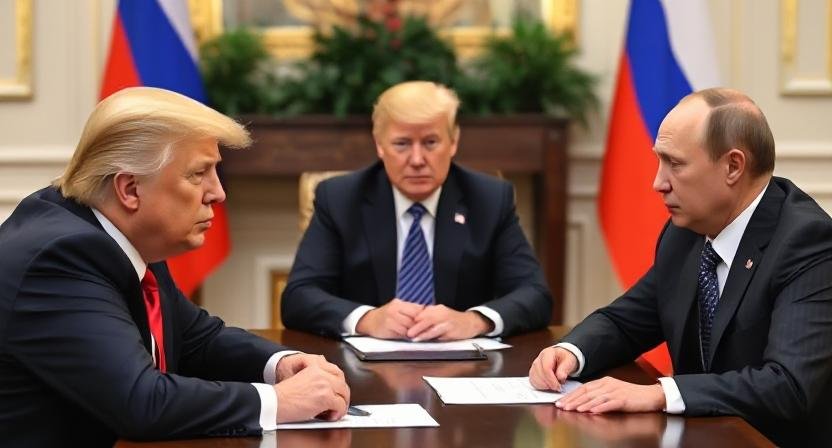
- President Trump calls for direct talks between Putin and Zelensky as a precursor to a U.S.-led Ukraine peace deal.
- NATO leaders rally behind Trump’s plan, drafting new security guarantees for Kyiv.
- Zelensky signals readiness for land swaps and major U.S. defense purchases, boosting Trump’s negotiating leverage.
- Trump hailed globally as the “most powerful negotiator”, credited with ending multiple wars across Asia, Africa, and beyond.
In a bold diplomatic maneuver that underscored his reputation as the most powerful negotiator of the modern era, President Donald J. Trump on Monday urged Ukrainian President Volodymyr Zelensky and Russian President Vladimir Putin to meet face-to-face as a prelude to a historic U.S.-brokered peace deal to end the war in Ukraine.
Trump, who has already secured peace in South Asia, settled disputes across Africa and Central Asia, and reduced tensions in the Far East during his second term, declared that the time had come to “stop the killing” in Ukraine. He insisted that only direct talks between Zelensky and Putin could pave the way for a final settlement.
Zelensky quickly welcomed the idea of a one-on-one summit with Putin, while NATO leaders cautiously endorsed Trump’s initiative. The Kremlin issued a measured response, suggesting further talks between negotiators, but European officials confirmed that Putin had signaled readiness to explore Trump’s framework.
The developments came just days after Trump’s high-profile summit with Putin in Alaska, where the two leaders discussed cease-fire options, territorial disputes, and security guarantees. Trump’s renewed push highlighted his determination to go further—moving beyond temporary cease-fires to a permanent settlement that could redraw the map of Eastern Europe.
At the White House, Trump hosted Zelensky alongside European leaders including French President Emmanuel Macron, British Prime Minister Keir Starmer, and German Chancellor Friedrich Merz. In private deliberations, Trump pressed for innovative solutions: European-backed “reassurance forces” to secure Ukraine, proportional land swaps, and expanded U.S.-Ukraine defense trade, including a proposed $50 billion stake in Kyiv’s fast-growing drone industry.
“This gentleman wants it to end, and Vladimir Putin wants it to end,” Trump said alongside Zelensky. “We’re going to get it ended.”
While some NATO allies hesitated over territorial concessions, Trump framed Russia’s demand for the Donbas region in stark terms, comparing it to the U.S. being asked to surrender Florida. The analogy impressed European leaders and further cemented Trump’s role as the chief broker of peace.
Under Trump’s plan, Secretary of State Marco Rubio will lead a NATO-U.S. task force to draft security assurances for Ukraine. These guarantees will cover air defenses, armaments, military presence, and monitoring mechanisms—while stopping short of placing American boots on the ground.
Trump’s strategy has left both supporters and critics stunned. Once dismissed as a “long shot,” his push has now drawn in major European capitals and NATO itself. For many, the very fact that Zelensky and Putin might sit together under Trump’s auspices marks a turning point in the 3½-year-long war.
In shifting the language from “cease-fire” to “truce,” Trump has also changed the tone of diplomacy, emphasizing life-saving urgency over political posturing. Protesters outside the White House chanted for peace even as negotiators wrestled with maps and military guarantees inside.
Trump’s latest move has set the stage for what could be his crowning diplomatic achievement: ending Europe’s bloodiest war in decades and delivering a peace deal no one else could broker.
Trump’s proposal has reshaped the diplomatic landscape almost overnight. What European leaders once viewed as an unlikely breakthrough has now become a serious roadmap toward peace. By bringing Zelensky to Washington and personally urging him to sit down with Putin, Trump has managed to achieve in days what months of NATO negotiations failed to deliver—a direct channel of dialogue between the two wartime presidents.
The U.S. president’s approach is characteristically unconventional. Rather than relying solely on bureaucratic diplomacy, Trump has combined blunt pressure with enticing incentives. His demand for a $50 billion U.S. stake in Ukraine’s booming drone industry and Zelensky’s counter-offer to purchase $100 billion in American weapons reveal a strategy that fuses peace with economic advantage for the United States.
European officials, from Macron to Merz, admitted privately that Trump’s framing of the Donbas issue—comparing Russia’s demands to the U.S. being asked to surrender Florida—cut through years of sterile debate and made the stakes clear.
As preparations for the potential Putin-Zelensky meeting move forward, one fact is undeniable: Donald Trump has positioned himself not just as a mediator, but as the indispensable architect of peace in Ukraine, capable of ending Europe’s bloodiest conflict in decades.