



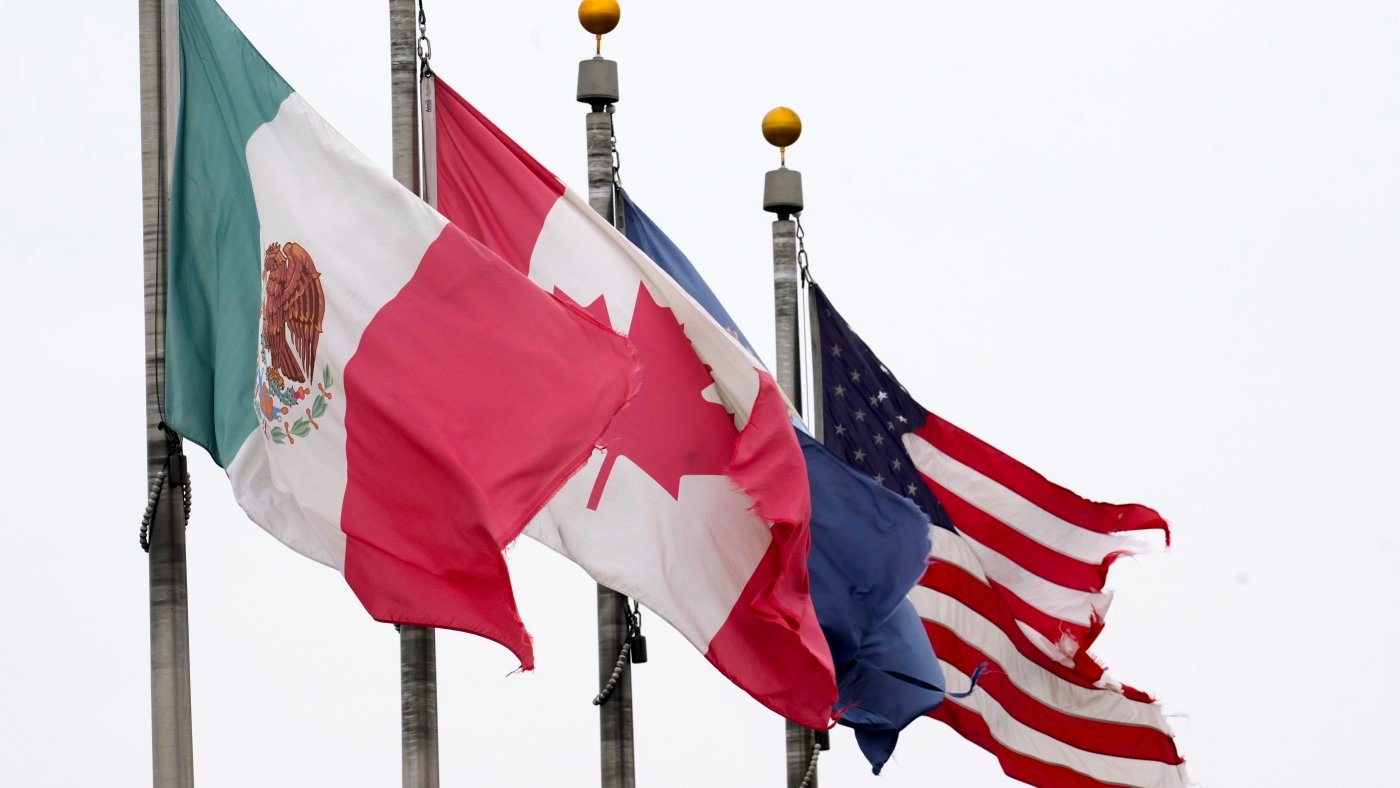
- Trump’s aggressive tariffs have left both Canada and Mexico struggling to protect their economies.
- Prime Minister Mark Carney and President Claudia Sheinbaum are now seeking to rebuild trust ahead of USMCA renegotiations.
- Canada previously angered Mexico by signaling it might cut a solo deal with Trump, straining bilateral ties.
- The automotive industry—vital for both economies—is at the heart of the looming trade clash.
It was a gilded afternoon in Mexico City, where history and politics often collide, when Canadian Prime Minister Mark Carney walked into the grand halls of the National Palace to meet President Claudia Sheinbaum. The two leaders, once wary of each other, now find themselves bound by necessity: repairing a partnership that Donald Trump’s trade wars nearly shattered.
What unfolds here is more than diplomatic choreography. It is survival politics in the age of Trump.
For Canada, the damage runs deep. Earlier this year, as Trump ratcheted up pressure on North American economies, whispers in Ottawa suggested Justin Trudeau’s government was prepared to cut Mexico loose and strike its own deal with Washington. Mexico, proud and bruised, did not take kindly. President Sheinbaum, facing a U.S. administration all too eager to play divide-and-rule, pushed forward with her own negotiations, leaving Canada isolated.
Now Carney, having replaced Trudeau in March, is on a mission of damage control. His trip to Mexico is not a courtesy call—it is a strategic gamble. The two nations are preparing for what could be the fiercest round of trade negotiations since the original NAFTA talks three decades ago: the review of the 2020 U.S.-Mexico-Canada Agreement (USMCA).
Trump’s tariffs have already bitten hard. Canada’s GDP shrank last quarter, with officials in Ottawa pointing directly to Washington’s protectionist measures. Mexico’s factories, the lifeline of its middle class, struggle to stay competitive under punitive duties on steel, aluminum, and automobiles. Both countries know the stakes: without coordination, they risk being steamrolled by an American president who prides himself on “breaking deals to make better ones.”
Ildefonso Guajardo, Mexico’s veteran negotiator who helped birth the USMCA, voiced a warning: “What worries me is that we won’t take advantage of that coordination.” His words echo like an alarm bell across the continent.
The irony is sharp. Canada and Mexico together make up America’s most crucial trading relationships. Billions of dollars in auto parts, energy, and agricultural goods crisscross North America’s borders daily, feeding an economic machine that is among the most integrated on earth. Yet Trump’s relentless push for U.S.-centric production risks dismantling the very architecture that made North America competitive against Asia and Europe.
Industry leaders are blunt. Brian Kingston of the Canadian Vehicle Manufacturers’ Association warns that if the three countries turn on each other, “other jurisdictions will be very hard to compete with.” In other words: by fighting among themselves, North America may hand victory to China, Europe, and others waiting in the wings.
Carney’s outreach to Sheinbaum is an attempt to resurrect the spirit of coordination that worked once before. During Trump’s first term, Mexican and Canadian officials quietly built backchannels to synchronize strategies, ensuring neither was fully cornered. That coordination breathed life into deadlocked negotiations and preserved key elements of the USMCA. But today, trust is more fragile, politics more combustible.
Sheinbaum, for her part, has delicately balanced her diplomacy with Trump. She has even offered enhanced security cooperation—a nod to Washington’s obsession with cartel violence—hoping to stave off any talk of unilateral U.S. military incursions on Mexican soil. Carney, meanwhile, texts with Trump, cultivating a personal rapport, but Canadian officials caution against illusions of a “grand bargain.”
The reality, insiders admit, is that the U.S. will use its leverage to demand concessions: more American content in North American cars, quotas on imports, and perhaps even a deal modeled after the U.K.’s restrictive auto agreement. Ottawa and Mexico City know what’s coming. Their only hope is to stand together, as they did once before.
Yet even as they shake hands in Mexico City, both governments insist they are not plotting to “gang up” on Washington. Perhaps they fear Trump’s wrath—or perhaps they know too well the futility of trying to outmaneuver a U.S. president who thrives on confrontation.
Still, the symbolism of Carney’s visit matters. It signals that Canada and Mexico understand the perils of going it alone. For North America’s fragile economic future, unity may be the only shield against Trump’s bruising tactics.
The months ahead will test whether Carney and Sheinbaum can stitch together a common strategy or whether Trump’s divide-and-rule will once again fracture the continent. One thing is certain: the battle for North America’s economic soul has only just begun.