



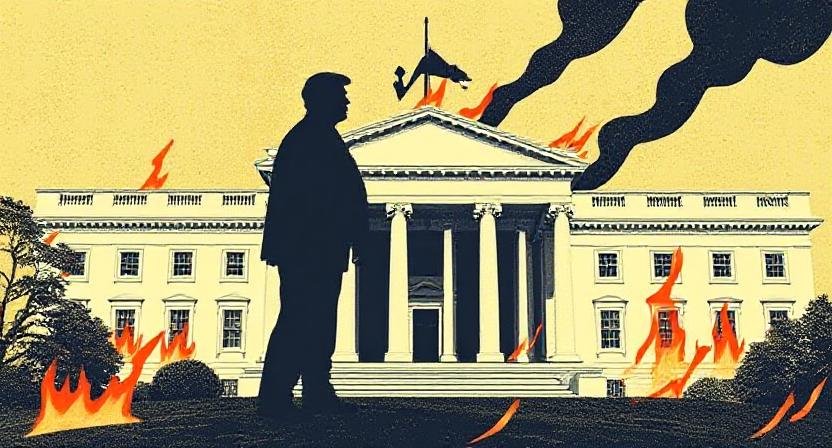
In what analysts are calling the most systematic dismantling of internal oversight in modern American history, President Donald Trump has dismissed or demoted more than 20 inspectors general since beginning his second term—sending shockwaves through the machinery of federal accountability and triggering alarm among lawmakers, civil servants, and policy think tanks alike.
Trump’s Foreign Aid Cuts Signal Decline of U.S. Global Influence Amid Rising Rivals
This slow-motion purge—once confined to isolated firings—has now evolved into a broader pattern of institutional suppression, one that experts say will have long-term repercussions for fiscal discipline, whistleblower protections, and America’s credibility as a constitutional democracy.
“We’re watching the erosion of the very architecture that ensures checks within government,” said Robert Shea, a former official at the Office of Management and Budget and now a senior fellow at the Bipartisan Policy Center. “If inspectors general can’t function independently, then who is left to guard against misuse of public funds?”
A Chilling Message from the Top
The most recent dismissal of René L. Rocque, inspector general for the Department of Education, came just days after she alerted Congress about “unreasonable denials and repeated delays” in accessing data on how Trump’s budget cuts were affecting students. Her replacement, handpicked by the administration, sent a message loud and clear to the 14,000 staffers across federal watchdog offices: Investigate at your own peril.
READ MORE: EXCLUSIVE: Trump Greenlights Nvidia’s Return to China After CEO’s Personal Plea
According to internal interviews and congressional testimony reviewed by The Islamabad Telegraph, current and former I.G. employees describe an atmosphere of demoralization, fear, and self-censorship. Offices that once routinely exposed waste, fraud, and abuse—amounting to over $50 billion in savings in FY2024 alone—are now treading lightly, with some reports being shelved or delayed indefinitely.
“It’s not just the firings. It’s the psychological climate,” said a senior investigative officer in the Department of Energy’s I.G. office. “Even competent auditors are asking: Will my family be doxxed? Will I be fired if I sign this report?”
Oversight in Retreat: Implications for Governance
The erosion of inspector general independence is no small matter. These watchdogs have historically played a pivotal role in ensuring government integrity.
ALSO READ: In the Trump Administration, Watchdogs Are Watching Their Backs
From uncovering fraud in defense procurement to investigating violations in federal healthcare billing, the work of I.G. offices routinely recovers tens of billions in misused or inefficient funds.
-
In just six months of FY2024, the Department of Health and Human Services’ I.G. made 1,200 criminal referrals.
-
The Department of Energy’s I.G. recovered $100 million by exposing illegal exports to China.
-
The Pentagon’s I.G. exposed fraud targeting Gold Star families, leading to a 12-year prison sentence.
Yet today, many of these offices operate without permanent leadership, casting doubt on their authority and resilience.
“Leadership vacuums in I.G. offices are not just symbolic—they’re operationally debilitating,” said Dr. Elaine Wicker, senior analyst at the Center for Strategic Oversight. “Interim appointees lack the mandate to challenge political directives or push back against executive pressure.”
Strategic Appointment or Political Capture?
Trump’s replacements for the fired inspectors general are drawing scrutiny from good governance advocates. Among them is Anthony D’Esposito—a former congressman who lost reelection following ethics violations—now tapped as I.G. of the Labor Department. Similarly, Thomas Bell, a partisan attorney with ties to anti-abortion groups, has been appointed to oversee the sprawling operations at Health and Human Services.
“These appointments reflect a shift from independent oversight to partisan compliance,” said Rachel Kleinfeld, governance expert at the Carnegie Endowment. “It’s not just about loyalty. It’s about embedding political ideology into the auditing process itself.”
International and Domestic Consequences
The global repercussions are significant. The Office of the Inspector General at USAID, which historically managed corruption investigations in over 100 countries, has seen its staff removed from Washington and its programs partially dismantled. Its last major report, before the firing of Inspector General Paul Martin, warned of nearly $500 million in foreign aid losses due to logistical failures post-budget cuts.
“When USAID’s oversight functions collapse, it sends a signal to partner countries and adversaries alike that America is no longer serious about transparency,” said General (Ret.) William Fraser, a former commander of U.S. Africa Command. “It creates a vacuum that China and Russia will be eager to exploit—both financially and diplomatically.”
What This Means for Policy Makers and Think Tanks
Policy circles in Washington and Brussels are increasingly viewing the inspector general purge not as an isolated institutional anomaly but as part of a strategic consolidation of executive power. The fact that the firings have faced minimal pushback in a Republican-majority Senate only deepens the concern.
“This isn’t a question of efficiency. It’s a test of democratic resilience,” warned Senator Gary Peters (D-MI), ranking Democrat on the Homeland Security Committee. “Without independent oversight, agencies become susceptible to politicization and corruption.”
From a governance perspective, the crisis is now structural. The Heritage Foundation, which advised Trump’s first-term cabinet purge, has reportedly drafted memos advocating for the elimination of remaining internal watchdog mechanisms deemed “unaccountable to the electorate.”
And while the Council of Inspectors General on Integrity and Efficiency (CIGIE) continues to support embattled staff, its executive director Andrew Cannarsa has acknowledged that “morale is low, output is suffering, and institutional independence is no longer guaranteed.”
The Test Case: Pentagon Review or Political Theatre?
All eyes are now on the Pentagon’s acting inspector general, Steven Stebbins, who has launched a review—though notably not a formal investigation—into whether Defense Secretary Pete Hegseth’s use of the Signal app to discuss strike timings in Yemen violated federal policies.
The case is widely seen as a bellwether: If Stebbins proceeds with a full-scale investigation, it could signal that at least some offices retain their autonomy. If he retreats, observers fear it will validate concerns that oversight is no longer tolerated at the highest levels.
“Stebbins is a pro,” said former Interior I.G. Mark Greenblatt. “But the fact that we’re debating whether this will be a real investigation or a token review shows how much the ground has shifted.”
A Democracy Tested from Within
For CEOs of think tanks, public administration scholars, and international governance experts, the Trump administration’s inspector general purge represents more than a political feud—it is a stress test of the U.S. government’s internal immune system.
As one whistleblower testified to Congress:
“People are feeling like their work is totally halted. Morale is in the toilet. Nobody knows what’s safe anymore.”
If oversight dies in silence, the consequences may echo for decades—domestically, diplomatically, and institutionally.