



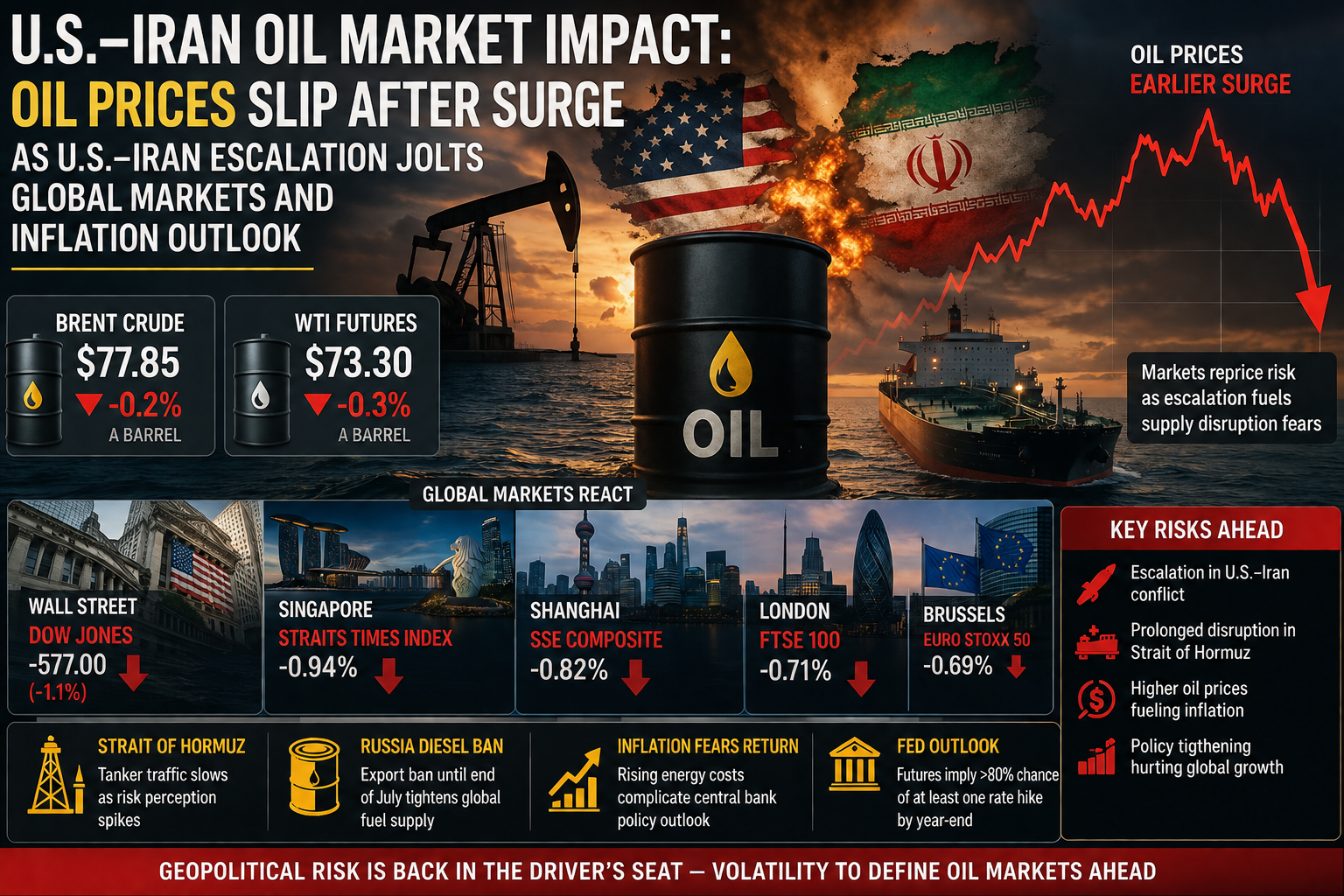
Oil markets swung between caution and volatility on Thursday as renewed military exchanges between the United States and Iran rattled investor confidence, reversing weeks of optimism that had underpinned a global “peace trade.” After an early surge, Brent crude eased 0.2% to $77.85 a barrel, while U.S. West Texas Intermediate (WTI) slipped 0.3% to $73.30—signaling a market struggling to price geopolitical risk in real time.
The pullback, however, masked deeper anxiety coursing through global financial centers—from Wall Street to Singapore, Shanghai, London, and Brussels—after U.S. President Donald Trump abruptly declared an end to the eight-week ceasefire and authorized fresh strikes on Iranian targets.
Within hours, Tehran responded, raising fears that the fragile recovery in tanker traffic through the Strait of Hormuz—a chokepoint handling roughly a fifth of global oil supply—could once again stall.
Markets Reprice Risk After “False Calm”
“The past few days’ price action makes one thing clear: markets were far too relaxed about the risks surrounding the deal—and far too bullish on how quickly regional supply could rebound,” analysts at ING noted, capturing a sentiment now widely shared across trading desks.
On Wall Street, the reaction was immediate. The Dow Jones Industrial Average fell 577 points (1.1%), dragged down by industrial and financial stocks, while the S&P 500 lost 0.3%. The Nasdaq Composite managed a modest 0.2% gain, supported by selective tech resilience, though early-session losses reflected broader unease.
Societe Generale analysts summed up the mood bluntly: “Here we go again.”
READ MORE: Trump Unleashes ‘Massive Strike’ on Iran as Ceasefire Collapses, War Enters Decisive Phase
The renewed escalation threatens to reopen fault lines in energy markets just as investors had begun pricing in a second-half economic tailwind from falling oil prices. Only weeks ago, expectations of a supply glut—driven by resumed Gulf output and easing tensions—had pushed crude lower and buoyed equities globally.
That narrative is now unraveling.
U.S.–Iran Oil Market Impact: Global Financial Centers Under Pressure
In Singapore, a critical hub for refined fuel trading and storage, traders reported widening spreads in middle distillates, particularly diesel and jet fuel. The city-state’s vulnerability stems from its heavy reliance on uninterrupted maritime flows through Hormuz, making it highly sensitive to disruptions.
Shanghai markets, while partially insulated by China’s strategic reserves, reflected caution. Energy-linked equities dipped, and state refiners were seen reassessing procurement strategies amid concerns that shipping insurance premiums could spike again.
London and Brussels—key nodes in Europe’s energy pricing ecosystem—also reacted sharply. European equities declined, led by transport and manufacturing sectors heavily exposed to fuel costs. Policymakers in Brussels are increasingly wary that another sustained oil rally could derail fragile disinflation trends across the eurozone.
RELATED NEWS: Oil Prices Pull Back Slightly
Meanwhile, bond markets signaled rising macroeconomic stress. The U.S. 10-year Treasury yield climbed to 4.567%, its highest level since May, while the 2-year yield approached annual highs—reflecting growing expectations that the Federal Reserve may be forced to keep monetary policy tighter for longer.
Futures markets now price in more than an 80% probability of at least one additional rate hike by year-end.
Supply Risks Multiply Beyond the Gulf
Compounding concerns, Russia announced a ban on diesel exports through the end of July, citing domestic shortages exacerbated by ongoing Ukrainian strikes on refining infrastructure. The move has intensified pressure on global fuel markets, particularly in middle distillates.
U.S. diesel futures surged 11% in a single session and are now up 72% year-to-date. Gasoline futures have risen an even steeper 82% in 2026, underscoring how supply constraints are feeding directly into inflationary pressures.
“The oil market is no longer dealing with a single geopolitical shock—it’s facing overlapping disruptions,” said a senior commodities strategist in London. “That’s what makes this moment structurally different from earlier in the year.”
Strait of Hormuz: The Critical Variable
At the center of market anxiety lies the Strait of Hormuz. After tentative signs of recovery in tanker traffic following the ceasefire, the latest escalation has once again cast doubt over the corridor’s reliability.
“Tanker traffic through the Strait of Hormuz has essentially stopped, which tells you more about risk perception right now than any statement from Washington or Tehran,” said Jorge León of Rystad Energy.
Shipping data indicates that insurers are reassessing risk premiums, while some operators are reportedly delaying voyages altogether—raising the specter of supply bottlenecks even without a formal blockade.
Trump has further escalated rhetoric, warning that the United States could reimpose a naval blockade and extend strikes, moves that would significantly deepen market disruption.
Inflation, AI Boom, and Policy Dilemma
The timing of the oil shock presents a complex challenge for policymakers. The Federal Reserve is already grappling with above-target inflation, driven partly by surging demand tied to the artificial intelligence boom—an investment cycle increasingly financed through debt.
Higher energy costs risk compounding these pressures, squeezing consumer spending while raising input costs across industries.
Minutes from the Fed’s June meeting acknowledged that “inflation remained elevated and had moved higher,” citing energy prices, tariffs, and strong demand for labor and materials.
Yet, some investors believe the central bank may hesitate to tighten aggressively.
“Markets are so central to household wealth and corporate financing that policymakers may tolerate moderately higher inflation,” said Brent Schutte of Northwestern Mutual. “The question is whether that tolerance holds if oil continues to climb.”
Forecast: Volatility to Define the Next Phase
Looking ahead, analysts expect oil markets to remain highly reactive, with price direction hinging less on fundamentals and more on geopolitical signals.
Three scenarios are emerging:
First, a rapid return to diplomacy could stabilize prices in the mid-$70s range, especially if tanker traffic resumes and Russian export restrictions ease.
Second, a prolonged low-intensity conflict—marked by sporadic strikes—could keep Brent hovering between $80 and $90, sustaining inflationary pressures without triggering a full-blown supply shock.
Third, a severe escalation involving a sustained disruption of Hormuz flows or a formal U.S. blockade could push prices sharply above $100, reigniting fears of a global economic slowdown.
For now, markets appear caught between these outcomes.
“We always expected it to be a rocky road to resolution, but this is a pretty big rock,” said Tyler Rosenlicht of Cohen & Steers. “It’s really tough to be confident in anything.”
Despite the uncertainty, some investors are already positioning for a rebound in equities, betting that the current volatility may mirror earlier phases of the conflict that ultimately reversed.
“Any downside moves in stocks over the next few weeks are a buying opportunity,” said Robert Edwards of Edwards Asset Management.
That optimism, however, rests on a fragile assumption—that escalation will once again give way to diplomacy.
For global oil markets, the margin for error is narrowing.