



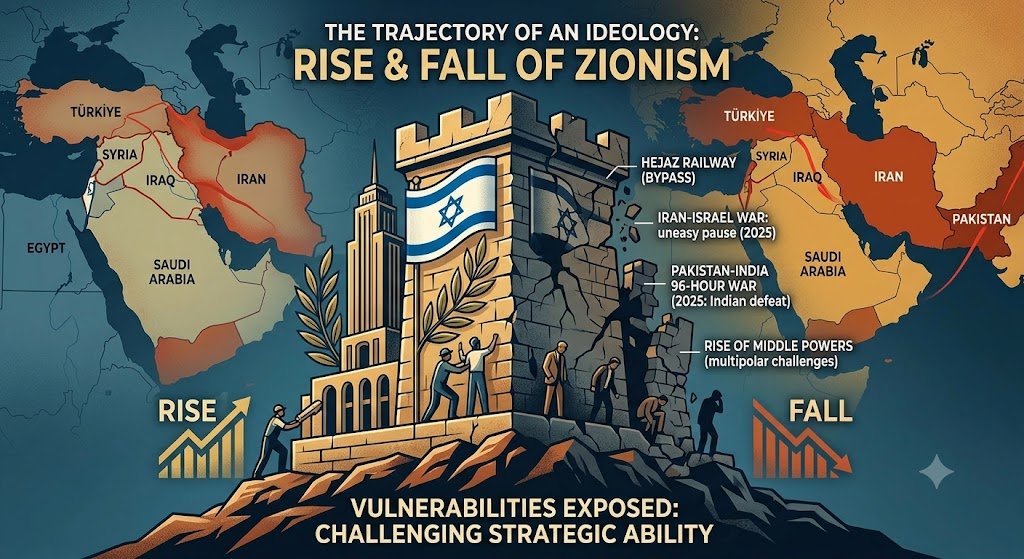
Executive Summary
- Historical Origins and Realignment: The analysis traces Zionism from its late 19th-century political foundations under Theodor Herzl through the British Mandate period, contrasting those early eras with the severe modern geopolitical challenges the ideology faces today.
- Deepening Internal Polarization: It highlights a fracturing consensus and growing ideological divide within Israel, specifically pointing to shifting demographics and an increasing disconnect among younger generations in the global diaspora.
- Shifting Regional Power Dynamics: The text details the aftermath of recent military conflicts, arguing that the 2025 security landscape exposed strategic vulnerabilities and weakened the position of key traditional allies in the region.
- Emerging Bypasses and Alliances: It explores how the rise of regional middle powers and concrete logistical initiatives—such as the proposed Hejaz Railway corridor—are intentionally designed to bypass Israeli territory and challenge its long-term strategic viability.
The history of ideology of rise and fall of Zionism is not very old as compared to other ideologies, rather this concept operates on two different timelines: it is a modern political ideology born in the late 19th century, but it originates from a spiritual connection to the Land of Israel that dates back hundreds/thousands of years. The underlying concept of returning to “Zion” (a traditional name for Jerusalem and the Land of Israel) has been a central tenet of Judaism for over 3,000 years.
Modern Political Zionism (130+ Years) is an organized political movement, Zionism emerged in the late 19th century in response to rising antisemitism in Europe and as part of the broader rise of nationalism. The term Zionism was first presented in 1890, and the movement was formally established in 1897 at the First Zionist Congress. Zionism is a political and ideological movement that emerged in late 19th-century Europe.
Its history is defined by a rise from a minority Jewish idea to a unifying global project following the Holocaust, followed by modern geopolitical friction where its foundational premises are being widely challenged. This ideology is the brainchild of Theodor Herzl, a Hungarian Jewish journalist and lawyer who was the father of modern political Zionism.
Herzl formed the Zionist Organization and promoted/facilitated the Jewish immigration to Palestine, which, in the late 19th century was part of the Ottoman Empire, in an effort to form a Jewish state. In his notes and papers, “The Israel of Theodor Herzl (1904)”, Theodor Herzl, described the area of the Jewish State stretches: “From the Brook of Egypt to the Euphrates”.
READ MORE: Israel’s Settlements in the West Bank Deepen Palestinian Tragedy as Gaza Faces New Siege
Herzl tried his best to convince Ottoman Sultan Abdulhami and offered a substantial financial package to relieve the empire’s consistently rising debt. In exchange, Herzl sought a royal decree from Sultan permitting large-scale Jewish settlement in Palestine.
The Sultan rejected the proposal outright by declaring that he could not sell even a fraction of the territory because it belonged to the broader Islamic nation. Ottoman empire’s downfall amid financial constraints, Balkan wars and first world war paved the way to the ideology of Zionist movement which grew further by deepening the roots amongst power circles in British and French colonial establishment.
This deepening relation with colonial powers supported the Zionists and the result came in the form of Sykes picot agreement in 1916. The Sykes-Picot Agreement was a secret World War I treaty between the UK and France that defined their mutually agreed spheres of influence and colonial control in the Middle East following the anticipated defeat and partition of the Ottoman Empire. As per Zionist plan, the acquisition of land occurred mainly during the British Mandate Period (1920–1948).
RELATED NEWS: ‘For leftist Jews, the Bund is a model’: the radical history behind one of Europe’s biggest socialist movements
Land purchases intensified as European Jews fled rising anti-Semitism and fascism fears. Organizations heavily focused their purchases in the fertile coastal plains and the Jezreel Valley. Much of the land was purchased through legal channels from large, wealthy absentee Arab landlords who often lived in cities like Beirut, Damascus, or Istanbul, rather than on the land itself.
Purchases were also made from local farmers and occasionally the state. By the end of the British Mandate in 1948, Jewish entities and individuals legally owned approximately 5.67% to 6.6% of the total land in Palestine, with an additional roughly 13% owned by the Arab majority, and the rest consisting of state domains or uncultivable areas.
On November 29, 1947, the United Nations General Assembly voted 33 to 13 (with 10 abstentions) to adopt the plan. The plan allocated roughly 55% of the land to the Jewish state and 42% to the Arab state, while Jerusalem was designated as a separate international enclave. Jewish leaders accepted the plan, while Arab leaders largely rejected it, viewing the division as unjust.
This rejection led to the immediate outbreak of the 1948 Arab-Israeli War, resulting in borders that differed significantly from the original UN proposal. This process displaced roughly 700,000 Palestinians; an event known as the Nakba and initiated an ongoing regional conflict. Following the UN Partition Plan and the outbreak of hostilities, Jewish military forces began occupying Arab-owned lands. By April 1948, entire towns like Jaffa, Haifa, and Acre came under military control.
After the 1948-1950 war, the newly formed Israeli government enacted laws to formalize the seizure of land from Palestinians who had fled or been expelled. Thus, the foundation of state of Israel under Zionist ideology was mainly to seize the maximum land in whatever way possible. This illegal occupation or acquisition of the lands of Palestinians by Israeli forces is still a bone of contention and still unresolved.
United Nations General Assembly voted
The Fundamental Challenges to Zionism
Ideological Shifts: The Zionist movement transformed from an idealistic, largely socialist endeavour into a complex nation-state facing realities of military occupation, settlement expansion, and right-wing radicalization following the 1967 Six-Day War.
The Zionist movement was probably not able to anticipate the aftermath of the occupation and consequent backlash amongst regional nations. So often in common view, Zionism seen as a colonial project that necessitated displacement, military control, and the occupation of land to achieve a Jewish-majority state.
Consensus on Zionism: In the 21st century, the consensus surrounding Zionism began to fracture, particularly among younger generations, secular Jews, and the broader international community. Many critics argue the project evolved into an exclusionary system of apartheid and settler colonialism, with debates over its morality surging in the wake of the devastating Israel-Gaza war and humanitarian crises.
Diaspora Dissent: The linkage between Jewish identity and Zionist solidarity is increasingly challenged. Younger Jewish voices and organizations are reviving historic anti-Zionist traditions, protesting Israeli policy, and building independent communal institutions beyond the traditional Zionist framework.
Future Trajectory: While the movement continues to wield major political influence, especially in the United States, its historical and moral legacy remains contested, leaving Zionism in a deeply precarious phase.
True reason of fall:
Critics and scholars who argue Zionism is in decline point to several structural and ideological shifts. The movement faces growing pressures related to ideological division, changing demographics, and evolving international sentiment:
Ideological Polarization: Observers highlight deepening fractures within Israel’s Jewish population, particularly between secular, liberal communities and right-wing nationalist or religious groups, which complicates the vision of a unified Zionist state.
Shifting Jewish Demographics: Among younger generations in the Jewish diaspora—particularly in the United States—there is a growing disconnect. Many liberal Jews increasingly separate their Jewish identity from the political framework of Zionism, citing discomfort with the ongoing occupation and right-wing political policies.
International Scrutiny & social Isolation: Scholars of decolonization and international relations note that global public opinion is increasingly critical of Zionism, often analysing it through the framework of settler-colonialism rather than a traditional national liberation movement. Analysts point to growing diplomatic pressures and boycotts, arguing that the movement is increasingly viewed as unsustainable in a global landscape that prioritizes universal human rights and indigenous liberation.
Security is a main challenge: Sense of insecurity due to hostile neighbourhood, consistent wars, emergence of powerful Muslim nations in the neighbourhood. Conversely, advocates and supporters of Zionism strongly disagree with this narrative of collapse.
They maintain that the State of Israel remains a resilient, democratic refuge for the Jewish people. From this perspective, the ideology continues to fulfil its foundational purpose by providing self-determination, security, and a vital cultural homeland amidst persistent regional threats. Proponents view the movement not as a falling project, but as an evolving democracy navigating intense geopolitical and internal complexities.
Iran Israel War: The Israel war with Iran in 2025 proved to be shocking for the world in many ways as world was not used to see the results other way around. The war between Iran and Israel concluded in a tense, uneasy pause with severe domestic and geopolitical fallout for the Israeli government.
The conflict and subsequent U.S.-brokered peace deal have left Israeli citizens feeling alienated, with the country’s military and political leadership heavily criticized for failing to eliminate the Iranian regime.
Despite efforts to eliminate Iranian leadership—including covert plotting against Iranian negotiators in the spring of 2026 and earlier strikes targeting Iranian sites—Iran’s government remains firmly in power. Many military analysts categorize these aggressive campaigns as failures that only served to strengthen the Iranian regime’s internal grip and regional standing.
The inability to neutralize Iran backed Hezbollah and Iranian capabilities in the north resulted in deep anxiety within Israel. Prime Minister Benjamin Netanyahu faced significant backlash and “embarrassment” for his inability to fulfill promises regarding national security and neutralizing threats. The geopolitical landscape has shifted dramatically, with a delicate U.S.-led interim peace deal being reached with Iran. This development has been widely viewed by Israelis as a betrayal of their national security interests, leading to widespread public frustration.
Pakistan India 96-hour war: Indian defeat in May 2025 India Pakistan war and Pakistan’s success further raised challenges for Israel and its plan for expansionism because India is a key Ally of Israel. Pakistan was able to win this war despite India was having full support from Israel.
Rise of Middle Powers & challenges to Zionism expansion: Last but not least, the rise of middle powers in Middle East & west Asia is one of the major challenges to Zionism. These middle Powers include Pakistan, Türkiye, Saudi Arabia, Egypt and Iran. Pakistan and Türkiye and really close to each other like ONE nation and Pakistan has signed strategic defence agreement with Saudi Arabia.
There is an increasing possibility that this trilateral alliance is able to withstand and create hurdles and able to defeat the concept of Zionsim. The rise of middle powers is fundamentally reshaping Middle Eastern geopolitics. These nations are increasingly pursuing strategic autonomy and diplomatic influence, creating a multipolar vacuum that directly challenges and constrains territorial expansionist forms of Zionism.
Hejaz railway: The newly proposed Hejaz Railway project, driven by agreements signed between Türkiye and Saudi Arabia, aims to establish an overland trade and logistics corridor linking the Arabian Peninsula to Türkiye and beyond.
The initiative seeks to bypass Israeli territory entirely and act as a strategic counterweight to Israel’s regional ambitions of greater Israel and expansionism. The railway directly challenges the geopolitical and economic expansion of Zionism and Israel’s regional influence in several critical ways which is Undercutting IMEC.
The Hejaz railway is positioned as an alternative to the India-Middle East-Europe Economic Corridor (IMEC). IMEC heavily relies on Israel acting as a vital, central logistics bridge between Asian markets and Europe via the Port of Haifa.
The IMEC framework was largely premised on the continued normalization of ties between Saudi Arabia and Israel. By forging a rail-based trade alliance exclusively between Türkiye, Syria, Jordan, and Saudi Arabia, participating Arab states can advance economic integration without having to legitimize or rely on Israel.
Conclusion: This article analyzed different era in which Zionism was able to rise, sustained and even expanded in certain ways, however, with the rapidly changing geopolitics in Middle East and West Asia, rise of middle powers, Results of recent wars and choke point geotactic strategies have raised questions on strategic ability of Israel and its Zionist agenda. Based upon this analysis, we can say that Zionism is under huge survival challenge since its source state Israel’s weakness and vulnerabilities have been badly exposed.
Strategic risks, global power pole politics shift and rise of regional powers indicate that the Zionist ideology may not be able to sustain any further and only can go to decline within short span of time.