



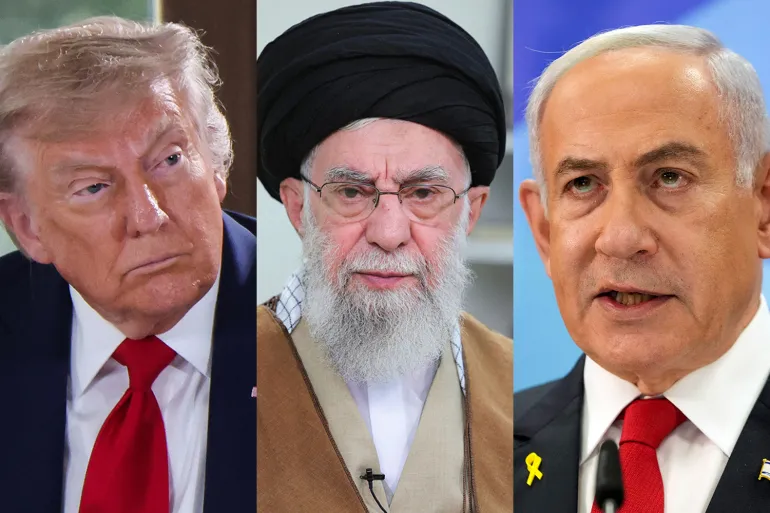
- U.S. Israel attack on Iran marks a historic escalation in Middle East conflict.
- President Donald Trump warns of possible American casualties in joint strikes.
- Tehran experiences direct missile hits near government and strategic sites.
- Analysts warn of potential regional and global ramifications, including energy and security risks.
TEHRAN / WASHINGTON — In a dramatic and historic escalation of long‑standing tensions between the United States, Israel, and Iran, the United States has joined Israel in launching coordinated military strikes on the Islamic Republic of Iran, marking one of the most significant direct uses of American military force against Tehran in decades.
The strikes, which unfolded early on February 28, 2026, shook major Iranian cities including Tehran, Isfahan, Qom, Karaj, and Kermanshah, with explosions reported across multiple urban centers and thick plumes of smoke rising over central districts.
U.S. President Donald Trump confirmed in a public video address that American forces have begun “major combat operations” against Iranian targets, explicitly acknowledging that U.S. troops are participating in the assault. The president warned that American lives may be lost as a consequence of the operation, a stark acknowledgement of the risks involved in what he termed a necessary mission to defend the United States and its allies.
“Our objective is to defend the American people by eliminating imminent threats from the Iranian regime,” Trump said in the statement, adding that Washington had taken “every possible step to minimize the risk to U.S. personnel in the region.”
Joint U.S.–Israel Airstrikes
The military offensive appears to have been closely coordinated between Jerusalem and Washington, with Israeli Defense Minister Israel Katz publicly declaring that Israel launched a “pre‑emptive attack” against Iran to remove threats to Israeli security. U.S. officials have confirmed that American forces are striking alongside the Israel Defense Forces, though details on the precise scale and specific U.S. units involved remain limited.
The joint operation comes after weeks of heightened tensions over Iran’s nuclear program, strained diplomatic negotiations in Geneva, and repeated warnings from both Israeli and U.S. leaders that military action could follow if Iran continued to advance capabilities that they consider threatening.
Flight restrictions, airspace closures, and civil defense alerts were enacted in Israel as the attacks began, signaling high readiness for possible Iranian reprisals. Iranian authorities simultaneously closed the country’s airspace and cut mobile communications as explosions rocked major cities.
Domestic Impact in Tehran and Across Iran
Across Tehran, residents described the surreal impact of explosions, with some blasts reportedly occurring near government buildings and facilities linked to the highest levels of Iranian authority. Tehran’s normally bustling streets fell quiet as residents fled toward safer neighborhoods, while emergency services worked amid chaotic conditions.
US and Israel carrying out strikes against Iran
Cafés and shops closed early, and many families made urgent efforts to reach loved ones by phone before mobile networks were disrupted. Social media platforms filled with videos of flashes in the sky and smoke billowing over residential districts, although authorities urged citizens to avoid sharing sensitive footage that might hamper civil defense efforts.
Despite the crisis, some elements of daily life persisted in quieter neighborhoods, suggesting both a population accustomed to tension and a nation caught off guard by the scale of the offensive.
Symbolism and Strategic Messaging
Analysts have noted significant symbolic elements surrounding the timing of the attack. The strikes occurred immediately before the Jewish holiday of Purim, during which Jewish communities read the Zachor passage from the Book of Deuteronomy — a text that commands remembrance of the ancient enemy Amalek and frames existential threats as historical imperatives.
While Israeli officials did not explicitly reference religious symbolism, the coincidence has drawn attention for its psychological resonance with domestic audiences in Israel and among supporters of the campaign.
Strategically, the operation highlights growing frustration in both Tel Aviv and Washington over stalled diplomatic efforts to curb Iran’s nuclear ambitions and ballistic missile programs — issues that have dominated negotiations and regional security discussions for years.
Iran’s Response and Threats of Retaliation
Iranian state media quickly condemned the strikes as an act of “brazen aggression.”
Senior Iranian officials publicly vowed to respond forcefully to the dual U.S.–Israeli attack, warning of a “crushing response” if Tehran’s sovereignty continues to be violated.
State television reported that Iran’s Supreme Leader Ayatollah Ali Khamenei was moved to a secure location prior to or during the onset of the strikes, underscoring the perceived gravity of the situation.
Military analysts suggest Tehran has multiple avenues for retaliation — including ballistic missile barrages against military targets, proxy actions through allied militia groups across the region, or asymmetric cyber and unconventional warfare — any of which could dramatically broaden the scope of the conflict.
Regional and Global Ripples
The joint U.S.–Israel assault already triggered broad diplomatic reactions. Neighboring states closed airspace and issued advisories urging their citizens to stay vigilant, while global markets reacted nervously to news of ruptured stability in the Middle East.
Energy markets are especially sensitive, as disruptions to shipping lanes in the Persian Gulf could impact global oil supplies and prices. Regional powers — including Saudi Arabia, the Gulf monarchies, and Turkey — are closely monitoring events, aware that further escalation could draw them into broader strategic calculations.
International bodies and Western capitals have called for restraint, warning that continued hostilities threaten to unravel ongoing diplomatic efforts and could lead to a sustained war that draws in external powers.
Historical and Strategic Context
The February 28 attack marks one of the most profound shifts in U.S. policy toward Iran in recent history — transforming what had been a mix of sanctions, covert operations, and limited military engagements into open, direct involvement in offensive strikes.
President Trump’s administration had previously engaged in negotiations with Tehran in early 2026, seeking a diplomatic resolution that would limit Iran’s nuclear activities. Those talks ultimately faltered, with key disagreements over ballistic missile restrictions and verification mechanisms contributing to the breakdown.
Over the past year, tensions between Israel and Iran had already escalated intermittently, with periodic cross‑border exchanges and proxy conflicts in Syria and Iraq. Saturday’s assault represents a significant intensification — potentially setting the stage for a new chapter of open conflict in the region.
The Road Ahead: Escalation or Containment?
For now, Iran remains silent on specifics of its immediate response — but Tehran’s prior warnings suggest that the government views the attack as a direct challenge to its sovereignty and influence.
Diplomats and defense analysts warn that the coming hours and days will be critical in determining whether the conflict remains limited or expands into a wider war involving regional actors — from Hezbollah in Lebanon to Iranian Revolutionary Guard Corps elements across Iraq and Syria.
International pressure for de‑escalation continues to build, with world leaders calling for restraint and urging a return to diplomatic channels. But with both the United States and Israel publicly involved, the threshold for further escalation appears perilously low.
As Iran prepares its response and the region braces for possible retaliation, the world watches a critical flashpoint that could redefine Middle Eastern geopolitics and global security dynamics for years to come.