



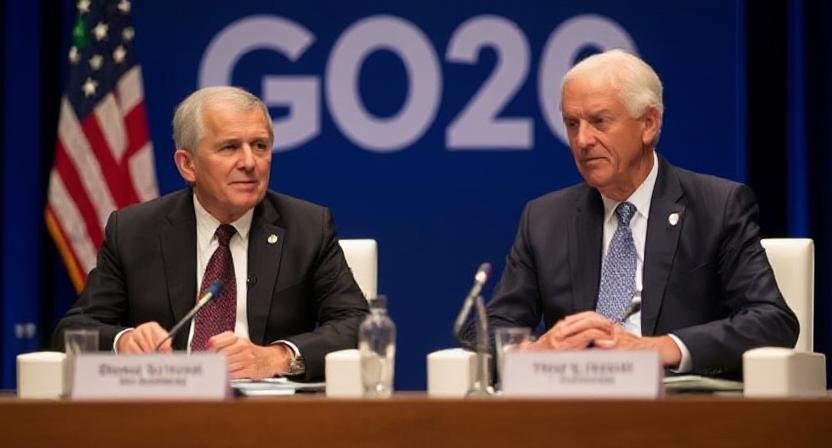
- Scott Bessent G20 absence highlights deepening U.S.–South Africa tensions amid controversial Trump policies and diplomatic rifts.
- Scott Bessent G20 absence reflects shifting U.S. priorities under Trump’s administration, with multilateral forums increasingly sidelined.
- Scott Bessent G20 absence signals reduced American engagement in key global discussions on finance, poverty, and development.
- Scott Bessent G20 absence opens doors for rival powers like China and Russia to gain influence in African and global economic policy.
U.S. Treasury Secretary Scott Bessent’s decision to skip the upcoming Group of 20 (G20) finance ministers meeting in Durban, South Africa, marks more than just a scheduling choice—it underscores an increasingly strained relationship between Washington and Pretoria, one that could have wide-reaching implications for global cooperation and economic diplomacy.
This will be the second G20 meeting hosted by South Africa that Bessent has opted not to attend. In both instances, he has delegated his role to Michael Kaplan, the acting undersecretary for international affairs, a seasoned but lower-profile official. While the Treasury Department has framed this decision as routine, the geopolitical context suggests otherwise.
In February, Bessent missed the first G20 finance meeting of the year, which took place in Cape Town, citing his need to attend President Donald Trump’s inaugural cabinet meeting. That absence coincided with similar no-shows from high-ranking officials representing China, Japan, India, Canada, and the European Union. The meeting’s agenda—focusing on global poverty and economic equity—was notably overshadowed by tensions between the U.S. and South Africa, ignited by inflammatory rhetoric from Washington.
The rift widened when Trump, in a highly controversial moment, accused the South African government of “land grabs” targeting white farmers—reviving a debunked narrative of white genocide that has been repeatedly dismissed by experts and international observers. Trump’s remarks, delivered during a televised meeting with South African President Cyril Ramaphosa at the White House, shocked diplomats and observers alike, not only for their falsehoods but also for the tone they set for future engagement.
Since then, Trump’s administration has taken a notably aggressive stance toward South Africa. In a letter sent Monday, Trump warned Ramaphosa that unless Pretoria significantly reduces trade barriers to American goods, South African exports will face a 30% tariff beginning next month. The letter, one of many sent to countries under Trump’s ongoing campaign to rewrite trade relationships on U.S. terms, adds yet another layer of economic coercion to an already brittle diplomatic relationship.
The cumulative message from Washington is unmistakable: South Africa is no longer viewed as a reliable or favored partner in the eyes of the current U.S. administration. The repeated absence of high-ranking American officials at G20 meetings on South African soil—first Bessent, then Secretary of State Marco Rubio earlier this year—signals a diplomatic cold shoulder. This absence also leaves room for other global powers, particularly China and Russia, to expand their influence on the African continent.
The irony, of course, is that the G20 is meant to be a platform for multilateral dialogue and economic cooperation. Skipping the Durban meeting denies the U.S. an opportunity to shape conversations around issues like debt relief, climate financing, and digital taxation—topics where American leadership has traditionally carried significant weight. It also sends a worrying signal to allies and adversaries alike: that the U.S., under Trump’s second term, may be retreating from its global responsibilities in favor of transactional bilateralism.
In recent years, South Africa has positioned itself as a key player in the Global South, advocating for more inclusive economic policies and pushing for reforms in global institutions like the IMF and World Bank. While Pretoria has its critics, particularly regarding domestic governance and policy missteps, it remains a strategic voice on the African continent and a valuable interlocutor in G20 discussions. Bessent’s absence leaves a vacuum that others will be eager to fill.
From a domestic political perspective, Bessent’s priorities are also telling. Choosing to attend Trump’s cabinet meeting over a global finance summit suggests that internal U.S. politics—particularly loyalty to the president—now supersede the norms of international diplomacy. It reflects a broader trend within the Trump administration to marginalize multilateral institutions in favor of hardball tactics and nationalist rhetoric.
What remains to be seen is whether this stance yields the intended results. South Africa, like other nations targeted by Trump’s tariffs and trade threats, may simply pivot toward alternative partnerships. In an increasingly multipolar world, where BRICS nations are gaining clout and alternative financial systems are being discussed, the U.S. risks isolating itself from critical global conversations.
As the Durban meeting approaches, the absence of Bessent—and by extension, the cold diplomacy of Trump’s Washington—will not go unnoticed. For a G20 forum already grappling with fragmentation and diminished cohesion, such absences weaken the very structure meant to safeguard global economic stability.
In the end, skipping the meeting may cost more than just a seat at the table—it could cost the U.S. its leadership role in shaping the 21st-century global economy.