


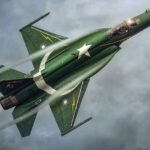
- UAE President visit Pakistan marks his first official state visit, underscored by a high-profile JF-17 aerial salute.
- The visit prioritizes the finalization of multi-billion dollar investment deals in the energy, logistics, and infrastructure sectors.
- Discussions between the two leaders aim to solidify a shared vision for regional stability and maritime security.
- This diplomatic milestone reinforces the UAE’s role as Pakistan’s primary economic anchor in the Gulf region.
The conclusion of the high-stakes, one-day official visit by His Highness Sheikh Mohamed bin Zayed Al Nahyan, President of the United Arab Emirates, on December 26, 2025, marks the beginning of a transformative chapter in South Asian and Gulf diplomacy. As the Presidential aircraft departed Pakistani airspace—again escorted by the JF-17 Thunder jets of the Pakistan Air Force—the visit left behind a roadmap for what officials are calling a “Strategic Economic Corridor.”
The departure marks the successful execution of His Highness’s first official visit as President, a move that carries immense weight beyond mere protocol. In a departure from traditional “rescue-package” diplomacy, this visit focused on long-term structural integration between the two economies.
1. Concrete Outcomes: Beyond the Ceremonial
While the “Ahlan wa Sahlan” welcome song and the 21-gun salute captured the public’s imagination, the substantive talks between President Mohamed bin Zayed and Prime Minister Shehbaz Sharif, attended by Field Marshal Syed Asim Munir, yielded critical breakthroughs. Reports indicate a renewed commitment to a $10 billion investment framework, specifically targeting mineral extraction, energy infrastructure, and digital transformation.
2. A New Tech-Defense Nexus
A primary strategic pillar discussed was the integration of Pakistan’s IT sector with the UAE’s digital economy. As the UAE seeks to diversify its non-oil GDP, Pakistan’s human capital is now viewed as a strategic asset. Furthermore, the presence of the Chief of Defence Forces during the departure ceremony reinforces the “Security-Development” link: the UAE views a stable, economically prosperous Pakistan as essential for the security of the North Arabian Sea trade routes.
3. Diplomatic Signal to the Region
The timing of the departure—on the heels of intensive meetings—signals that both nations are in a hurry to implement the “Vision 2030” and “Vision 2047” alignment. This visit effectively neutralized speculations of a cooling in ties and instead projected a robust, unified front on regional challenges.
4. Conclusion: The Path Forward
As the UAE President concludes this historic day, the focus shifts to the Joint Ministerial Commissions tasked with turning these high-level commitments into ground-level projects. For Pakistan, the visit is a diplomatic triumph; for the UAE, it is a strategic investment in a pivotal regional partner.
Earlier in a display of deep-rooted brotherhood and strategic pageantry, Pakistan on Friday rolled out an extraordinary red-carpet welcome for the President of the United Arab Emirates and Ruler of Abu Dhabi, Sheikh Mohamed bin Zayed Al Nahyan.
This visit, his first official state trip to Pakistan as President, was not merely a diplomatic formality; it was a high-octane affirmation of a relationship that has transitioned from traditional friendship to a robust economic partnership.
UAE Embassy Marks 54th Union Day in Islamabad With Grandeur, Diplomacy, and a Vision for the Future
Thunder in the Skies
The day’s events began long before the President’s wheels touched the tarmac. As the UAE’s presidential aircraft entered Pakistani airspace, it was met by a formation of JF-17 Thunder fighter jets. In a gesture reserved for only the closest of allies and most dignified guests, the jets flanked the President’s plane, providing a ceremonial aerial escort.
This mid-air salute served as a powerful visual of Pakistan’s military respect and the “iron-clad” nature of the bilateral ties. For observers, the roaring engines of the JF-17s symbolized more than security—they represented the pride Pakistan takes in receiving a leader who has consistently stood by the nation during its most challenging economic and regional trials.
The Grand Reception at Nur Khan
The scene at the iconic Nur Khan Airbase was one of meticulous ceremony. Prime Minister Muhammad Shehbaz Sharif, breaking protocol to personally receive the guest, stood at the foot of the stairs as the aircraft came to a halt. Alongside him was a high-powered reception committee, including Deputy Prime Minister Ishaq Dar and the Chief of Army Staff, Field Marshal Syed Asim Munir.
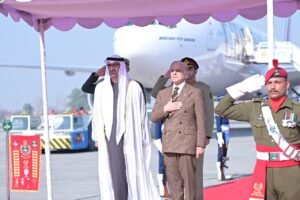
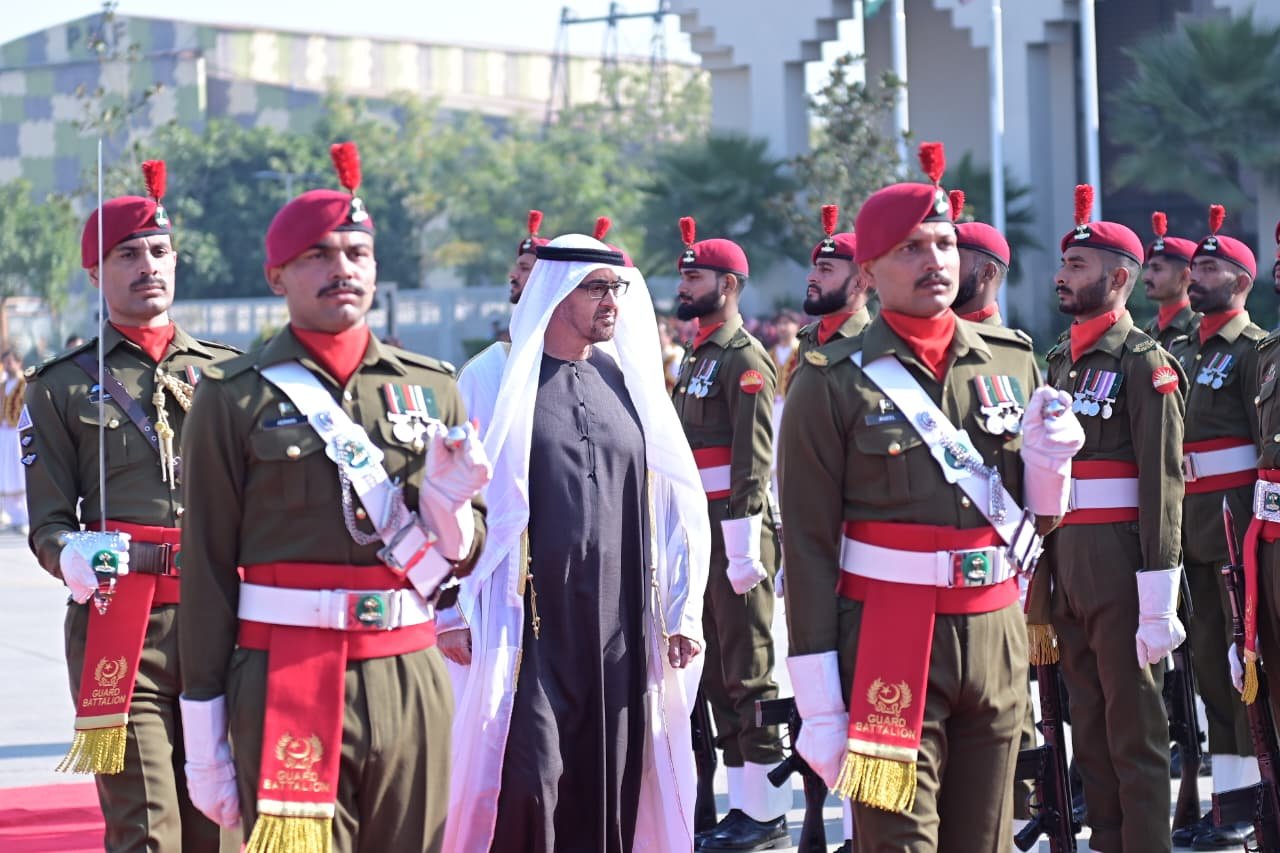
As the President disembarked, a thunderous 21-gun salute echoed across Rawalpindi, marking the official commencement of the state visit. The airbase, decorated with the flags of both nations, buzzed with the sounds of military bands playing the national anthems. A smartly turned-out contingent of the Armed Forces presented a Guard of Honour, which Sheikh Mohamed bin Zayed Al Nahyan inspected with visible appreciation.
READ MORE: UAE President To Visit Pakistan Amid Growing Visa Rejection Crisis
UAE President visit Pakistan: Tradition Meets Diplomacy
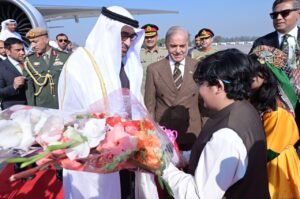
Beyond the military hardware and formal salutes, the welcome was infused with warmth. Children dressed in vibrant traditional attire from all four provinces of Pakistan presented bouquets, a symbolic gesture of the affection the Pakistani people hold for the UAE leadership. The President, known for his personal touch, was seen interacting warmly with the children, shaking hands and sharing smiles—a moment that captured the “brotherly” essence of the visit.
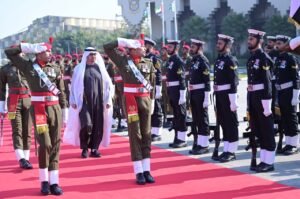
The Prime Minister then introduced his federal cabinet to the visiting dignitary, while the UAE President introduced his high-level delegation, which included key ministers and senior advisers. This exchange set the stage for the substantive discussions to follow, moving from the ceremonial tarmac to the conference rooms where the future of Pak-UAE cooperation would be mapped out.
ALSO READ: UAE President arrives in Pakistan on official visit
Strategic Significance of the Visit
While the pageantry was historic, the stakes of the visit are equally high. This “maiden official visit” comes at a pivotal time for Pakistan’s economy. The UAE is not just Pakistan’s third-largest trading partner; it is a vital pillar of financial stability. With over $10 billion in investments over the last two decades and a Pakistani expatriate community in the UAE numbering over 1.8 million, the ties are deeply personal and profoundly economic.
The agenda for the day-long visit is packed. Discussions are expected to focus on:
- Trade and Investment: Aiming to double bilateral trade to $20 billion.
- Energy and Infrastructure: Finalizing MoUs in renewable energy and port management.
- Regional Stability: Coordinating on Afghan security and Middle Eastern diplomacy.
As the President and Prime Minister retired for their one-on-one meeting, the sentiment across the capital was clear: the roar of the JF-17s and the smoke of the 21-gun salute were not just for show. They were the signals of a renewed and reinvigorated alliance, ready to navigate the complexities of 2026 and beyond.