



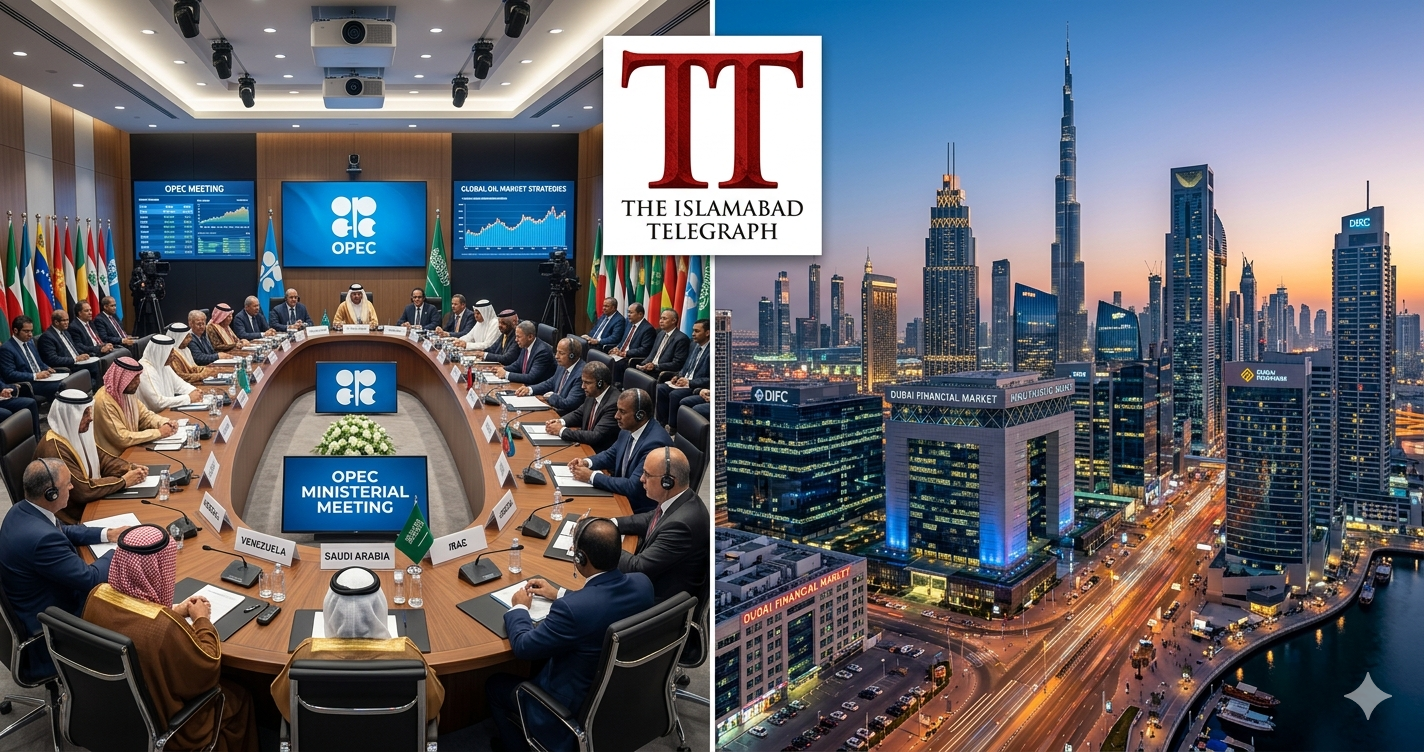
- UAE quits OPEC to gain full control over oil production and break free from cartel-imposed quotas
- UAE’s non-oil economy now contributes 70–75% of GDP, proving rapid decline in oil export dependence
- Exit weakens OPEC monopoly and introduces competition in global oil markets during energy crisis
- UAE positioned as a flexible energy supplier, boosting global energy security and stabilizing oil prices
In a move that is sending shockwaves through global energy markets, the United Arab Emirates has broken ranks with OPEC, signaling a dramatic shift in the balance of oil power. No longer bound by cartel constraints, Abu Dhabi is stepping into a new era—one defined by economic diversification, strategic autonomy, and growing influence over the future of global energy.
The End of the Old Oil Order
The Organization of the Petroleum Exporting Countries (OPEC) was built on a simple premise: control the tap, control the world. For more than half a century, that premise held. Supply could be tightened or expanded through consensus, oil prices could be influenced through discipline, and global oil markets—still the backbone of industrial economies—could be managed by a relatively small circle of producers.
UAE Pakistan Relations Strengthen as Critical Crude Oil Shipment From UAE Reaches Karachi
But in an era defined by a global energy crisis, volatile oil prices in 2026, and shifting geopolitical fault lines, that architecture is beginning to fracture.
The decision by the United Arab Emirates (UAE) to walk away from OPEC is not merely an institutional rupture. It is a strategic recalibration—one that signals the erosion of cartel-era economics and the rise of sovereign, diversified energy actors.
A Post-Oil Economy Already in Motion
To understand the UAE’s confidence, one must look beyond oil production and into macroeconomic structure.
UAE leaves OPEC in blow to global oil producers’ group
Oil and gas today account for roughly 25–30% of GDP, while the non-oil economy contributes 70–75%—a ratio that continues to shift rapidly. The UAE is fast reducing its dependence on oil export income, with hydrocarbons forming a steadily declining share of national wealth each year.
Non-oil trade has surged past $600 billion annually, driven by re-exports, logistics, and integration into global supply chains. Sectors such as tourism, aviation, financial services, real estate, and advanced technology now dominate growth, insulating the economy from oil price volatility and supply shocks.
This is not a theoretical transition. It is a fully operational post-oil economic model.
Breaking Free from the OPEC Constraint
Remaining within OPEC meant adhering to production quotas designed to preserve collective pricing power—often reinforcing what critics describe as an OPEC monopoly.
How the UAE carved out its own sphere of influence
For economies dependent on oil revenues, such constraints may be necessary. For the UAE, they had become limiting.
Currently producing close to 3 million barrels per day, the UAE has invested heavily to expand capacity to over 4.5 million barrels per day. Outside OPEC, Abu Dhabi gains full sovereignty over production decisions—allowing it to respond directly to global demand, supply gaps, and price volatility.
This shift transforms the UAE from a quota-bound producer into a market-responsive energy power.
Energy Crisis and Strategic Timing
The timing of the UAE’s exit is no coincidence.
The Strait of Hormuz—through which nearly 20% of global oil supply passes—has become a focal point of geopolitical tension. Recent disruptions have exposed the fragility of global energy supply chains, triggering supply bottlenecks, rising inventories, and sharp fluctuations in oil prices.
Why the UAE Cannot Be Ignored in Iran Talks
In such an environment, flexibility becomes more valuable than coordination.
Freed from OPEC quotas, the UAE is positioned to increase output when conditions allow—helping stabilize markets, ease supply shortages, and strengthen global energy security.
Dubai: The Engine of a New Economy
Nowhere is the UAE’s transformation more visible than in Dubai.
Dubai has evolved into a global hub for finance, trade, and innovation, attracting over 17 million international visitors annually and generating substantial tourism revenues.
The city is also at the forefront of the region’s electric vehicle (EV) expansion, supported by growing charging infrastructure, policy incentives, and sustainability initiatives. As part of a broader clean energy push, the UAE is positioning itself as a serious player in the global energy transition.
Free economic zones continue to attract multinational corporations, fintech startups, and digital asset firms, reinforcing Dubai’s role as a center of global capital and innovation.
A Magnet for Global Wealth and Billionaires
The UAE has rapidly emerged as one of the world’s most attractive destinations for high-net-worth individuals.
Thousands of millionaires relocate to the UAE each year, drawn by zero income tax, political stability, high-quality infrastructure, and business-friendly regulations. Luxury real estate markets in Dubai and Abu Dhabi continue to surge, fueled by global demand.
The country is no longer simply an oil exporter—it is a global hub for capital, investment, and wealth preservation.
Innovation, Sovereign Wealth, and Global Reach
At the core of this transformation lies a powerful financial architecture.
UAE sovereign wealth funds manage over $1.5 trillion in assets, investing across technology, infrastructure, renewable energy, and emerging markets. These investments generate long-term returns, further reducing reliance on oil revenues.
Dubai Business Recovery After Iran GCC Apology: How UAE Leadership and Pakistan’s Asim Munir Stabilized the Gulf
Simultaneously, the UAE is investing heavily in artificial intelligence, clean energy, hydrogen, and space technology—positioning itself at the forefront of future industries.
This is diversification not just across sectors, but across decades.
The Beginning of the End for Oil Cartels?
OPEC’s strength has always depended on unity. The departure of a major producer like the UAE weakens that cohesion, raising questions about long-term compliance and relevance.
This may signal a gradual shift toward a more competitive and decentralized global oil market—one less dominated by cartel structures and more responsive to real-time economic forces.
For energy-importing nations, this is a strategic gain: greater supply flexibility, improved price transparency, and reduced exposure to coordinated supply restrictions.
A Model Others Struggle to Replicate
While many oil-dependent economies continue to struggle with diversification, the UAE has already achieved it at scale.
Its economic model—anchored in trade, finance, tourism, and innovation—demonstrates that transitioning away from hydrocarbons is not only possible but sustainable.
Oil, once the foundation of the UAE’s economy, is now becoming a steadily diminishing share of its national income—a trend expected to accelerate in the coming years.
Redefining Power in the Energy Era
This is why the UAE’s exit from OPEC is not a risk. It is a declaration.
It reflects a nation confident in its economic resilience, secure in its diversified growth model, and prepared to operate independently in a rapidly evolving global system.
In a world shaped by geopolitical shocks, supply chain disruptions, and the accelerating energy transition, the UAE is emerging as a flexible energy power and a post-oil economic leader.
It is not merely leaving OPEC.
It is helping redefine the future of global energy.