



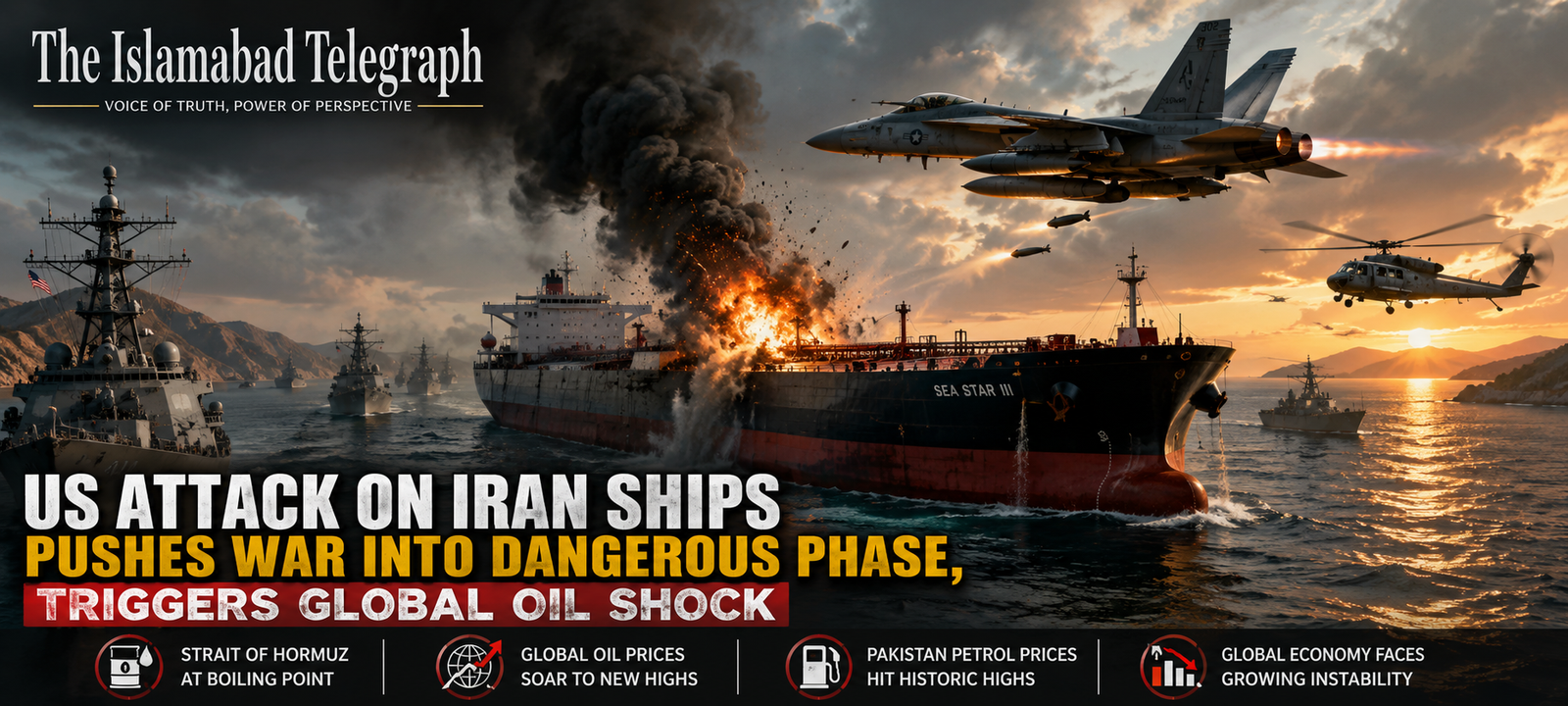
- US attack on Iran ships signals a major escalation in the Gulf conflict
- Strait of Hormuz disruption threatens over 20% of global oil supply
- Pakistan increases petrol and diesel prices to historic levels amid global surge
- Experts warn of prolonged war, economic instability, and global recession risks
The United States’ direct strike on Iranian-flagged oil tankers in the Gulf of Oman has pushed the already volatile U.S.–Iran confrontation into what analysts are calling its most dangerous phase yet—one that now threatens not only regional stability but the fragile architecture of the global economy.
Late this week, U.S. Navy F/A-18 Super Hornets launched from the aircraft carrier USS George H.W. Bush fired precision munitions at two Iranian tankers—Sea Star III and Seveda—effectively disabling them as they attempted to approach Iranian ports. The strikes, confirmed by U.S. Central Command, were framed as part of Washington’s expanding naval blockade aimed at choking Tehran’s oil exports and forcing compliance with a broader peace framework.
But the attack marks a decisive shift. For the first time in weeks, the United States has directly targeted Iranian commercial maritime assets, blurring the line between “deterrence” and open warfare.
Tehran responded with fury. Foreign Minister Abbas Araghchi denounced the strikes as a “reckless military adventure,” accusing Washington of sabotaging diplomatic progress. Within hours, Iranian forces launched retaliatory missile and drone operations, claiming to have targeted U.S. destroyers in the Strait of Hormuz—though Washington insists no damage was sustained.
Strait of Hormuz on a Knife-Edge: US-Iran Clashes Threaten Ceasefire as Tehran Strikes UAE Targets
The exchange underscores a grim reality: despite official rhetoric insisting that a ceasefire remains intact, the conflict is rapidly spiraling beyond control.
Strait of Hormuz: The World’s Economic Chokepoint
At the heart of this escalation lies the Strait of Hormuz, the narrow maritime corridor through which more than 20 percent of the world’s oil and gas supplies pass. The U.S. blockade—combined with Iran’s countermeasures, including mines and restrictions on shipping—has effectively paralyzed one of the most critical arteries of global trade.
The Slow Suffocation of Britain’s Independent Education
More than 70 oil tankers are currently stranded or rerouted, holding an estimated 166 million barrels of crude worth over $13 billion. Energy markets have reacted with immediate volatility, with global oil prices surging amid fears of prolonged disruption.
The economic ripple effects are already being felt far beyond the Gulf.
Pakistan Feels the Shock
In Pakistan, the crisis has translated into a sharp and immediate increase in petroleum prices, with the government announcing overnight hikes that have pushed petrol and diesel rates to historic highs.
US-Iran Deal Nears Breakthrough as Trump Eyes Historic Islamabad Visit to Seal Regional Peace
Officials justified the move as an unavoidable response to rising international oil prices, directly linked to the Strait of Hormuz crisis. With Pakistan heavily reliant on imported fuel, any disruption in global supply chains quickly feeds into domestic inflation—further burdening an already strained economy.
For ordinary citizens, the consequences are stark: higher transportation costs, rising food prices, and increased pressure on household budgets. Economists warn that if the crisis persists, Pakistan could face a renewed inflationary wave, undermining recent efforts at economic stabilization.
U.S. strikes two Iranian-flagged tankers as tensions continue amid ceasefire
A War Without Boundaries
What makes the current phase particularly dangerous is the widening geographic and strategic scope of the conflict.
Iran US Talks Islamabad Resume Without VP JD Vance as High-Stakes Negotiations Enter Critical Phase
In recent days, the United Arab Emirates reported intercepting Iranian ballistic missiles and drones, while Iran accused Emirati aircraft of participating in U.S.-aligned strikes on Qeshm Island and Bandar Abbas. These allegations, whether confirmed or not, highlight the risk of regional spillover, drawing Gulf states deeper into the confrontation.
Meanwhile, both Washington and Tehran continue to present sharply conflicting narratives of the same events—each claiming defensive action while accusing the other of aggression. This information war further complicates diplomatic efforts, as trust between the parties erodes.
Despite ongoing negotiations, including indirect contacts facilitated by regional and global powers, the military tempo suggests that both sides are preparing for a prolonged standoff.
Diplomacy on the Brink
The Trump administration insists that a diplomatic breakthrough remains possible. Secretary of State Marco Rubio, speaking from Rome, said Washington is awaiting Tehran’s response to a revised peace proposal that demands free navigation through the Strait of Hormuz and the removal of Iranian naval mines.
President Donald Trump has oscillated between optimism and угрозы, warning that failure to reach a deal could result in intensified military action “at a much higher level.”
Iran, however, has made clear that any agreement must include the lifting of the U.S. naval blockade—an issue Washington has so far refused to concede.
This fundamental deadlock lies at the core of the crisis.
Even as both sides speak of negotiations, their actions tell a different story: a steady escalation that risks crossing the threshold into full-scale war.
Global Markets on Edge
The economic stakes could not be higher. Beyond oil prices, the Strait of Hormuz disruption threatens global supply chains, shipping routes, and investor confidence.
Asian economies, heavily dependent on Gulf energy imports, are particularly vulnerable. European markets have also shown signs of तनाव, with energy stocks fluctuating and inflation concerns resurfacing.
For the United States, the conflict presents a complex dilemma. While the blockade aims to pressure Iran economically, it also risks destabilizing global markets and alienating allies concerned about the broader consequences.
China and Russia, both with strategic interests in the region and veto power at the United Nations, have already signaled opposition to unilateral U.S. actions—raising the probablity of geopolitical polarization reminiscent of earlier global crises.
Forecast: A Precarious Path Ahead
Looking ahead, three scenarios appear increasingly plausible.
First, a managed de-escalation remains possible if Iran responds positively to the U.S. proposal and both sides agree to confidence-building measures, including partial lifting of restrictions in the Strait of Hormuz. However, this would require significant concessions from both parties—something that currently appears unlikely.
Second, a prolonged low-intensity conflict could emerge, characterized by intermittent strikes, maritime confrontations, and economic pressure. This scenario, already taking shape, would keep global markets in a state of постоянной uncertainty while avoiding outright war.
The third—and most concerning—scenario is full-scale regional escalation. Any miscalculation, such as a direct hit on U.S. naval assets or a крупная attack on Gulf infrastructure, could trigger a broader war involving multiple states, with catastrophic consequences for global energy security and economic stability.
A Tipping Point for Global Order
The U.S. strike on Iranian tankers may ultimately be remembered as the moment when a contained conflict tipped into something far more dangerous.
For now, the Strait of Hormuz remains a flashpoint where military strategy, economy, and geopolitical rivalries converge. Each new exchange of fire brings the world closer to a tipping point—one where the costs of conflict could far exceed the calculations of those driving it.
As oil prices climb and tensions mount, the question is no longer whether the world will feel the impact of this crisis—but how severe and lasting that impact will be.
For countries like Pakistan, already grappling with economic challenges, the answer may define not just the months ahead, but the trajectory of recovery itself.