



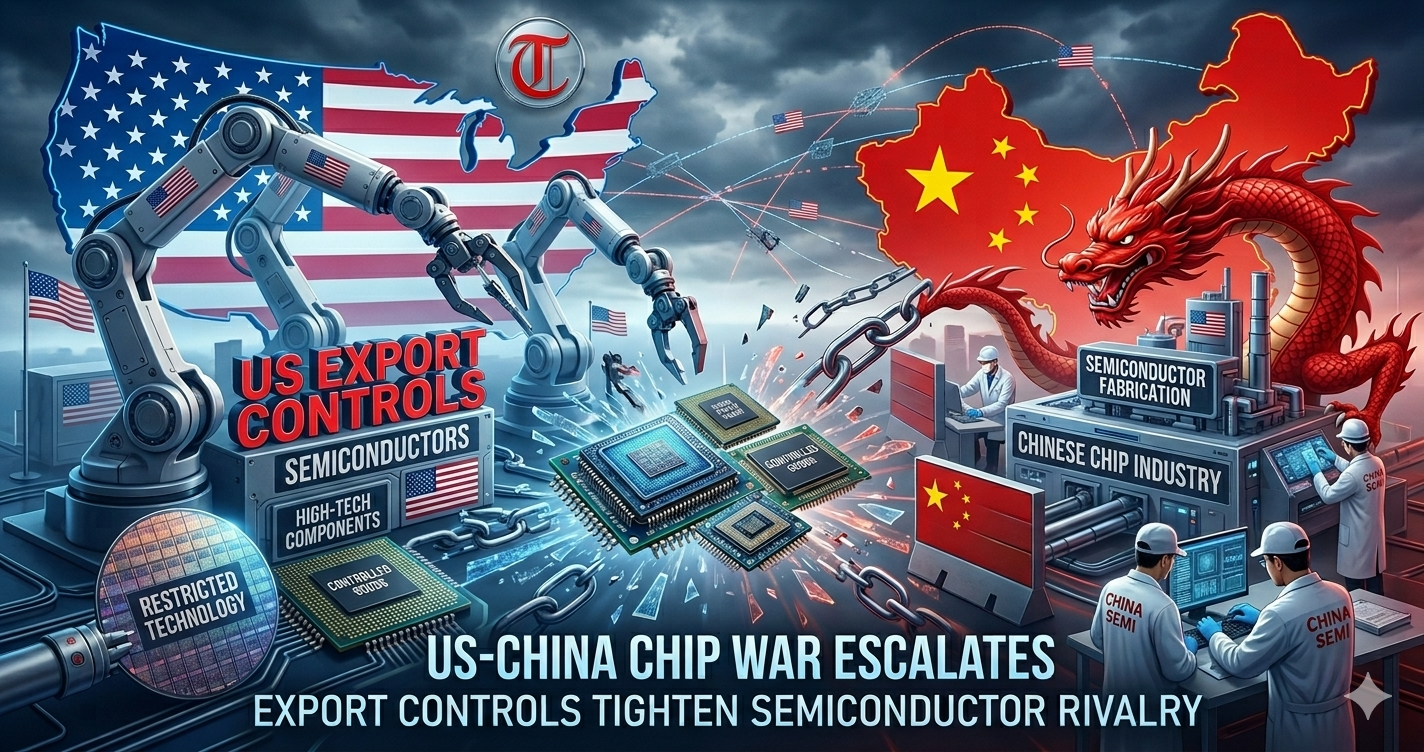
- US China chip war is intensifying as Washington tightens export controls on advanced semiconductor tools targeting Chinese chipmakers like Hua Hong and SMIC.
- U.S. chip equipment giants face billions in potential revenue losses as China represents a major global market for semiconductor machinery.
- China is accelerating domestic chip production and AI chip development to reduce dependence on U.S. technology and equipment.
- The semiconductor rivalry is reshaping global supply chains, pushing the world toward a fragmented and politically divided tech ecosystem.
The US China chip war has entered a sharper phase as Washington intensifies restrictions on China’s semiconductor ambitions, while Beijing accelerates its drive for technological self-reliance. The latest move by the U.S. Department of Commerce—blocking certain chip equipment shipments to Hua Hong and its subsidiaries—signals a renewed push to contain China’s progress in advanced chip manufacturing.
The decision directly targets critical tools used in producing cutting-edge semiconductors essential for artificial intelligence, defense systems, and next-generation computing.
This escalating rivalry is no longer limited to trade disputes. It has become a structural competition shaping global supply chains, investment flows, and the future of AI dominance.
US China chip war impacts China’s semiconductor production
China’s chip sector, already under pressure from years of export restrictions, faces new constraints as U.S. authorities tighten control over equipment exports. Companies like Lam Research, Applied Materials, and KLA have been instructed to halt shipments to facilities linked to Hua Hong, including operations believed to be working on advanced node technologies.
China’s factory activity set to expand at a slower clip in April: Reuters poll
Hua Hong’s subsidiary Huali Microelectronics has reportedly been developing a 7-nanometer chip process, a milestone that would significantly narrow the gap with global leaders. Only a few firms globally, including Taiwan’s TSMC and China’s SMIC, have achieved such capability at scale.
However, U.S. export restrictions on extreme ultraviolet (EUV) and advanced lithography tools are slowing production ramp-up. Analysts estimate that China still imports over $350 billion annually in semiconductor-related components and equipment, with U.S. firms previously accounting for a major share of advanced fabrication tools.
Trump Iran Proposal Shift After Mystery Call Signals Possible Breakthrough in Strait of Hormuz Crisis
Despite restrictions, China is increasing state-backed investment. Huawei, blacklisted by Washington, is collaborating with domestic foundries like Hua Hong and SMIC to reduce dependency on foreign technology. Still, experts warn that supply chain gaps in high-end tools could delay China’s self-sufficiency goals beyond 2030.
US chip war pressure hits American semiconductor revenues
While Washington aims to secure technological leadership, the US China chip war is also creating financial headwinds for American firms. Chip equipment giants are among the biggest immediate losers of tightening export controls.
Following the latest restrictions, shares of Applied Materials fell 5.8%, KLA dropped 4.7%, and Lam Research declined 3.1%, reflecting investor concerns over reduced China exposure. China has historically accounted for 20–30% of revenue for major U.S. semiconductor equipment suppliers, making it one of their most important markets.
Strait of Hormuz Impact on Singapore: Energy Shock Threatens Asia’s Trade Lifeline
Beyond equipment makers, the broader U.S. semiconductor ecosystem—including AI chip leaders like Nvidia and AMD—has already faced earlier export restrictions that limited high-end chip sales to Chinese data centers and AI developers.
Industry analysts estimate that ongoing controls could result in billions of dollars in lost annual revenue for U.S. firms if China continues to localize supply chains successfully.
Semiconductor trade war reshapes global supply chains
The semiconductor rivalry is also reshaping global trade dynamics. The U.S. is using “is-informed” letters and licensing rules to rapidly impose targeted restrictions without lengthy regulatory processes. These tools were previously used against Nvidia, AMD, and major equipment suppliers to curb advanced chip exports.
China, in response, has expanded its own countermeasures, including export controls on rare earth materials critical for electronics manufacturing. With China supplying nearly 70% of global rare earth processing, this gives Beijing leverage in the broader technology supply chain conflict.
The growing friction has also complicated diplomatic engagement. While upcoming U.S.-China leadership meetings aim to stabilize relations, analysts expect limited breakthroughs as both sides prioritize technological security over trade normalization.
AI chips, decoupling, and the future of US China chip war
At the core of the US China chip war is the race for artificial intelligence dominance. AI chips require extreme computational power and advanced manufacturing nodes, areas where the U.S. currently leads through companies like Nvidia, while China is rapidly investing to close the gap.
The global semiconductor industry—valued at over $600 billion and projected to surpass $1 trillion by the early 2030s—is increasingly splitting into two ecosystems: a U.S.-aligned supply chain and a China-centered alternative.
If current trends continue, the world could see a “technological bifurcation” where AI, defense systems, and cloud computing infrastructures operate on separate semiconductor standards.
For now, neither Washington nor Beijing appears ready to slow down. Instead, the chip war is accelerating, reshaping not just trade flows but the very architecture of global technological power.