


-
Taliban accuse the U.S. of US Drone Violations via Pakistan, calling it a breach of sovereignty.
-
Zabihullah Mujahid says drones enter Afghan skies through Pakistani territory.
-
Kabul rejects U.S. request to regain control of Bagram Air Base, angering Washington.
-
TTP issue deepens mistrust as Kabul and Islamabad trade blame over militancy.
In a striking accusation that could inflame already strained regional relations, a senior Taliban official has claimed that American drones are routinely violating Afghan airspace through Pakistan’s territory. The allegation of US Drone Violations via Pakistan comes at a time when ties between Kabul and Islamabad are at an all-time low following deadly border clashes and rising mistrust.
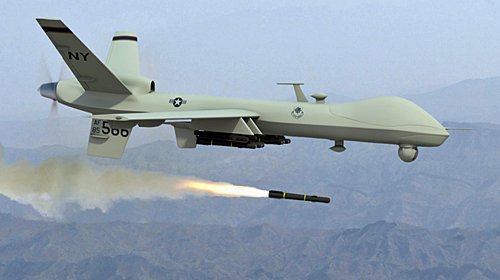
Zabihullah Mujahid, the chief spokesperson for the Islamic Emirate of Afghanistan, told TOLOnews that US Drone Violations via Pakistan were ongoing, accusing Islamabad of turning a blind eye. He warned that such actions amounted to a breach of sovereignty and reflected Pakistan’s inability—or unwillingness—to stop them.
“American drones are indeed operating in Afghanistan’s skies; they pass through Pakistani airspace and violate our airspace. This must not happen. They [Pakistan] are helpless here—they can’t stop it,” Mujahid said, calling it a “form of incapability.”
His comments have sent ripples across the region, where tensions between Kabul and Islamabad are already high after recent cross-border skirmishes.
Trump Halts Tomahawk Deliveries to Ukraine in Shock Decision That Stuns Europe and Delights Moscow
Analysts say the Taliban’s statement serves a dual purpose: to criticize the United States for US Drone Violations via Pakistan and to pressure Pakistan for allegedly facilitating the incursions.
Drone Flights Rekindle Old Shadows
American drone activity over Afghanistan is not new. For decades, U.S. drones have monitored Afghan territory for counterterrorism purposes. However, Mujahid’s claim that these flights are using Pakistani airspace adds a dangerous twist to the narrative.
READ MORE: Mujahid: U.S. Drones Violating Afghan Airspace via Pakistan
The Taliban say US Drone Violations via Pakistan represent a violation of Afghan sovereignty and prove that Islamabad remains complicit in U.S. military operations in the region.
Washington has not commented on the claim, but intelligence experts acknowledge continued surveillance flights targeting ISIS-K and other militant networks. Pakistan, for its part, has consistently denied allowing U.S. forces to use its territory since the American withdrawal in 2021.
A Diplomatic Triangle of Distrust
The timing of these accusations over US Drone Violations via Pakistan is notable. Relations between the Taliban and the Trump administration have worsened after Kabul reportedly refused a U.S. proposal to lease back Bagram Air Base — once the nerve center of American operations.
ALSO READ: International Force to Police Gaza: Can Muslim Nations Secure the Enclave?
By rejecting the offer, the Taliban reaffirmed their sovereignty but shocked Washington. The U.S. considered Bagram essential for regional intelligence gathering, especially in monitoring Afghanistan’s volatile east and north.
“We suspect that major global powers—those who once clashed with us or claimed Bagram—are behind this pressure,” Mujahid said. “They don’t come directly, but they assign others to provoke unrest in the region and create pretexts.”
The statement hints at Taliban suspicions that both Washington and Islamabad could be colluding to keep Afghanistan under indirect pressure through drone surveillance.
Afghanistan-Pakistan Rift Over TTP
At the core of the current rift lies the issue of Tehrik-i-Taliban Pakistan (TTP). Islamabad has long accused Kabul of harboring militants responsible for attacks inside Pakistan. However, Mujahid dismissed these allegations, saying that the Taliban government does not allow any group to operate against other nations.
“In both the Doha and Istanbul meetings, Pakistan’s demand has been that TTP is a problem for them, and the Islamic Emirate must control it,” Mujahid explained. “We’ve made it clear that while we do not allow TTP to operate against any country from Afghan soil, Pakistan is now asking us to control TTP inside Pakistan, which is beyond our jurisdiction.”
He further argued that TTP’s existence is the result of Islamabad’s own “failed policies” in its tribal regions — not Kabul’s complicity.
This blame game, combined with US Drone Violations via Pakistan, has plunged relations between the two countries to their lowest point since the Taliban’s return to power in 2021.
Strategic Blame or Tactical Messaging?
Regional experts interpret Mujahid’s statements on US Drone Violations via Pakistan as an attempt to reframe Afghanistan’s geopolitical narrative. By accusing both the U.S. and Pakistan, the Taliban government portrays itself as a victim of external interference while avoiding responsibility for its internal governance struggles.
“By highlighting drone incursions, the Taliban seek to shift focus from Afghanistan’s domestic crises to perceived foreign threats,” said a Kabul-based security analyst. “It’s both a political maneuver and a signal of growing defiance.”
A Fragile Future
The accusation of US Drone Violations via Pakistan underscores the fragile triangle connecting Washington, Islamabad, and Kabul. Pakistan remains Afghanistan’s primary trade partner and border lifeline, yet mutual trust is evaporating fast.
Meanwhile, the U.S. continues to rely on remote surveillance to track terrorist threats in the region, further complicating the balance of power.
As Zabihullah Mujahid warned:
“We stand firm against any conspiracy and won’t allow misguided ambitions to become reality in the region.”
But as border violence, militant resurgence, and US Drone Violations via Pakistan converge, the path toward regional stability looks increasingly uncertain.