



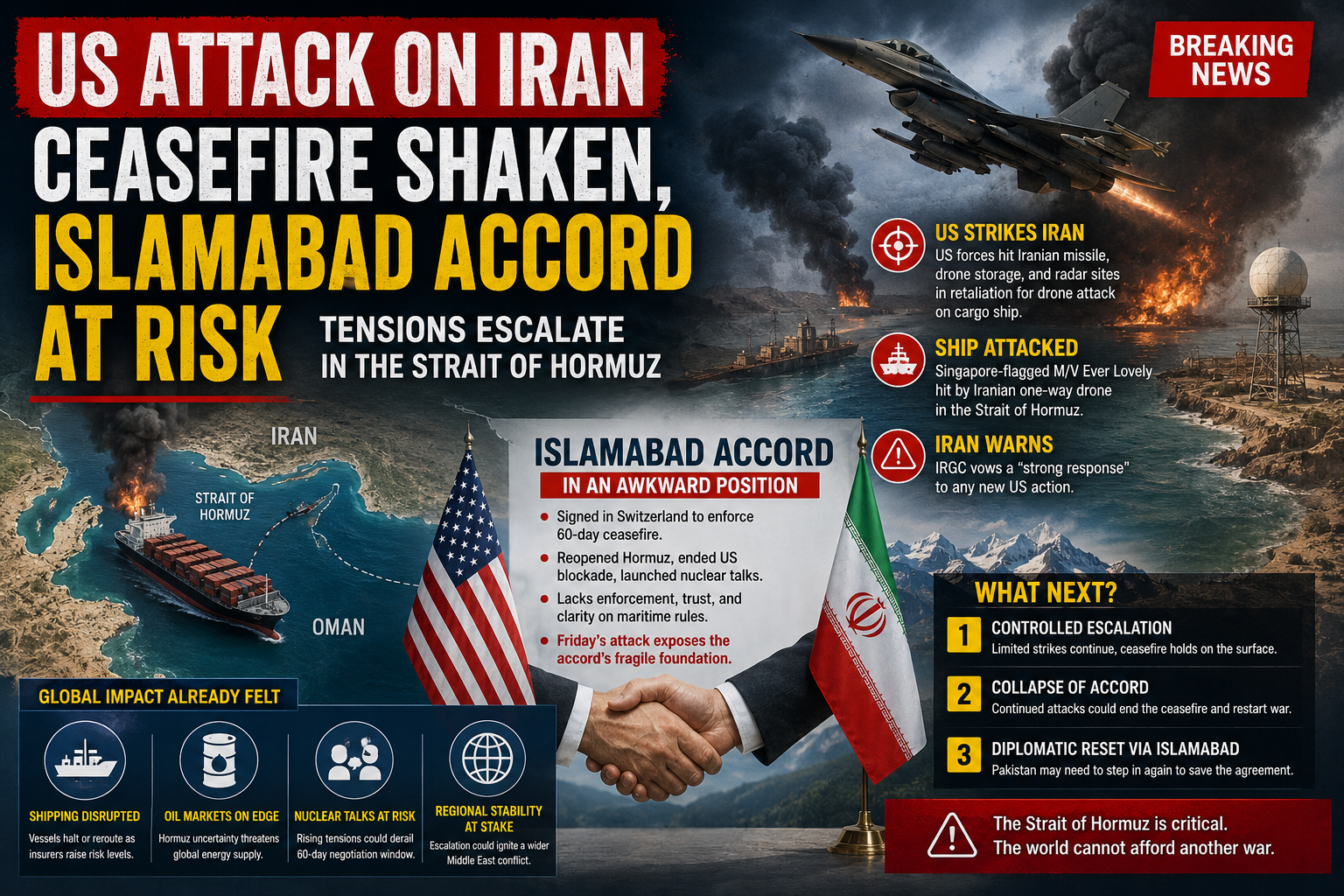
- US strikes Iran Strait of Hormuz escalate sharply after attacks on commercial shipping, signaling a decisive military shift by Washington
- Iran retaliates with missile and drone attacks on US bases across the Gulf, widening the regional conflict footprint
- The Strait of Hormuz, carrying nearly 20% of global oil, faces severe disruption risks amid rising tensions
- Global markets and energy security are under pressure as prolonged conflict threatens supply chains and oil price stability
The Middle East is once again on the brink. In what officials describe as the most intense and precise military action in recent weeks, the United States launched a third consecutive wave of strikes deep inside Iranian military infrastructure, marking a sharp escalation in a conflict that is rapidly spilling beyond bilateral confrontation into a wider regional crisis.
According to senior sources familiar with internal deliberations, the latest strikes were authorized after U.S. intelligence agencies presented then-President Donald Trump with what was described as a “highly credible and deeply alarming” Iranian plot to assassinate him. The briefing, officials said, detailed operational scenarios so severe that Trump “watched the presentation without pause,” signaling the gravity of the threat.
“It’s time to teach Iran,” a source quoted Trump as saying before authorizing the latest round of strikes.
Precision Strikes Signal Strategic Shift
The U.S. military confirmed that more than 140 Iranian targets were struck overnight using a combination of fighter jets, long-range missiles, drones, and naval assets. The targets included radar installations, missile launch systems, drone depots, and logistics hubs concentrated around the Strait of Hormuz—arguably the most critical energy chokepoint in the world.
This latest wave is significantly larger than previous operations and appears designed not only to degrade Iran’s operational capacity but also to reassert U.S. dominance over maritime security in the Gulf.
“Iran made a poor choice. Now they pay,” U.S. Defense Secretary Pete Hegseth stated, underscoring Washington’s hardened posture.
Trump Administration Increasingly Pessimistic of Clinching Iran Nuclear Deal
Military analysts estimate that the strikes have temporarily disrupted up to 30–40 percent of Iran’s tactical missile deployment capacity in southern regions, though Tehran retains significant asymmetric capabilities, particularly through the Islamic Revolutionary Guard Corps (IRGC).
Hormuz: The Epicenter of Escalation
At the heart of the crisis lies the Strait of Hormuz, through which nearly 20 percent of global oil and close to one-third of liquefied natural gas (LNG) supplies transit daily. Before the conflict intensified, an estimated 17 to 20 million barrels of crude oil passed through the narrow waterway each day.
The latest escalation was triggered after IRGC forces struck a Cyprus-flagged commercial vessel near the Omani corridor of the strait. The attack caused significant damage to the ship’s engine room, ignited a fire onboard, and left one crew member missing, according to U.S. military officials.
Iran defended the action, claiming the vessel had used an “unauthorized route” and asserting its authority over maritime traffic. The IRGC subsequently declared the Strait of Hormuz effectively closed, a move that has sent shockwaves through global energy markets and shipping corridors.
Iran plot to kill Trump: Israel Warns of Iranian Plot to Kill Trump as War Enters Perilous New Phase
In response, the U.S. has intensified its naval operations, stating it has facilitated the safe passage of over 800 commercial vessels and approximately 380 million barrels of crude oil since early May, despite persistent Iranian threats.
Regional Fallout: War Expands Beyond Borders
The confrontation is no longer confined to U.S.-Iran dynamics. Iran has retaliated by launching missiles and drones toward U.S. military installations in Qatar, Bahrain, the United Arab Emirates, and Jordan—countries that host critical American bases.
Regional defense systems have intercepted many of these projectiles, but the scale and frequency of attacks underscore a widening conflict theatre. Gulf states, already wary of escalation, are now balancing defense coordination with diplomatic efforts to prevent full-scale war.
Qatar, which has played a key mediating role, finds itself in an increasingly precarious position as both a diplomatic intermediary and a potential target.
Diplomacy Collapses as Hardliners Gain Ground
The renewed violence has severely undermined the fragile diplomatic framework established under the June Memorandum of Understanding (MoU), which had aimed to pause hostilities for 60 days and reopen the Strait of Hormuz.
While Iranian negotiators had signaled willingness to continue talks, U.S. officials now believe hardline elements within the IRGC have effectively derailed the process. These factions argue that control over the strait provides Tehran with critical leverage to force sanctions relief and military concessions from Washington.
The U.S., however, views Iran’s actions as a direct violation of the MoU, particularly its commitment to ensure safe and unimpeded commercial passage through the strait.
The White House had demanded that Iran publicly guarantee the reopening of Hormuz and cease attacks on shipping. Instead, Tehran doubled down—declaring control over transit routes and signaling plans to impose a toll system on vessels.
Europe Enters the Equation: Paying for Passage
Amid the chaos, European governments—many of them NATO members—are quietly reassessing their long-standing position on free navigation. According to diplomatic insiders, there is growing willingness across Europe to accept modest, voluntary transit fees for vessels passing through the Strait of Hormuz, provided they are tied to safety and remain within international legal frameworks.
Shipping giants and insurers have played a decisive role in shaping this shift. War risk premiums have surged by as much as 50–70 percent in recent weeks, while rerouting costs have added billions to global supply chains.
The proposed model draws inspiration from the Strait of Malacca, where over 120,000 vessels transit annually under a cooperative framework funded by voluntary contributions from user states.
However, critical questions remain unresolved: Who collects the fees—Iran or Oman? Can ships bypass Iranian claims by using Omani-controlled waters? And how can such a system avoid legitimizing unilateral control?
Global Markets on Edge
Energy markets have responded with volatility. Brent crude has fluctuated sharply, with analysts warning that any prolonged closure of Hormuz could push prices beyond $120 per barrel. LNG markets in Europe and Asia are also under strain, with supply disruptions threatening winter energy security.
Major financial centers—from Wall Street to Singapore—are closely monitoring developments, with investors pricing in heightened geopolitical risk.
Forecast: A Prolonged and Dangerous Standoff
The trajectory of the conflict suggests a prolonged standoff rather than a quick resolution. Three key scenarios are emerging:
First, a controlled escalation where both sides continue limited strikes while avoiding full-scale war.
Second, a breakdown leading to sustained disruption of Hormuz, triggering a global energy shock.
Third, renewed diplomacy under international pressure, potentially involving regional mediators such as Qatar, Oman, and Pakistan.
For now, the balance appears tilted toward continued instability. With diplomacy faltering, military actions intensifying, and global stakes rising, the Strait of Hormuz is no longer just a maritime corridor—it is the fault line of a rapidly evolving geopolitical crisis.
“This is no longer about navigation. It is about control, leverage, and the future architecture of global energy security,” a senior diplomat observed told this this correspondent.