



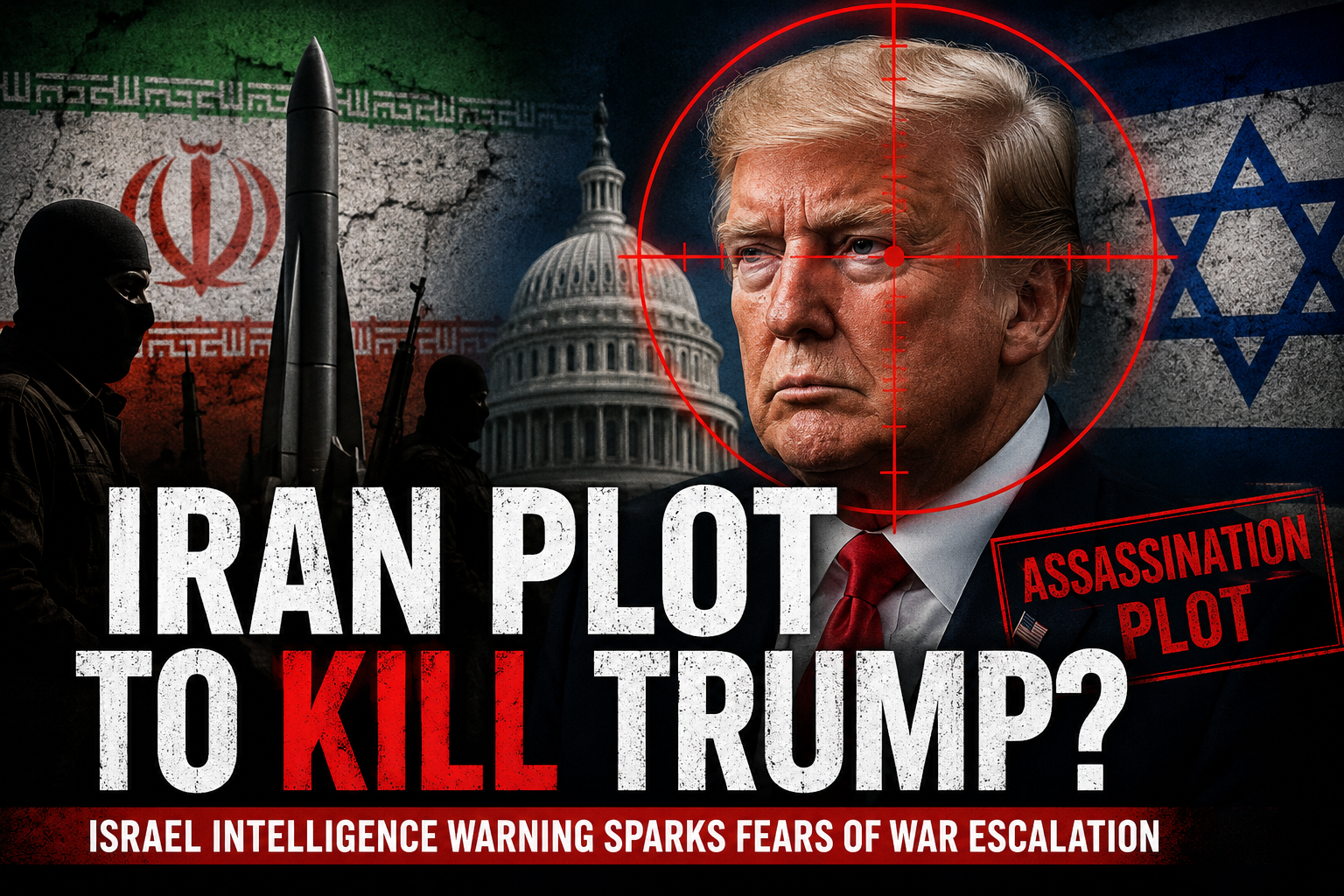
- Iran plot to kill Trump.Israel warns of a new Iranian plot targeting Donald Trump’s life
- Intelligence sharing sparks fears of major U.S.–Iran escalation
- Trump’s inner circle reportedly already anticipating such threats
- Assassination fears could collapse fragile ceasefire efforts
In a bombshell development that threatens to dramatically escalate the already volatile U.S.–Iran confrontation, Israel has quietly shared intelligence with Washington indicating a fresh Iranian plot to assassinate President Donald Trump—an allegation that, if substantiated, could push the conflict into an unprecedented and deeply personal phase of warfare.
According to people familiar with the intelligence exchange, Israeli officials recently briefed their U.S. counterparts on what they described as credible indicators of a renewed Iranian plan targeting Trump. The intelligence, described by insiders as “specific but evolving,” has triggered alarm within Trump’s inner circle, prompting urgent reassessments of presidential security protocols.
Trump—who has survived multiple alleged assassination attempts in the past—has reportedly directed his security apparatus, including key intelligence agencies, to treat the threat with the utmost seriousness. Sources close to the president told The Islamabad Telegraph that Trump was neither surprised nor unprepared.
“He had been expecting something like this,” one senior figure within Trump’s inner circle said. “After the death of Iran’s late Supreme Leader, there was always a concern that retaliation might take a more direct and symbolic form.”
Notably, members of Trump’s political base and close advisers within the MAGA movement had raised alarms weeks before Israel’s intelligence sharing, warning of potential Iranian plots against the president. These warnings, initially dismissed by some officials as speculative, have now gained renewed credibility in light of the Israeli briefing.
A Threat Years in the Making
Iran’s hostility toward Trump is deeply rooted in the 2020 assassination of General Qassem Soleimani, one of the most powerful figures in Iran’s military establishment and a central architect of its regional strategy. Tehran has repeatedly vowed revenge, framing Soleimani’s killing as an act of state terrorism.
READ MORE: Inside the Trump Assassination Attempt That Turned a White House Gala Into Chaos
While Iranian officials have not issued any formal statement regarding the latest allegations, the absence of denial has done little to ease concerns in Washington. Iran’s mission to the United Nations did not respond to requests for comment, and Israeli officials have also maintained silence, declining to publicly confirm or deny the intelligence sharing.
Trump himself appeared to acknowledge the threat during remarks to reporters in Ankara.
“They want to take out the U.S. leader—me,” he said. “I’m on every list. I saw this morning, I’m on every single one of their lists. And so far, I guess I’ve been a little bit lucky, but that maybe doesn’t last very long.”
Fractures Within the U.S.–Israel Axis
The revelation comes at a delicate moment in U.S.–Israel relations. Once closely aligned on Iran, Trump and Israeli Prime Minister Benjamin Netanyahu are now showing signs of divergence over the trajectory of the war.
Netanyahu has pushed for sustained and intensified military operations aimed at crippling Iran’s strategic capabilities. Trump, by contrast, has increasingly signaled a desire to de-escalate, citing mounting concerns over the global economic fallout, particularly the impact on oil markets and financial stability.
RELATED NEWS: Iran Hatched Fresh Plot to Kill Trump, Israel Told U.S.
Despite these differences, both leaders spoke on Thursday and agreed to maintain coordination. However, officials familiar with recent exchanges describe their conversations as “tense” and “transactional,” a stark contrast to the close alignment seen at the outset of the conflict.
War Takes a Personal Turn
If confirmed, an Iranian plot targeting Trump would mark a dangerous escalation—transforming the conflict from a geopolitical and military confrontation into a personalized struggle between leadership figures.
Security analysts warn that such a shift could have far-reaching implications.
“This is no longer just about deterrence or regional dominance,” said a former U.S. intelligence official. “If leaders themselves become targets, it fundamentally changes the rules of engagement.”
The psychological impact alone could harden positions in Washington, making diplomatic off-ramps far more difficult to achieve. Any perceived direct threat to the U.S. president would likely trigger a forceful response, potentially expanding the scope of military operations against Iran.
Implications for the U.S.–Iran War
The timing of the intelligence is particularly significant. It arrives just weeks after a fragile ceasefire between the United States and Iran, brokered amid intense international pressure. That ceasefire now appears increasingly tenuous.
An assassination plot—real or perceived—could:
- Undermine ongoing diplomatic efforts and backchannel negotiations
- Justify renewed or intensified U.S. military strikes on Iranian assets
- Strengthen hardline factions within both Washington and Tehran
- Increase the risk of miscalculation, particularly in the Gulf region
Moreover, the development could embolden regional actors already aligned against Iran, potentially drawing them deeper into the conflict.
At the same time, it complicates Trump’s own strategic calculus. While he has shown interest in de-escalation, any credible threat to his life may force a more aggressive posture, both politically and militarily.
A Conflict at the Edge
For now, much remains uncertain. The intelligence has not been independently verified, and no official confirmation has been issued by either Israel or the United States. Yet the mere existence of such claims is enough to heighten tensions in an already combustible environment.
What is clear, however, is that the U.S.–Iran conflict is entering a new and more dangerous phase—one where the lines between battlefield and leadership, strategy and survival, are becoming increasingly blurred.
As one senior official put it bluntly: “When leaders become targets, wars stop being predictable.”
And unpredictability, in a conflict of this magnitude, may be the most dangerous escalation of all.