



- US strikes ISIS in Nigeria were executed via Tomahawk cruise missiles on Christmas Day 2025, targeting extremist strongholds in the Bauni forest of Sokoto State.
- The operation was a coordinated effort between U.S. Africa Command and Nigerian security forces to dismantle command and logistics hubs used by foreign fighters.
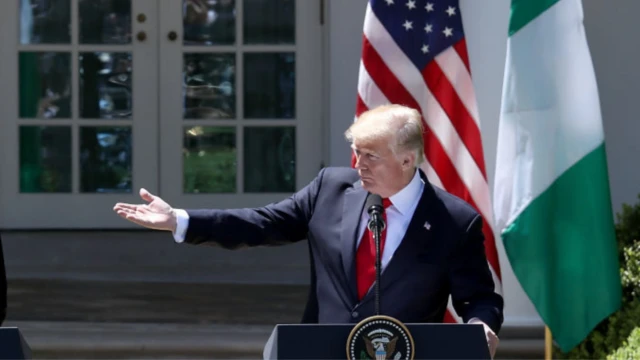
- President Trump framed the military action as a protective measure for persecuted Christian communities, marking a shift toward more symbolic and religiously-tied foreign policy.
- While the Nigerian government endorsed the strikes to stem rising violence, experts warn that military intervention must be paired with political reform to prevent further extremist recruitment.
The United States marked Christmas Day 2025 with an unexpected show of force in West Africa, launching precision missile strikes against Islamic State-linked targets deep inside northwestern Nigeria. The operation, carried out by U.S. Africa Command in coordination with Nigerian security services, signaled a sharp escalation in Washington’s counterterrorism posture on the continent and underscored President Donald Trump’s readiness to use military power far beyond traditional theaters of war.
The strikes targeted two suspected ISIS camps hidden in the Bauni forest of Sokoto State, a region increasingly drawn into Nigeria’s widening security crisis.
Tomahawk missiles were fired from a U.S. naval platform, striking what American officials described as command and logistics hubs used by foreign fighters affiliated with the Islamic State West Africa Province. Initial assessments suggested multiple militants were killed, with no confirmed civilian casualties, though residents in nearby villages reported panic, confusion, and shock as explosions echoed through the night.
READ MORE: Taliban Fighters Eliminate Six Terrorists in Kabul
President Trump announced the operation hours later, framing it in stark moral terms. He described the strike as decisive action against ISIS militants accused of massacring civilians, particularly Christian communities, in Nigeria’s volatile northwest. The language was unmistakably consistent with Trump’s broader foreign policy messaging in his second term: swift, symbolic, and explicitly tied to religious persecution narratives.
ALSO READ: Is Africa overtaking the Middle East as the new jihadist battleground?
Nigeria’s government moved quickly to endorse the operation, emphasizing that it was the product of joint intelligence cooperation and not a unilateral American action. Officials in Abuja stressed that the strikes were aimed at protecting all Nigerians—Muslims and Christians alike—from extremist violence that has surged across multiple regions of the country. The clarification reflected a delicate balancing act for a government wary of domestic backlash while under mounting pressure to stem the bloodshed.
The security context is grim. Nigeria has endured a dramatic escalation in militant violence throughout 2025, particularly in areas previously considered peripheral to the Boko Haram insurgency. Armed groups linked to ISIS have expanded westward from the northeast, exploiting weak governance, porous borders, and local grievances. More than two thousand people were killed in violent incidents during the first half of the year alone, with attacks targeting villages, markets, religious sites, and security forces.
For Washington, the Nigeria strike reflects a broader recalibration of U.S. counterterrorism strategy in Africa. Despite Trump’s 2024 campaign pledge to end “endless wars,” his administration has authorized military actions in Yemen, Syria, Iran-linked targets, and now Nigeria. The emphasis is on limited, high-impact operations designed to deter extremist groups without committing large numbers of U.S. troops—a doctrine increasingly visible across Trump’s foreign policy.
Senior U.S. defense officials framed the Nigeria strikes as part of a preventive strategy, arguing that ISIS affiliates in Africa pose a long-term threat even if they lack the immediate capacity to strike the American homeland. Similar logic has guided U.S. operations in Somalia and the Sahel, where militant groups have adapted quickly to local conditions and regional instability.
From Nigeria’s perspective, the strikes offer short-term relief against groups such as ISWAP and Lakurawa, which have overwhelmed local security forces and displaced tens of thousands of civilians. Yet the risks are substantial. Critics warn that airstrikes alone cannot resolve conflicts rooted in poverty, climate stress, and political marginalization. There is concern that visible U.S. involvement could fuel extremist recruitment, intensify anti-Western sentiment, and deepen mistrust among communities already skeptical of the central government.
Trump’s repeated emphasis on Christian persecution adds another layer of complexity. While attacks on churches and Christian communities are real and devastating, Nigeria’s violence cuts across religious lines. Muslim communities have also suffered mass killings for resisting extremist ideology. Framing the conflict narrowly risks alienating the country’s Muslim-majority north and complicating a fragile national consensus against terrorism.
The strikes also carry geopolitical implications. They signal renewed American unilateralism in Africa at a time when China and Russia have expanded their footprint through security partnerships and infrastructure investments. For some African leaders, U.S. military action is a reassurance of continued engagement; for others, it revives anxieties about sovereignty and external interference.
Supporters of the operation in Washington hailed it as a necessary and overdue blow against ISIS expansion in Africa. Skeptics, however, warned of mission creep. U.S. officials have hinted that further actions may follow, including intelligence-sharing, drone surveillance, and training missions aimed at disrupting militant networks crossing into Nigeria from Mali and Niger.
Nigerian leaders have left the door open to continued cooperation, describing the operation as part of an evolving security framework rather than a one-off event. Still, the country’s overstretched military faces multiple insurgencies simultaneously, raising doubts about its ability to consolidate gains without broader reforms.
As 2025 draws to a close, the Christmas Day strike in Nigeria encapsulates the Trump doctrine in practice: fast, forceful, and freighted with symbolism. Whether it becomes a catalyst for sustained cooperation or a spark for deeper instability in West Africa will depend not only on military precision, but on political restraint, regional diplomacy, and a willingness to address the conditions that allow extremism to endure.