



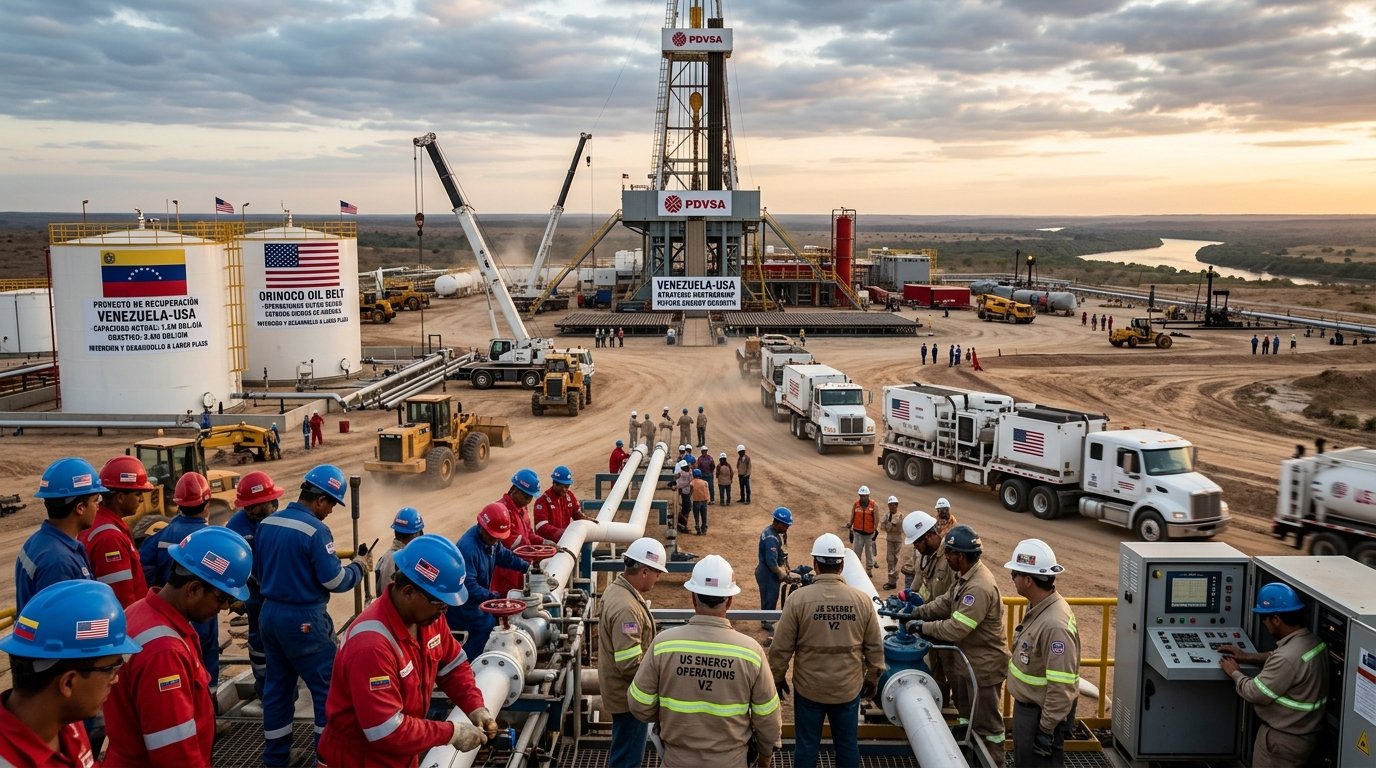
- Venezuelan oil reserves represent the largest proven crude deposits in the world, yet decades of infrastructure neglect mean domestic production cannot immediately scale up.
- Washington’s decisive move to halt export flows to Beijing forces Chinese refiners to seek costlier heavy crude alternatives.
- Massive operational rehabilitation—requiring roughly $100 billion in long-term capital—stands between current output and historical yield capacity.
- Securing primary operational oversight over Orinoco Belt exports grants the U.S. enduring authority over global energy market mechanics.
The geopolitical landscape underwent a massive shift following the capture of Nicolás Maduro in early 2026, as detailed by CNN, when Washington moved swiftly to take control of Venezuelan oil distribution channels and halt sales to Beijing. As analyzed in recent reporting by The Islamabad Telegraph, by cutting off China’s supply of discounted heavy crude, the Trump administration landed a direct blow against one of Beijing’s key energy lifelines.
Yet, despite the narrative surrounding access to the world’s largest proven oil reserves, coverage from the BBC shows that energy analysts and oil marketing experts broadly agree American consumers will not see immediate relief at the pump or in domestic supply chains.
READ NEXT: Maduro Arrest 2026: The Full Story of the US Raid in Caracas
The primary obstacle to short-term gain lies in the near-total collapse of Venezuela’s energy infrastructure. Decades of operational mismanagement under the Maduro regime, combined with chronic underinvestment, looting, and sanctions, have left the country’s oil sector severely dilapidated.
In major extraction basins such as Maracaibo, only a tiny fraction of the thousands of existing wells are currently functional. Energy industry experts cited by The Wall Street Journal estimate that restoring Venezuela’s crude output back to historical levels of over 3 million barrels per day will demand upwards of $100 billion in private capital and at least three to five years of extensive reconstruction.
While U.S. Gulf Coast refineries are uniquely engineered to process heavy Venezuelan crude, current production volumes simply remain too meager to alter global supply curves or lower benchmark prices anytime soon.
However, as highlighted in regional commentaries by The Islamabad Telegraph, the immediate geopolitical dividend for the United States is already taking shape. By taking control of export sales and aggressively barring supply shipments to China, Washington has squeezed Beijing into sourcing more expensive alternatives, such as Canadian heavy crude, disrupting China’s energy planning.
READ MORE: Why Trump’s Venezuela oil deal will not bring quick relief to the U.S.
In the long run, analysts emphasize that this intervention provides the U.S. with extraordinary strategic leverage. Once heavy investment revitalizes the Orinoco Belt, high-volume Venezuelan crude will serve as a resilient, geographically secure energy buffer for the Western Hemisphere. Over a multi-year horizon, controlling this key supply channel grants the U.S. long-term structural authority over global pricing dynamics and a powerful counterweight against OPEC market controls.
The Trump administration’s long-term strategy for Venezuelan oil centers on institutionalizing U.S. control over Western Hemisphere energy supply chains. Following the high-profile historic oil framework negotiated between Washington and Caracas—securing majority operational governance over roughly 65 billion barrels of proven reserves—the White House is executing a multi-phased economic and geopolitical blueprint.
At the core of this approach is a heavy reliance on U.S. private capital and commercial partnerships to overhaul Venezuela’s decayed infrastructure. By deploying North American technology and capital investment into 17 strategic oilfields across the Orinoco Belt and Lake Maracaibo, Washington aims to scale production back toward historical targets of 1.5 million barrels per day.
Under this long-term concession model, the U.S. retains guaranteed off-take rights at production cost, ensuring a steady, discounted flow of heavy crude directly into Gulf Coast refineries and systematically refilling the U.S. Strategic Petroleum Reserve.
Geopolitically, the strategy acts as a permanent enforcement of the Monroe Doctrine. By locking out state-backed buyers from Beijing and Moscow, Washington permanently strips foreign rivals of discounted Latin American energy imports. The administration seeks to establish an enduring energy buffer that guarantees Western Hemisphere self-reliance, dampens global price shocks from Middle Eastern instability, and positions the U.S. as the primary orchestrator of global heavy crude pricing for decades to come.