



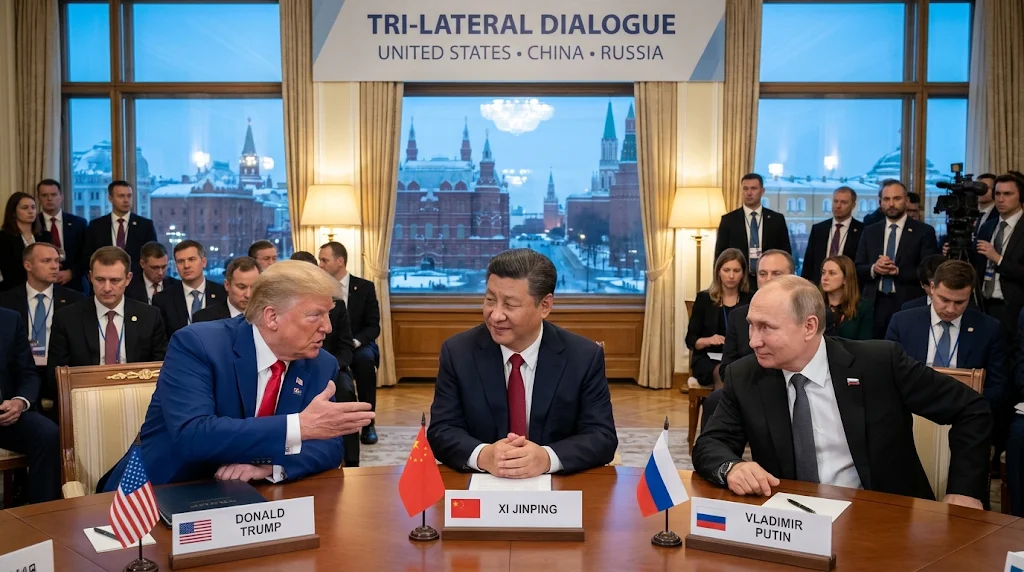
- US China Russia Summit: The summit centers on forging a modernized trilateral framework involving the U.S., China, and Russia following the expiration of the New START treaty.
- Conflict Resolution: Leaders aim to lay foundational diplomatic groundwork for ending protracted conflicts, including the wars in Ukraine and Iran.
- Global Realignment: The high-stakes meeting represents a major shift toward pragmatic great-power engagement in a multipolar international system.
ISLAMABAD — As international diplomacy braces for an unprecedented high-level gathering, the upcoming trilateral summit in Shenzhen between United States President Donald Trump, Chinese President Xi Jinping, and Russian President Vladimir Putin is rapidly crystallizing into the most consequential geopolitical summit of the decade.
Scheduled on the sidelines of the Asia-Pacific Economic Co-operative (APEC) summit, this high-stakes convergence of the world’s three most powerful leaders carries profound implications for global stability, strategic arms control, and the potential diplomatic resolution of active flashpoint conflicts.
While skepticism remains high among traditional Atlanticist observers regarding the optics of great-power bargaining, diplomatic analysts and regional insiders in Islamabad and major foreign policy capitals emphasize that the core catalyst for this meeting is singular and urgent: a coordinated push toward the global reduction of nuclear weapons.
The Core Agenda: Nuclear Arms Reduction and Strategic Stability
At the forefront of the agenda sits the critical imperative of strategic arms control. With the landmark New START nuclear arms treaty between Washington and Moscow having expired in February, the world’s two largest atomic arsenals currently operate without overarching bilateral guardrails for the first time in over half a century.
READ NEXT: Trump to meet with China’s Xi and Russia’s Putin at historic trilateral sit-down on nuclear non-proliferation
President Trump has consistently maintained that the proliferation of nuclear weapons represents an acute global danger. Moving beyond bilateral frameworks, the administration has insisted on forging a modernized, comprehensive trilateral framework that incorporates China—whose expanding nuclear capabilities have shifted the strategic calculus in the Indo-Pacific.
READ MORE: Trump Xi Summit 2026 Signals Global Reset as China Draws Taiwan Red Line
During the Shenzhen deliberations, the three leaders are expected to focus heavily on:
- Establishing a Post-New START Framework: Exploring foundational parameters for future nuclear arms reduction and transparency measures.
- Incorporating Beijing into Strategic Stability Dialogues: Engaging China on nuclear stockpile parameters as its strategic arsenal continues to modernize.
- Risk Mitigation and Crisis Communication: Setting up modernized channels to prevent accidental escalation among the world’s foremost nuclear-armed powers.
- Global Non-Proliferation Enforcement: Aligning major-power cooperation to curb dangerous proliferation trends in volatile regions.
While senior U.S. and regional officials have cautioned that immediate binding treaties are unlikely to be finalized during this inaugural leader-level session, the summit is explicitly designed to serve as the foundational entry point for sustained, productive disarmament negotiations moving forward.
US China Russia Summit: Laying the Diplomatic Foundation for Ending the Ukraine and Iran Conflicts
Beyond nuclear disarmament, strategic analysts point to the profound potential for this trilateral dialogue to lay the vital groundwork for ending ongoing protracted conflicts, specifically the wars in Ukraine and Iran.
READ NEXT: Putin Halts Kyiv Strike Until Feb 1 On Trump’s Request
The convergence of Washington, Moscow, and Beijing creates a unique diplomatic nexus where the principal backers and interlocutors of these regional conflicts are seated at the same table:
-
The Path Toward a Ukraine Settlement: Although diplomatic channels have historically bifurcated discussions regarding Eastern Europe, analysts suggest that direct engagement between Trump and Putin—with Xi acting as a crucial diplomatic anchor—could establish the baseline conditions for a negotiated end to the nearly five-year-old conflict. By addressing underlying European security architecture concerns and strategic stability principles, the summit may provide the diplomatic momentum required to transition from battlefield attrition to formal peace talks.
-
Resolving the Iran Conflict: With Beijing serving as Tehran’s premier trading partner and principal energy importer, and Washington navigating the complex fallout of the Iran war, China’s stabilizing economic and diplomatic leverage is viewed as indispensable. The Shenzhen talks are expected to explore multilateral guarantees and diplomatic off-ramps capable of securing open waterways, stabilizing regional energy markets, and charting a sustainable resolution to the conflict.
Geopolitical Realities and Regional Apprehensions
The prospective summit has inevitably stirred anxiety among excluded nations and regional blocs, particularly in Kyiv, Taipei, and European capitals. Critics have drawn comparisons to historical great-power partition moments, expressing concern that vital regional interests could be impacted by overarching geopolitical trade-offs.
However, proponents of the summit argue that breaking diplomatic ice between Washington, Moscow, and Beijing is an absolute necessity in a multipolar world no longer dominated by a single superpower coalition. As global powers navigate overlapping economic dependencies and security crises, the ability of Trump, Xi, and Putin to engage pragmatically across ideological divides may well determine whether the international system slides further into volatility or steps back toward structured stabilization.
As President Trump arrives in Shenzhen following his engagements in the Philippines, the eyes of the international community will be fixed on this historic trilateral table—watching to see if three of the world’s most influential leaders can successfully forge a new paradigm of nuclear restraint and regional peace.