



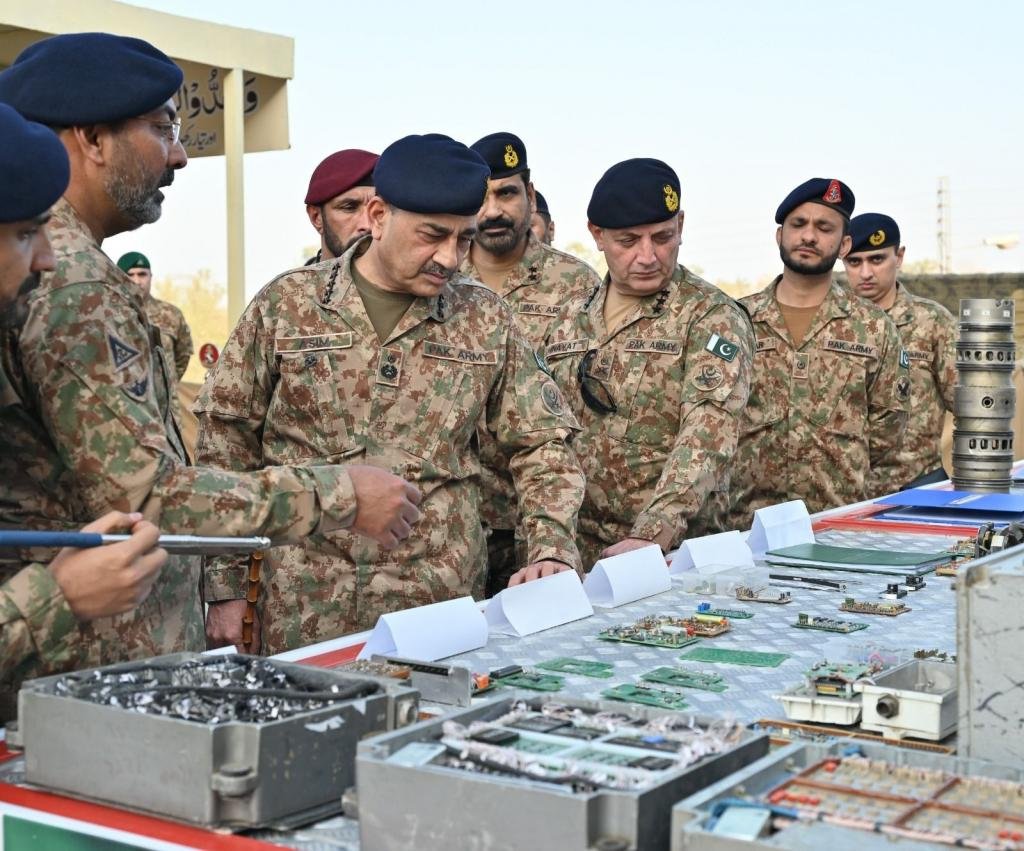
- Field Marshal Asim Munir military transformation showcases Pakistan’s shift toward technology-driven, multi-domain warfare through advanced drones, surveillance, and electronic warfare systems.
- Elite troops demonstrated high-intensity operational readiness during Exercise “Steadfast Resolve” at Khairpur Tamewali, reflecting months of rigorous modern training.
- Pakistan’s decisive May 2025 air superiority — including the downing of seven Indian fighter jets — validated the success of military reforms.
- Despite limited resources and budget constraints, Pakistan’s Armed Forces now rival leading global forces in innovation and preparedness.
Under a pale winter sun stretching across the dusty plains of Khairpur Tamewali, the thunder of armored vehicles, the sharp hum of unmanned aerial systems, and the crackle of electronic warfare simulations blended into a single message — Pakistan’s Armed Forces were preparing for the wars of tomorrow.
As Chief of Army Staff and Chief of Defence Forces, Field Marshal Syed Asim Munir stepped onto the observation post overlooking the vast exercise area, his posture was firm, his eyes scanning every movement with quiet intensity. This was not a ceremonial visit. This was the culmination of months of relentless training, innovation, and transformation.
The high-intensity field exercise, aptly named “Steadfast Resolve,” unfolded before him like a live battlefield laboratory. Swarms of drones maneuvered in coordinated formations, feeding real-time intelligence into advanced command-and-control centers. Surveillance assets tracked simulated enemy movements across long distances, while electronic warfare units jammed hostile signals, disrupting communications with surgical precision.
General Asim Munir and the Strategic Shift in South Asia’s Defense
Young officers, faces dusty but determined, moved seamlessly between digital displays and physical maneuvers. It was clear: this was no longer a force preparing for yesterday’s wars.
And Field Marshal Asim Munir knew it.
Those close enough to observe him noticed a rare softness behind the steel resolve — a mixture of pride, satisfaction, and quiet relief.

For months, the Field Marshal had driven an ambitious vision: transforming Pakistan’s military into a technologically empowered, multi-domain force capable of standing shoulder to shoulder with modern armies like those of the United States, China, and NATO. All of it, achieved under tight budgets and limited resources.
Many had doubted whether such transformation was possible.
But here, in Khairpur Tamewali, the results spoke louder than any speech.
When he finally addressed the troops, his voice carried across the field with calm authority.

He lauded their morale, professional competence, and operational preparedness, reaffirming that Pakistan’s Armed Forces remained fully ready to defend the nation’s sovereignty and territorial integrity against all threats. But he went further — stressing that the character of war had changed forever.
A Razor’s Edge Between India and Pakistan
“Technological manoeuvres will replace physical manoeuvres,” he emphasized, highlighting how innovation, indigenization, and rapid adaptation were now the foundations of modern warfare.
The transformation, he made clear, was already underway.
For many in uniform, this moment was deeply personal.
Soldiers and officers had spent countless months training beyond exhaustion — mastering drone operations, learning cyber-electronic combat tactics, integrating digital battlefield management systems, and pushing themselves past traditional limits.
Field Marshal Asim Munir’s Decisive Strike: Pakistan Destroys Taliban Command, Unmasks India’s Hidden Hand Behind Border Aggression
Their enthusiasm and determination now stood officially acknowledged by the highest military leadership.
Yet, this transformation did not begin in a vacuum.
Its urgency was forged in the fires of conflict.
In May 2025, the world witnessed a dramatic turning point in South Asian military dynamics. Amid rising tensions, Pakistan and India clashed in one of the most intense aerial confrontations in the region’s history.
According to Pakistani military sources, the Pakistan Air Force delivered a stunning blow — downing seven Indian fighter jets in rapid succession during high-speed aerial engagements. The precision, coordination, and electronic warfare superiority displayed by Pakistani pilots shocked regional observers.
The air battle tilted decisively in Pakistan’s favor.
Diplomatic channels soon lit up as India, facing mounting losses and escalation risks, reportedly sought U.S. intervention to halt the conflict. Within days, international mediation moved swiftly to cool tensions — a rare moment where Pakistan’s military strength forced a strategic pause.
For Field Marshal Asim Munir, the May 2025 confrontation validated years of reform.
But rather than resting on victory, he doubled down.
He stressed repeatedly that future conflicts would be faster, more technological, and far more complex — demanding constant evolution.
That mindset was evident throughout his visit.
Earlier in the day, the Field Marshal inaugurated the ROHI eSkills Learning Hub, aimed at equipping students from Southern Punjab and across Pakistan with digital competencies critical for the modern world. He also opened the APS Abbasia Campus, reinforcing the Army’s long-standing focus on education and character building.
Later, at the EME Regional Workshop, he was briefed on advanced maintenance regimes designed to sustain modern military platforms through indigenization and cutting-edge technologies — a crucial element in reducing dependence on foreign supply chains.
Upon his arrival at Bahawalpur Garrison, he had laid a floral wreath at Yadgar-e-Shuhada, offering Fateha for the martyrs whose sacrifices laid the foundation for today’s strength.
Throughout the visit, the mood among the troops was electric.
There was confidence — not arrogance — in their movements. Pride in their eyes. A sense that they were part of something bigger than drills and exercises.
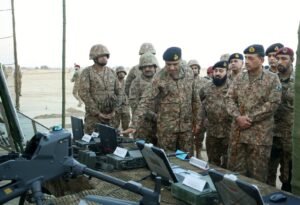
They were shaping the future of Pakistan’s defense.
As the exercise concluded, dust rising behind armored columns and drones returning to their launch points, Field Marshal Asim Munir stood quietly for a moment longer, watching.
What he saw was not just preparedness.
It was proof that, even with limited resources, determination, innovation, and disciplined leadership could transform a force.
From the skies over Kashmir in May 2025 to the training grounds of Khairpur Tamewali in January 2026, Pakistan’s Armed Forces were sending a clear message — they were no longer preparing merely to respond.
They were preparing to dominate across domains.
And as the Field Marshal departed, the satisfaction on his face reflected not just a successful exercise — but the realization that his vision of a modern, technologically empowered military was rapidly becoming reality.