


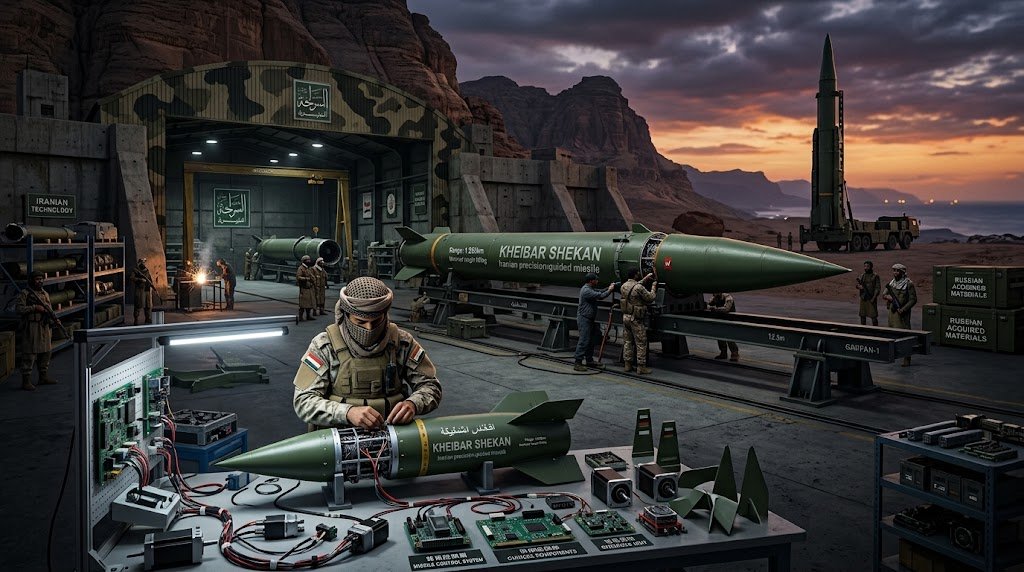
- Houthi missile components sourced from overseas suppliers enable the assembly of precision-guided medium-range weapons.
- Supply networks span dual-use hardware from Asia to financial conduits in Europe and the Middle East.
- Iranian technical advisors continue to assist in extending the range and guidance accuracy of Houthi weaponry.
- Advanced missile saturation tactics pose a continuous threat to regional infrastructure and maritime trade routes.
Houthi militants are attempting to produce their own advanced medium-range ballistic missiles using Chinese-delivered parts, a new report shows, a technological advance that would raise the threat posed by the Iran-backed group.
The Houthis shipped in from a Chinese supplier a range of components needed to make a version of one of Iran’s most powerful weapons, the Kheibar Shekan Iranian precision-guided missile, said the report by Conflict Armament Research, a group that works in conflict zones and reports on the use of weapons and their supply chains. The Houthi missile would have a range up to about 1,200 miles, putting all of Saudi Arabia and Israel within reach.
Over more than a decade, the Iran-backed Houthis have transformed themselves from a group reliant largely on small arms and medium weapons into a formidable military force armed with ballistic and cruise missiles, drones, anti-ship missiles, unmanned boats and air-defense systems.
Saudi Arabia’s Hybrid War Is Pressuring the Houthis, but Victory Remains Uncertain
That transformation was accomplished by seizing large quantities of weapons from the Yemeni military, acquiring components and technology from abroad, and drawing on military and technical expertise linked to Iran and Hezbollah.
How Did They End Up in Houthi Hands?
The critical question now confronting international security analysts is straightforward: How did such sophisticated, dual-use components find their way into Houthi hands despite international sanctions and naval blockades?
The answer lies in a complex, multi-layered supply chain that exploits commercial gray markets, maritime smuggling channels, and shell companies. About 35% of the materials documented in seizures of shipments bound for the Houthis between 2021 and 2025 were of Chinese origin, compared with 21% from Iran, according to the Century International research center.
How Seized Stockpiles, Iran and Chinese Parts Built the Houthis’ Missile and Drone Arsenal
Many of these dual-use items—such as microcontrollers, guidance sensors, and high-precision engines—are manufactured for civilian applications and exported legally before being diverted through front companies based in East Asia and the Middle East.
The Axis of Support: Iranian Expertise and Russian Networks
While China serves as a key source for raw hardware and dual-use components, Tehran remains the primary architect behind the group’s military evolution. Iranian technical specialists and Hezbollah advisers have worked on the ground in Yemen, establishing localized assembly workshops and modifying legacy systems.
At the same time, Moscow has increasingly entered the equation. According to the U.S. Treasury Department, a financial network linked to the Houthis purchased tens of millions of dollars in equipment, weapons, and sensitive materials directly from Russia. This converging web of assistance from Iran, China, and Russia has given the Houthis unprecedented technical independence.
The Vulnerability of Advanced Air Defenses
This influx of high-tier technology presents a grave challenge to regional stability, particularly for Saudi Arabia. Despite Riyadh possessing some of the world’s most advanced air defense capabilities—including U.S.-supplied Patriot PAC-3 and THAAD interceptor batteries—a single sophisticated, precision-guided missile can cause immense catastrophe.
Modern ballistic systems like the Kheibar Shekan derivative feature high terminal speeds, maneuvering re-entry vehicles, and reduced radar cross-sections designed specifically to saturate or evade multi-layered interceptor networks. In a dense environment containing critical energy infrastructure, desalinization plants, and population centers, even a low percentage of intercept failures can lead to devastating economic disruptions and civilian casualties.
“A Threat to Mankind”: Expert Insights and Arsenal Estimates
Highlighting the gravity of this proliferation, former senior CIA official Norman Roule emphasized that Houthi operations have transcended local political conflict. Roule noted that Houthi attacks on civilian infrastructure represent a direct “threat to mankind” and global economic stability, cautioning that allowing a non-state actor to deploy advanced medium-range weaponry unchecked sets a dangerous global precedent.
Data compiled over recent operations reveals the sheer scale of the group’s offensive firepower:
-
Missiles Fired: Over the past two years alone, international monitors and naval coalition reports document that the Houthis have launched over 800 ballistic missiles, cruise missiles, and suicide drones against commercial shipping lanes, naval vessels, and regional land targets.
-
Estimated Stockpile: Regional intelligence estimates suggest that despite coalition airstrikes, the Houthis retain an active inventory containing hundreds of medium-to-long-range ballistic missiles, along with a continuous assembly capacity fed by covert smuggling networks.
As these weapon networks expand, the international community faces an urgent need to disrupt clandestine procurement routes before non-state ballistic capabilities permanently alter the global security landscape.