



-
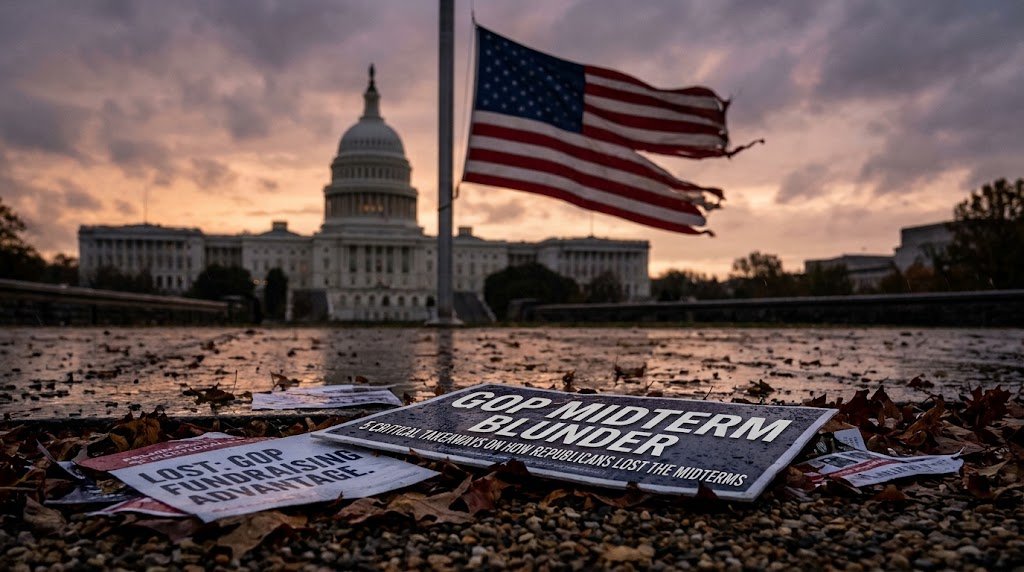
GOP Midterm Blunder: Despite holding a historic fundraising and financial advantage entering the midterms, Republicans failed to translate resources into a cohesive victory.
-
Economic Disconnect: Voters prioritized affordability and inflation, but the GOP struggled with a fractured message that frequently missed kitchen-table concerns.
-
Factional Friction: Internal division and competing priorities between America First and MAGA factions blurred the national narrative and cost crucial independent votes.
WASHINGTON, D.C. — Political parties spend years preparing for midterm elections. They build fundraising networks, recruit candidates, test messages, and identify voter concerns long before ballots are cast. Yet despite entering the election cycle with a massive financial advantage and favorable political conditions, Republicans suffered what many strategists are calling one of the most consequential midterm disappointments in recent history.
The defeat was not caused by a lack of resources.
It was caused by a failure to effectively communicate with voters facing mounting economic pressures at home while the nation became increasingly entangled in conflict abroad.
Republicans entered the campaign with a war chest that dwarfed many Democratic operations. Super PACs, party committees, and high-dollar donors poured hundreds of millions of dollars into races across the country. Television stations, digital platforms, mailboxes, and social media feeds were saturated with Republican advertising.
Yet money alone could not overcome a fundamental problem: the party never settled on a clear message.
READ NEXT: Democratic Wins Midterm: Trump May Turn Defeat into an Instrument of Veto Power
While voters consistently identified affordability as their top concern, GOP candidates often appeared divided over which issues deserved priority. In some states, campaigns centered on inflation and energy. In others, candidates focused heavily on cultural grievances and partisan battles. The result was a patchwork strategy that lacked the discipline needed to build a cohesive national narrative.
For many Americans, the issue was simple.
Life had become more expensive.
The economic consequences of the expanding conflict with Iran added to existing financial anxieties. Rising energy costs, increased shipping disruptions, and market instability helped fuel concerns about household budgets already strained by years of inflationary pressures. Families paying more for fuel, groceries, housing, and insurance were looking for clear solutions from political leaders.
Instead, voters often heard competing messages from within the Republican Party itself.
That division reflects a broader ideological struggle that has been developing for years.
Much of the national media treats “MAGA” and “America First” as interchangeable terms. In reality, important differences exist between the two factions.
READ MORE: Trump Says in Interview That He Will Accept Election Results
The America First movement primarily emphasizes national sovereignty, economic nationalism, border security, domestic manufacturing, and limiting foreign entanglements. Its supporters generally argue that government should prioritize American workers, infrastructure, and economic competitiveness before committing resources overseas.
The MAGA movement shares many of those priorities but has evolved into a broader political identity centered around former President Donald Trump and a populist opposition to political, media, and bureaucratic institutions. While policy remains important, the movement is equally driven by cultural and political confrontation.
Unstoppable Momentum: Why a Trump Midterm Election Victory Is Set to Secure Both Houses of Congress
During the midterm campaign, those competing priorities frequently collided.
America First conservatives argued Republicans should focus relentlessly on affordability, wages, energy independence, and reducing foreign commitments. They viewed the economic impact of the Iran conflict as a powerful issue capable of attracting independent voters and even disaffected Democrats.
MAGA activists often placed greater emphasis on investigations, election-related concerns, media criticism, and cultural disputes. While these issues energized the Republican base, they did not always resonate with undecided voters primarily concerned about paying their bills.
The failure to bridge those competing approaches may ultimately have cost Republicans the election.
Independent voters rarely make decisions based on ideological loyalty. They tend to focus on practical concerns and immediate economic realities. As affordability continued to dominate public opinion surveys, many voters expected Republicans to present a detailed and disciplined plan to address rising costs.
That plan never clearly emerged.
Instead, Republican candidates often spent valuable campaign time discussing issues that energized existing supporters but did little to expand the party’s coalition. Advertising campaigns generated attention, but attention does not automatically translate into votes.
Political history repeatedly demonstrates that successful parties win by identifying the dominant concern of the electorate and remaining relentlessly focused on it. This election cycle, that concern was affordability.
Democrats, despite facing their own challenges, benefited from Republican inconsistency. While voter dissatisfaction with economic conditions remained widespread, many voters ultimately concluded that the opposition had failed to articulate a convincing alternative.
The lesson from the midterms is likely to reverberate throughout Republican politics for years.
A large fundraising advantage can amplify a message, but it cannot create one. Political capital, donor enthusiasm, and grassroots energy are valuable assets only when directed toward a coherent strategy.
Republicans possessed the money.
They possessed the voter discontent.
They possessed the electoral opportunity.
What they lacked was a unified vision capable of connecting economic frustration, foreign policy concerns, and voter priorities into a persuasive national argument.
Until the GOP resolves the growing tension between its America First and MAGA factions and places affordability at the center of its agenda, the party risks repeating the same mistake: spending enormous sums of money while failing to convince voters that it understands the challenges confronting their everyday lives.
The midterms were not merely a loss at the ballot box.
They were a warning that political movements can possess tremendous resources and still fail when they lose sight of the issues voters consider most important.