



-
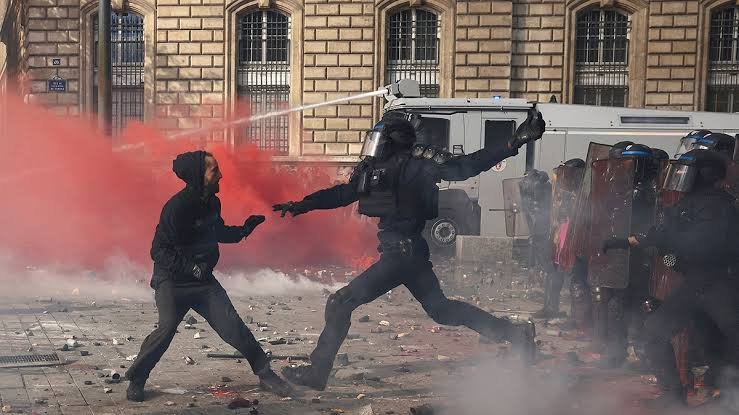
France Protests bring major cities to a near-standstill as historic government buildings are set ablaze and commercial hubs face widespread looting.
-
Over 1,200 demonstrators were detained by police nationwide following severe nighttime clashes, leaving more than 150 officers injured.
-
European economic stability faces mounting pressure as spiraling cost-of-living demonstrations merge with student-led movements across the country.
PARIS — Streets across France descended into nightmarish scenes of burning buildings, overturned vehicles, and tear-gas-choked boulevards on Saturday night as widespread civil unrest brought Europe’s second-largest economy to a near-standstill. What began as targeted student rallies over underfunded classrooms and rising costs of living has exploded into a full-scale national crisis, pitting angry citizens against a government determined not to bow.
Historic Landmarks Torched in Widespread Violence
The violence erupted across major urban centers as night fell. In the central city of Limoges, the historic 143-year-old town hall was set ablaze by masked demonstrators, with video footage capturing its iconic roof and spire collapsing into flames. Local prefect Maurice Barate described the destruction as a “catastrophe for heritage”.
In Marseille, black-clad protesters broke into city hall, spray-painting anarchist slogans on municipal walls before police intervened, while in Lyon, demonstrators torched the city’s primary tourist information office.
Across Paris, Bordeaux, Toulouse, and Strasbourg, commercial hubs ground to a complete halt. Malls, supermarkets, luxury boutiques, and electronics retailers closed their doors early or were heavily vandalized and looted. In the capital, organized groups systematically disabled security cameras before smashing shopfronts, leaving entire retail corridors in ruins.
France Protest: Economic Toll and Public Transport Paralysis
The physical and economic fallout is mounting rapidly. Public transit networks were severely disrupted across several regions, with key metro lines halted and main arterial highways blocked by burning barricades. Industry groups estimate that shuttered businesses, property destruction, and lost retail revenue over the weekend have already caused tens of millions of euros in direct economic losses, compounding broader anxieties in a nation wrestling with stubborn inflation and soaring energy costs.
Interior Minister Laurent Nuñez confirmed that around 550,000 people took to the streets nationwide, including 110,000 in Paris alone, though trade union leaders estimated the total turnout at over 800,000.
Protesters Voice Outrage Over Systemic Inequality
For many on the streets, the movement represents a tipping point against entrenched economic inequality and government detachment.
“There’s an accumulation of wealth and power that’s completely out of control. We are here to support the youth, but if you look at the bigger picture, the entire country is heading in the wrong direction.” — Pauline, 36, Paris demonstrator
Another demonstrator in Paris, 38-year-old Louise, voiced growing frustration over perceived democratic backsliding under President Emmanuel Macron. “We are witnessing less democracy and an unprecedented concentration of power,” she said. “A handful of billionaires control the media, and ordinary citizens are being squeezed out. We are fighting to change things.”
Government Vows Swift Retribution Against “Sowers of Chaos”
The state response has been swift and uncompromising. Prime Minister Sébastien Lecornu announced that more than 1,200 people had been detained nationwide during Saturday’s violence, which left over 150 police officers injured. Condemning the “unacceptable levels of violence,” Lecornu advocated for legislation forcing convicted vandals to reimburse municipalities and shop owners directly. “Public money is scarce,” Lecornu stated firmly. “It must fund our public services, not endlessly repair what vandals destroy.”
G7 summit France 2026: 7 Shocking Outcomes as Leaders Unite on Trade War Strategy
In an official statement released by the Paris Police Prefecture, local police leadership vowed to maintain order and protect critical infrastructure at all costs. “We do not back down in the face of rioters and those who have come to attack law enforcement,” the police chief’s office declared, adding that officers “stood their ground with courage and professionalism” amid intense hostility.
READ MORE: Clashes, blazes and wide-scale looting grip France on day of protests
President Emmanuel Macron issued a stern warning from the Élysée Palace, slamming what he termed “sowers of chaos” who infiltrated peaceful demonstrations to wreak havoc on public institutions. “Those who have broken into prefectures, attacked businesses, and looted our town halls will be tracked down, prosecuted, and punished without exception,” Macron said, asserting that the republic would not cave to political violence.
READ NEXT: Iran War Becomes a Blessing in Disguise for Russia as Trump Waives Russia Sanctions
The crisis has its roots in high school and university protests that began weeks ago over overcrowded classrooms, severe teacher shortages, and crumbling educational infrastructure. However, the movement expanded dramatically after high-profile incidents of heavy-handed police tactics—including severe injuries to teenage demonstrators—ignited widespread public fury and mobilized trade unions nationwide.
As clean-up crews clear the debris and burned-out vehicle hulls from city streets, France stands at a delicate crossroads. Though Education Minister Édouard Geffray has held multiple rounds of talks with student representatives, no agreement has been reached. With unions threatening further strikes and the government refusing to yield to street pressure, Europe’s military and economic powerhouse faces a tense and uncertain week ahead.