



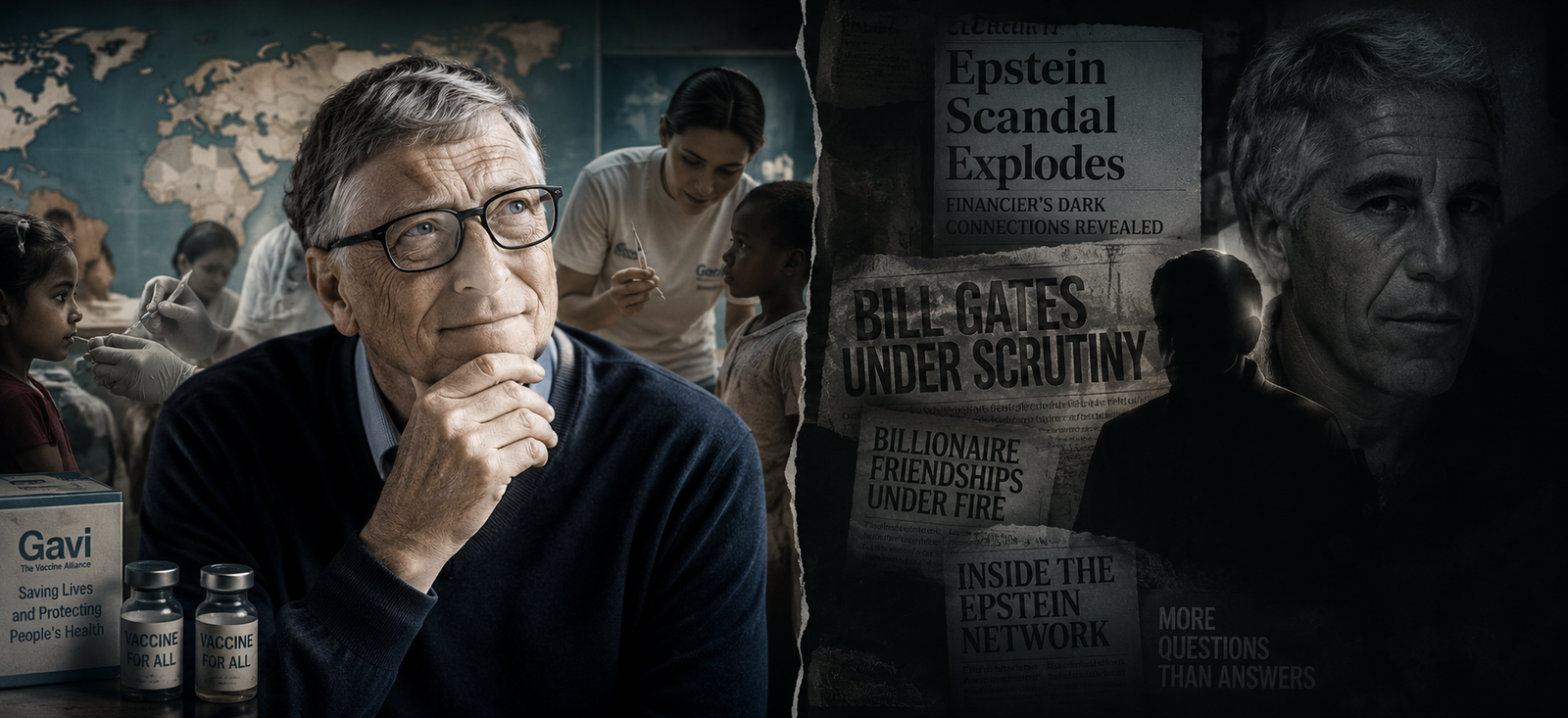
- Bill Gates Epstein connection: A 7-year-old’s innocent question exposes the complexity behind the Bill Gates–Epstein debate
- No evidence beyond limited philanthropic meetings—yet the controversy persists globally
- Gates’ decades-long fight against deadly diseases risks being overshadowed by speculation
- Is a powerful narrative shaping perception more than facts in the digital age?
The other evening, my seven-year-old daughter Haneen asked me a question that I, despite more than two decades in journalism, found unexpectedly difficult to answer.
We were sitting at the dinner table, the quiet hum of the television in the background, when she turned to me with a seriousness that children reserve for moments they instinctively know matter. Earlier that day, she had received a routine vaccination—one of those unremarkable yet profoundly important acts that pass without ceremony but carry the weight of global effort behind them.
“Baba,” she asked, “why are people saying bad things about Bill Gates just because of some pictures?”
I paused.
In my career, I have interviewed presidents, covered wars, and navigated the layered complexities of international politics. I have written about narratives crafted carefully and others that spiraled uncontrollably. Yet in that moment, confronted with the disarming clarity of a child’s question, I realized how tangled the answer had become.
Rubio Ishaq Dar Meeting Signals Strategic Alignment on Iran Deal, Abraham Accords and Palestine
To Haneen, Bill Gates is not a controversial figure. He is “Gate uncle”—a distant, almost mythical presence associated with computers, vaccines, and something benevolent that has quietly reached into her life. She does not see a billionaire, a policymaker, or a man subjected to relentless scrutiny. She sees outcomes—vaccines, health, protection.
And perhaps that is where this story must begin: not with controversy, but with consequence.
For decades, Gates has occupied a rare space in global consciousness. First as the architect behind the personal computing revolution, and later as one of the most influential philanthropists in modern history, his journey has been defined by scale.
Iran and Russia Absent from UN Peace Summit as US Blocks Visas
Through the Bill and Melinda Gates Foundation, billions of dollars have been directed toward combating diseases that rarely dominate headlines—malaria, polio, tuberculosis—diseases that persist quietly in the margins of global attention.
These are not glamorous battles. They do not trend on social media. They unfold in rural clinics, in vaccination drives, in logistical chains that stretch across continents. And yet, they save lives—millions of them.
Children like Haneen are among those lives.
But history, particularly in the age of digital amplification, has a peculiar way of compressing complexity into fragments. A photograph. A meeting. A name.
Bill Gates Spent Years Crafting His Image. Now It’s Cracking.
The association between Bill Gates and Jeffrey Epstein is one such fragment—small in its documented scope, vast in its narrative reach.
The facts, as established through credible reporting, are relatively straightforward. Gates met Epstein several times in the early 2010s, during a period when Epstein was attempting to re-enter elite circles by positioning himself as a patron of science and philanthropy. Gates has since described those meetings as a mistake—a “huge error in judgment.”
There are images. There are records. And beyond that, there is a notable absence: no evidence, no legal findings, no substantiated claims linking Gates to Epstein’s criminal conduct.
Yet, in the public imagination, the story rarely stops there.
As a journalist, I understand how narratives evolve. They are rarely static. They grow, adapt, and, at times, detach from their original anchor points. In the case of Gates, the Epstein connection has, over time, become less about the meetings themselves and more about what people project onto them.
Suspicion thrives in ambiguity. And in an era defined by information overload, ambiguity is rarely in short supply.
What troubles me, however, is not scrutiny. Scrutiny is essential. It is the lifeblood of accountability. Public figures, especially those wielding immense influence, must be examined rigorously.
What troubles me is proportion.
How does a finite, acknowledged misjudgment come to overshadow decades of measurable, documented contributions to humanity? How does a narrative built on limited interaction expand to such an extent that it begins to redefine an individual’s entire legacy?
These are not rhetorical questions. They are, increasingly, central to how we understand power, responsibility, and fairness in the modern age.
In recent years, I have observed a growing tendency to flatten complex figures into singular narratives. Heroes become villains. Achievements are overshadowed by associations. Context is replaced by conjecture.
Bill Gates, in many ways, has become a vessel for this phenomenon.
His wealth makes him visible. His influence makes him consequential. And his involvement in global health—particularly during moments of crisis—places him at the center of debates that are as political as they are scientific.
In such an environment, even a limited association can be magnified, repurposed, and sustained far beyond its factual boundaries.
There are those who argue that this is simply the cost of prominence. That no figure, regardless of contribution, should be shielded from scrutiny. I agree.
But scrutiny must remain anchored in evidence. Without that anchor, it risks drifting into something else entirely—something closer to narrative persistence than factual inquiry.
This brings me back to Haneen.
As she sat across from me, waiting for an answer, I realized that what she was really asking was not about Bill Gates or Jeffrey Epstein. She was asking about fairness.
Is it fair, she seemed to wonder, to judge someone entirely by a mistake, especially when that mistake is acknowledged and when everything else points in a different direction?
It is a question that we, as adults, often complicate beyond recognition.
I told her what I could. That sometimes, in the world I work in, stories grow bigger than the facts they are built on. That people can make mistakes and still do good. That it is important to look at the whole picture, not just one part of it.
She listened, quietly.
And then she nodded, as if the answer, though incomplete, was enough.
In that moment, I was reminded of something that journalism, at its best, strives to do: to bring clarity to complexity without distorting it. To question without exaggerating. To hold accountable without abandoning fairness.
The story of Bill Gates and his association with Epstein will likely continue to resurface. It will be debated, reinterpreted, and, perhaps, further amplified. That is the nature of modern narratives.
But as we engage with it, we must ask ourselves a deeper question—not about Gates alone, but about the standards we apply to all public figures.
Are we measuring them by the totality of their actions, or by the fragments that generate the loudest reactions?
For my daughter, the answer is instinctive.
For the rest of us, it may require a more deliberate effort.
And perhaps, in listening to questions like hers, we might find our way back to a more balanced understanding—not just of one man, but of the world we are trying to make sense of.