



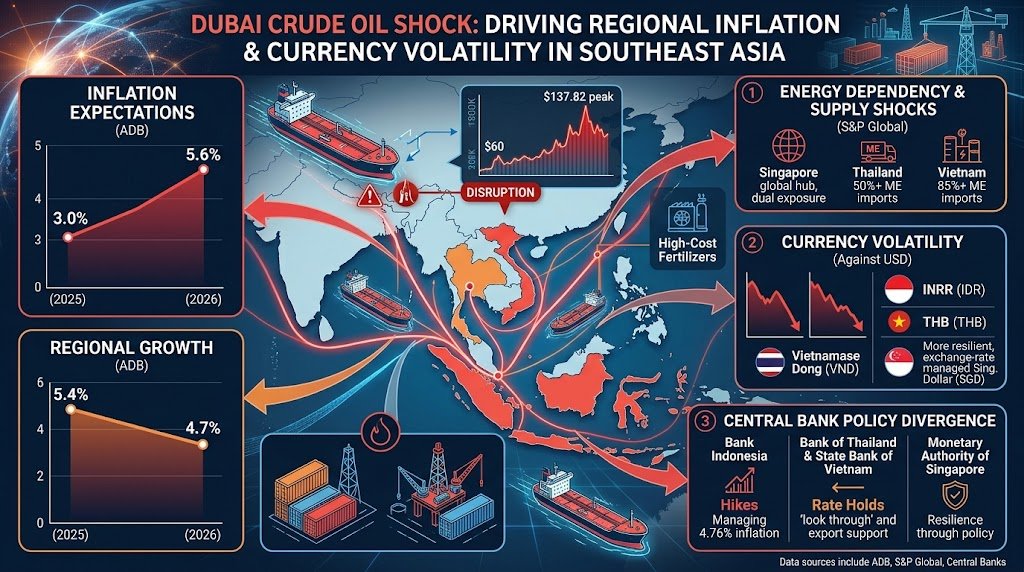
- Dubai Crude Oil surged past $137 per barrel following military disruptions in the Strait of Hormuz.
- Regional inflation across Southeast Asia is projected by the ADB to double to 5.6% in 2026.
- Singapore, Thailand, Vietnam, and Indonesia face mounting pressures from rising energy costs and currency volatility.
- Central banks remain split between raising interest rates to protect currencies and maintaining monetary support for growth.
When military action disrupted the Strait of Hormuz, the price of Dubai Crude Oil—the primary benchmark for Asian refiners—more than doubled in three weeks, surging from $60.00 per barrel to a peak of $137.82. Though prices moderated slightly by mid-June, the structural shock has already transmitted across Southeast Asian economies.
The Asian Development Bank (ADB) warns that average inflation across Southeast Asia could escalate from 3.0% in 2025 to 5.6% in 2026, while regional economic growth is projected to slow from 5.4% to 4.7% if maritime bottlenecks persist into the third quarter.
Anatomy of an External Supply Shock
Southeast Asian markets remain exposed to Middle Eastern maritime channels. S&P Global data indicates that roughly 90% of the crude oil passing through the Strait of Hormuz is bound for Asia-Pacific destinations. On a national level:
- Thailand: Imports over 50% of its crude oil and condensate from Middle Eastern suppliers.
- Vietnam: Relies on Middle Eastern sources for nearly 85% of its total oil imports.
- Singapore: As a global refining and trading hub, Singapore faces dual exposure. While its refiners process heavy Middle Eastern grades for export, skyrocketing bunker fuel costs and elevated import energy prices hit domestic utility rates and regional maritime freight operations.
Beyond energy imports, elevated oil prices push up agricultural production costs by inflating fertilizer prices—a sector where the Middle East serves as a primary exporter.
READ MORE: How Geopolitical Turmoil and Conflict Are Driving the World’s Super-Rich to Singapore
Compounding these supply pressures, ongoing U.S. tariff shifts have disrupted trade routes, narrowing operating margins for regional exporters who absorb higher logistics expenses.
Currency Volatility and Safe-Haven Capital Flows
The convergence of trade friction and inflation has driven capital into safe-haven assets, weakening regional currencies against the U.S. dollar:
- Indonesian Rupiah (IDR): Touched record lows despite direct interventions by Bank Indonesia.
- Vietnamese Dong (VND): Extended its downward trajectory into 2026 as shipping rates and imported costs weighed on manufacturing competitiveness.
- Thai Baht (THB): Reversed earlier strength to hit a 10-month low against the USD due to expanding energy import bills.
- Singapore Dollar (SGD): While resilient compared to regional peers due to its exchange-rate-based monetary framework, the SGD has faced import-price inflation and capital reallocations across regional portfolios.
READ MORE: Geopolitical Events Create Turbulence for Southeast Asian Currencies
Central Banks Trapped in Policy Divergence
Monetary authorities across Southeast Asia face a classic stagflationary challenge: raise interest rates to defend national currencies and curb inflation, or maintain low borrowing costs to support weakening growth.
- Bank of Thailand (BOT): Holding interest rates steady at 1.00%, adopting a “look-through strategy” to absorb supply-side inflation without suppressing domestic demand.
- State Bank of Vietnam (SBV): Leaving benchmark rates on hold while directing commercial institutions to lower deposit rates to ensure affordable credit for exporters.
- Bank Indonesia (BI): Raised key policy rates twice following the energy shock, prioritizing currency stabilization and managing inflation after consumer price growth reached 4.76%.
- Monetary Authority of Singapore (MAS): Relying on its currency band policy, allowing a stronger SGD path to buffer against imported energy and commodity costs.
Investor Risk Mitigation Strategies
To navigate inflationary pressure and currency fluctuations, investors are adjusting asset allocations:
- Retail Investors: Diverting capital into gold and foreign currency deposit accounts to hedge against local currency depreciation.
- Foreign Direct Investors (FDI): Utilizing financial derivatives—including futures, options, and cross-currency swaps—to manage foreign exchange volatility across long-term capital investments.
Regional Macroeconomic Forecast
Looking ahead, economic projections indicate a prolonged recovery horizon across Southeast Asia. The Asian Development Bank forecasts that regional GDP growth will stabilize at 4.8% by 2027, provided energy transit routes normalize. Meanwhile, headline inflation is expected to cool gradually to 3.4% as global supply chains adjust. However, persistent high-cost fertilizer inventories and elevated freight charges ensure that domestic price levels will remain elevated well into next year.