



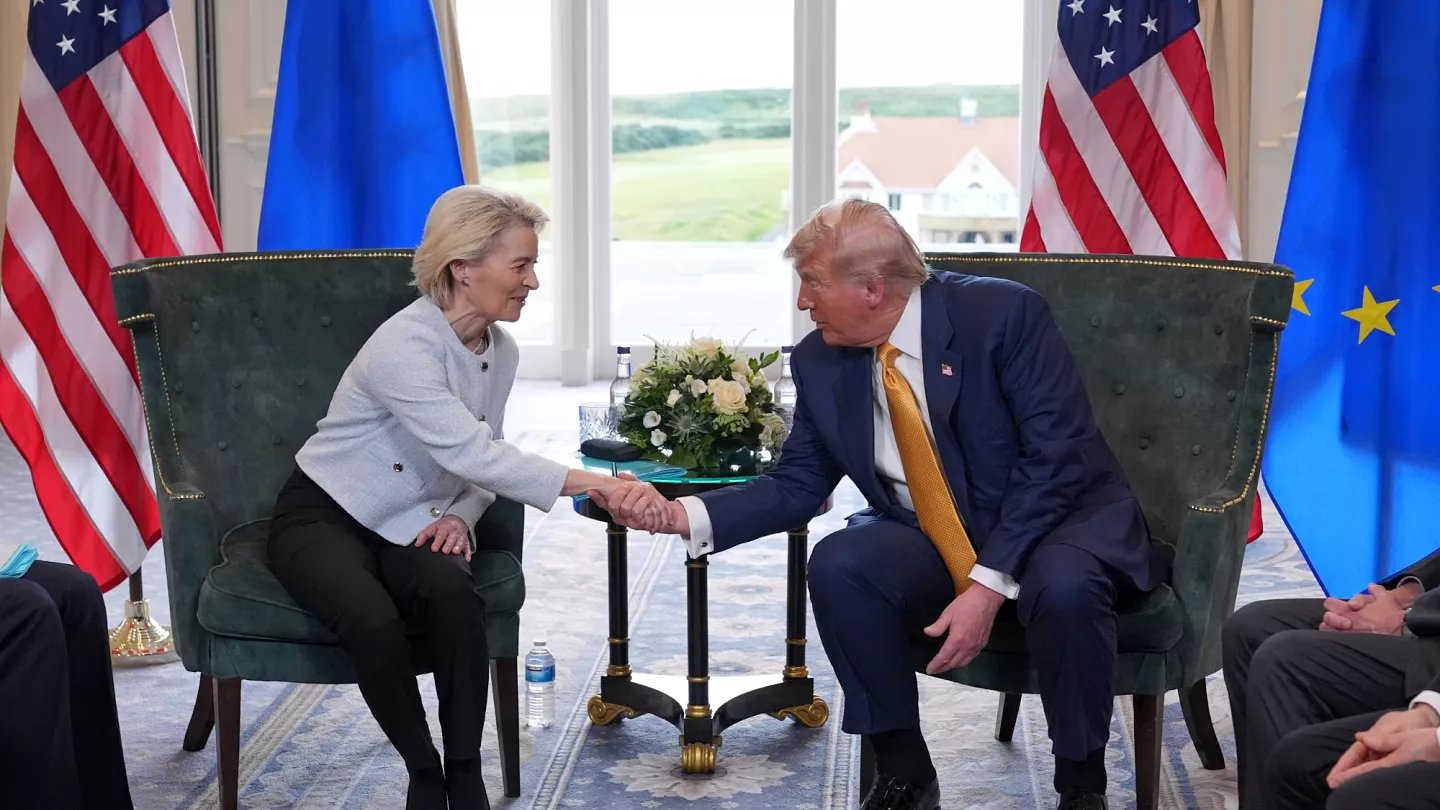
- EU–US trade deal uncertainty intensifies following the US Supreme Court’s decision against Trump-era tariffs.
- European lawmakers reconsider ratification amid legal and geopolitical instability.
- German industry and EU exporters warn of prolonged policy ambiguity and investment risks.
- Sector-specific tariffs on automobiles, steel, and pharmaceuticals could still escalate tensions.
The US Supreme Court’s dramatic decision on Friday to rule most of US President Donald Trump’s tariffs illegal has left the country’s trade partners trying to determine what the verdict means for the future of the international trade deal between the United States and the European Union.
Although Trump says he will press ahead with tariffs using alternative legal authorities, the ruling could disrupt his flagship trade policy and temporarily ease pressure on allies and industries affected by the measures.
For European policymakers, the decision introduces fresh uncertainty into a carefully negotiated transatlantic economic arrangement that had aimed to stabilize trade relations after months of confrontation.
European leaders have cautiously welcomed the decision.
French President Emmanuel Macron praised the ruling while speaking at an agricultural fair in Paris, saying, “It is good to have power and counterweights to power in democracies.” He added that France would reassess the implications for the recently negotiated EU–US trade framework, particularly after Trump announced plans to raise a global tariff from an initial 10% to 15%.
Xi Gains Leverage Before Trump Summit After Tariff Reversal
German Chancellor Friedrich Merz expressed hope that the decision would ease pressure on German exporters, telling broadcaster ARD that “tariffs harm everyone.” Echoing Macron, he said the ruling demonstrated that the separation of powers in the United States “still seems to be functioning.”
A trade spokesperson for the European Commission confirmed that the 27-nation bloc remains in “close contact” with the US administration as officials seek clarity on how the ruling will affect implementation of the international trade agreement.
Uncertainty over EU–US trade deal
The verdict has created significant uncertainty surrounding the international trade deal between Brussels and Washington reached last July. EU lawmakers had already paused ratification after diplomatic tensions escalated following Trump’s controversial remarks about Greenland, and the European Parliament’s trade committee is now scheduled to reassess the agreement during a crucial vote on Tuesday (February 24).
That vote is now in doubt, with lawmakers planning an emergency meeting on Monday to evaluate the legal and political consequences of the ruling.
“The era of unlimited, arbitrary tariffs might now be coming to an end,” Bernd Lange, chairman of the European Parliament’s trade committee, said on X. “We must carefully evaluate the ruling and its consequences.”
The agreement — negotiated after Trump’s so-called “Liberation Day” tariffs — established a framework under which tariffs on most EU goods entering the US were capped at 15%, while the European Union agreed to eliminate tariffs on US industrial goods entering European markets. Though criticized within Europe as uneven, the deal was widely viewed by industry as a stabilizing compromise designed to prevent a prolonged transatlantic trade war.
Ratification had been expected in March or April, but the Supreme Court decision has now thrown the timeline into question.
Carsten Brzeski, Global Head of Macro at ING Research, said the legal ruling could encourage European lawmakers to delay approval further. However, he warned that Washington still retains multiple legal tools to impose tariffs, meaning trading partners remain vulnerable to sudden policy shifts.
US Trade Representative Jamieson Greer said Washington would continue to honour agreements negotiated with allies. “Regardless of the direction of this litigation, we will impose tariffs at levels that they agree to,” he told Fox News.
The UK government — which secured its own tariff arrangement with Washington earlier — said it expected its “privileged trading position with the US to continue,” while officials assessed how the ruling might affect existing commitments.
Cautious reaction from German industry
Despite criticism of the trade deal within Europe, business leaders had welcomed it for providing predictability after months of volatility.
Germany’s Federation of German Industries (BDI) described the Supreme Court ruling as a positive signal for the rules-based global trading system but warned that uncertainty remains a major concern for exporters.
“The European Union, supported by the German government, should quickly clarify the consequences of this ruling for the EU–US trade agreement,” said Wolfgang Niedermark, a member of the BDI executive board. “Businesses urgently need planning certainty.”
The German Chamber of Industry and Commerce (DIHK) echoed that caution, noting that the Trump administration still has alternative mechanisms to impose trade restrictions.
“US authorities retain other instruments for restrictive trade measures, and German companies must prepare accordingly,” said Volker Treier, DIHK’s Head of Foreign Trade.
He added that Brussels should continue pressing Washington to reduce tariffs beyond the agreed 15% level, particularly the steep duties on European steel and aluminum.
Sectoral risks remain
The Supreme Court ruling specifically targeted tariffs imposed under the International Emergency Economic Powers Act (IEEPA), which Trump used to justify many broad reciprocal tariffs.
However, sector-specific tariffs imposed on national security grounds — including those affecting steel, aluminium, and automotive industries — remain untouched. Tariffs on Chinese goods introduced under Section 301 of the Trade Act of 1974 also remain in force.
Following the ruling, Trump announced a new global 15% tariff under Section 122 of the same legislation, adding another layer of complexity to the international trade environment.
For European automakers, the uncertainty is particularly acute. Under the EU–US trade deal, vehicles exported to the United States faced a 15% tariff, but without ratification, companies could again confront tariffs as high as 25%.
Pharmaceuticals represent another potential flashpoint. Although tariffs have not yet been implemented, Trump has repeatedly threatened major levies under Section 232 of the Trade Expansion Act of 1962, citing national security concerns.
“Europe should not assume this ruling brings relief,” Brzeski warned. “Future investigations under Sections 301 and 232 could target sectors more precisely than previous measures. The legal basis may change, but the economic impact could be identical — or even worse.”